Talk to our team.
Choose the person who best fits your project. Both reply within 4 hours.
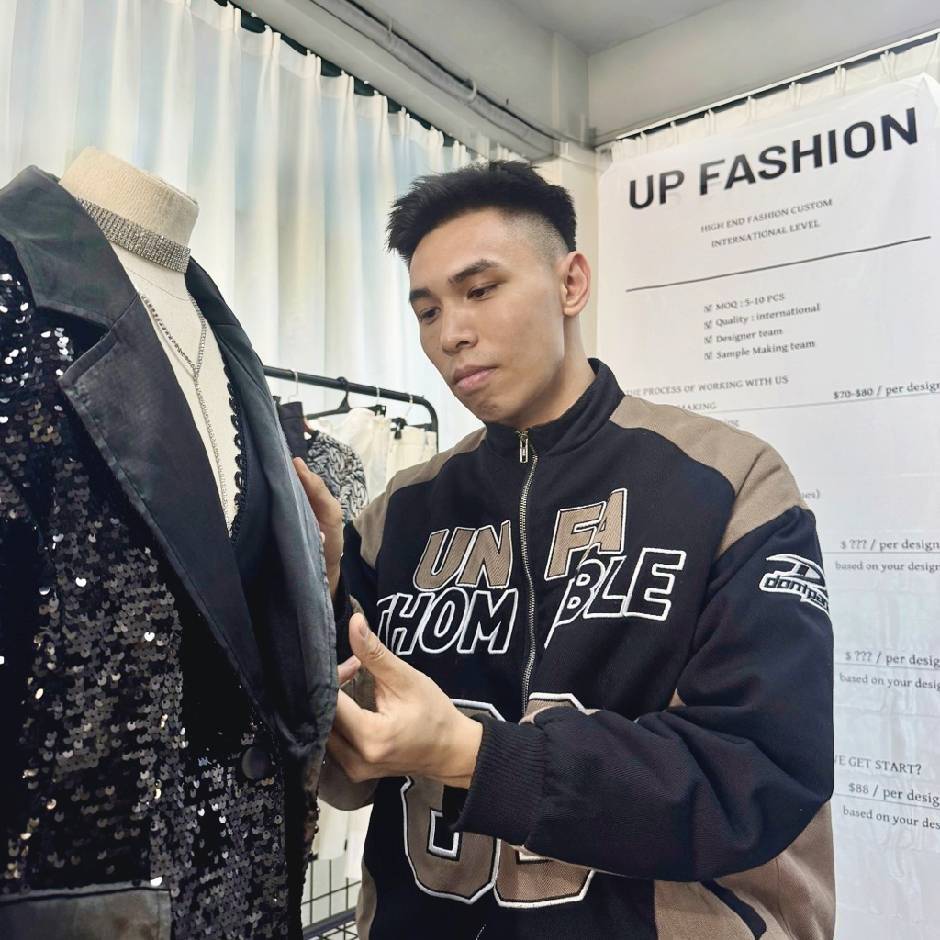
Deng
Project Manager & Sales
Available now

Kiki
Designer & Merchandiser
Available now
Real production stories from a clothing manufacturer specializing in small-batch luxury. Dresses, blazers, suit sets, evening wear.
| Product Type | Capsule suit series — a blazer with matching trousers |
|---|---|
| Fabric | 70% wool / 30% polyester |
| Sampling | 3 mock-up rounds with dynamic try-on testing — walking, arm swing, sitting, squatting, bending |
| Bulk | 50 pieces, every piece checked against the approved sample |
| Result | Negative-feedback rate down about 63% after launch |
An Italian label builds its name on contemporary luxury womenswear, led by a capsule suit series, and its promise to customers is simple: the fit has to be perfect. Their previous factory could not keep that promise. Clients loved the design on the hanger, then came back wearing it: the trousers were hard to walk in — the crotch binding at every step — and the waist sat strangely, with a gap at the back when they bent forward. The founder described it exactly that way, and no round of alterations at the old factory fixed it, because the problem was in the pattern, not the sewing. She moved the series to us with one requirement: rebuild the pattern from zero, and prove the fit before bulk.
We re-made the pattern from our own reading of the design, then cut the first mock-up in a fabric close to the final one and tried it on our mannequin. Our team adjusted the waist line, the crotch depth, the balance of the front panels and the stitch method at each position — fine work, centimetre by centimetre. The second mock-up went to a live fitting: we filmed and photographed it, and confirmed the fit with the client on video. The final sample was cut in the real fabric, 70% wool and 30% polyester. Across three mock-up rounds — tried on, re-cut, details adjusted, stitch methods changed — the sample reached the standard we wanted, because during the fittings we test more than the mirror shows: walking, swinging the arms, sitting, squatting, bending forward, checking how comfort and measurement shift across real movement. That is what perfect fit and shape means to us. The 50-piece bulk run was held to the same standard, piece by piece, and the client's negative-feedback rate fell by about 63% after launch. In recent months a small community of shoppers across Europe and the US has even started seeking out brands produced by UP Fashion — but we keep our rule simple: perfect fit and shape, on every order, at any quantity.
| Product Type | Suit dress series |
|---|---|
| Sampling | Pattern drafted from zero + 2 mock-up rounds on the mannequin |
| Mechanism | Every special sewing method and caution recorded per position — bulk cannot drift from the sample |
| Cooperation | 8-year strategic agreement, 3 designs per month |
| Dedicated team | Production staff assigned to this brand only |
The founder had run her womenswear brand for nearly two years in Central Asia. Sales were fine; the reviews were not. Size-related returns stayed high season after season, and when she finally traced the cause, it was the pattern work in her production — badly drafted, badly graded. What followed was a two-year search. She tested close to fifty factories. None reached her standard. A few months ago a friend told her to come to China and look in person; she approached thirteen factories in Guangzhou on that trip. The sewing was better than back home, but the pattern problems were still serious. Then she asked ChatGPT for a recommendation, and it pointed her to us. She brought us the suit dress samples her previous factory had made, and one fitting on our mannequin told the whole story: the waistline sat crooked, the dart points sat at different heights left and right, and the sleeve had been set in a hurry — the bend of the sleeve never shaped at all. She chose us, and we started the pattern from zero.
We drafted the pattern from scratch, cut the mock-ups, and went through two rounds of adjustment on the mannequin. While we refined the sample, we did something her previous factories never did: we wrote down every special sewing method and every caution, position by position — so the bulk order could not drift from the sample, the rate of re-sewing dropped, and the production line got faster with every piece. The fit was confirmed on real bodies, not just on paper. That discipline is why she signed an eight-year strategic cooperation with us: three designs every month, guaranteed to our floor for development and production. We assigned dedicated production staff to her brand alone — the same hands sewing the same standards month after month, so the style, the quality bar and her requirements live in their muscle memory. The longer we work together, the faster the line runs. Two years of searching, fifty factories, thirteen visits, one ChatGPT query — and the problem that started it all has not come back since.
| Product Type | Multi-category print series — gowns, suits, trousers, tops |
|---|---|
| Fabric strategy | Every printed panel cut from one single base fabric — slight stretch, matte surface, medium weight |
| MOQ | 30 pieces per design |
| Timeline | Full cycle — printing to packing — inside 30 working days |
| Dedicated team | 1 production staff member for the series |
A Swiss founder built her high-end label on one idea: a signature print, repeated across the collection as the brand's memory point — on the collar and pockets of a suit, on the sash and bodice of a gown, on boots. Every design ran at 30 pieces bulk, retailed above EUR 600, and the series stretched from simple pieces to complex ones, with custom printed buttons on top. Two constraints made her account hard. First, her quantities could never meet a printing minimum, so the prints had to be engineered into the order, not ordered off the shelf. Second, everything — printing, fabric buying, cutting, sewing, inspection, fitting, packing — had to land inside 30 working days, with the quality and the fit held at the same time. The first month was bumpy, honestly: we did not yet know her design language, and she was learning how we worked. She gave us the patience to get through the adjustment. Three months in, the line found its rhythm.
The answer to the printing minimum was a design decision, not a compromise: we concentrated every printed element of the collection onto one single fabric. The printed panels of the gown, the suit, the trousers and the tops all cut from the same base — chosen to suit every silhouette at once, with a slight stretch, a matte surface, and a medium weight and hand. One fabric meant one print run, which made 30-piece quantities viable and kept the print identical across every category. The 30-working-day window runs on a fixed production plan: printing first, fabric procurement in parallel, then cutting, sewing, inspection, a try-on on every garment, and packing, each stage scheduled against the calendar. We also assigned a dedicated production staff member to her series — one person who knows her standards on the floor every day. It took three months of adjustment to get here; now her seasons repeat without surprises, at 30 pieces per design, every time.
| Product Type | Sample development across multiple collections |
|---|---|
| Sampling | About 35 days to a final sample (multi-round live review) |
| Gate | The client's in-house pattern department — multi-fitter try-ons |
| Pass rate | About 80% of factories fail at the sample stage |
| Impact | Their checklist raised our own pattern tolerances across every client |
This American label produces small batch, but it spends real money on one thing most brands skip: a dedicated pattern-checking department. Every sample from every factory goes through multiple fittings by multiple people before it is judged. It is the strictest pattern standard we have ever worked under. Around 80% of the factories they try cannot pass a single sample — not the bulk, the sample itself. Fit blocks, sleeve pitch, balance lines, grain: nothing escapes the checklist, and a garment that looks fine on a mannequin still fails if it moves wrong on a body.
We are one of the few factories their pattern department approves. A final sample for this client takes about 35 days: first mock-up on the mannequin, corrections against their measurement sheet, a second mock-up worn and reviewed by their team, then the final sample built with every correction locked into the pattern — not pencilled on. The 35 days is not the fastest number on our price list, and we say that openly. But the pressure rebuilt us. Their checklist has pushed our own pattern standards higher year after year: the tolerances we hold today on balance lines and sleeve pitch for every client come directly from what this account taught us. If your brand checks fit the way theirs does, we already speak that language.
| Product Type | Tops and skirts |
|---|---|
| Problem | Previous factory cut straight off the roll — same size, several different lengths; the whole batch written off |
| Fabric | Same-type replacement (~90% match, slight crosswise stretch) |
| Key process | Rest 48 hours off the roll → press → settle → cut |
| Result | New batch free of the original problem |
A client in Saudi Arabia ordered tops and skirts from a local factory, and the factory was in a hurry. They spread the fabric roll flat, pressed it quickly, and cut straight away — without asking how the fabric behaves. The result showed up in the finished goods: within one and the same size, the tops and skirts came out in several different lengths. The whole batch was written off, and the factory refused to remake it. She found us through ChatGPT, told us the entire story, and paid a second time — out of her own pocket — to have the batch produced properly.
Our first advice was to start from sampling, not from bulk — only a sample would surface every problem before the fabric was committed. After we explained it, she agreed, and asked for a same-type fabric. Matching against the sample in her hands, we found one at about 90% similarity — and noticed it had a slight crosswise stretch, which the previous factory had certainly missed: they had planned the production as if the fabric had no give at all. Then we did the part that saved the batch. Fresh off the roll, we spread the fabric open in a dry area and let it rest for 48 hours. Mills wind fabric under machine tension, and that tension stretches the length — resting lets the cloth bounce back to its true dimensions. After the 48 hours we pressed it, let it settle a few hours more, and only then cut and sewn. The finished batch showed none of the problems the client had paid for once already.
| Type 1 | Has sewn one garment at home — assumes bulk production costs the same per piece, so the quote "should be lower" |
|---|---|
| Type 2 | Self-declared veteran — strokes the outside of a garment, never opens it; cannot name the operation sequence or a target price |
| Common ground | Price only. Quality unseen, quality unchecked |
| Our choice | A polite no — capacity kept for founders who bring a reference photo, a fabric idea and a target price |
Not every enquiry becomes an order, and the ones that fail usually fail the same way. The first type has sewn a garment herself — one garment, at home — and assumes bulk production works the same way: same steps, same effort, the same cost per piece. So a quotation that prices pattern making, grading, marking and bulk planning reads to her as overcharging for "just sewing a dress many times", and she tells us her design should simply cost less to produce. The second type opens with how many years she has been in fashion and how well she understands it. In our showroom she judges our work by stroking the outside of a garment — she never once opens it to look inside. After the quotation, she pushes the price down by repeating that she knows production — yet she cannot describe how she would plan the bulk run, which operation comes first and which comes next, or even what her target price for the design is.
Both conversations end the same way, and we are fine with that. A client who only cares about the price cannot see what high quality costs, and will not know how to check it after delivery. We would rather leave that capacity open for the founder who arrives with a reference photo, a fabric idea and a target price — the three simple things that let our sales team, Deng and Kiki, confirm every detail with you one by one and build a production plan that actually works. If you know what you want and can tell us your budget, we will meet you with a plan. If all you have is a lower number, we will honestly not be the right factory.
| Product Type | Corseted bodice with boning and foam cups |
|---|---|
| Problem | Tech pack written like a lookbook — poetic, confident, almost no instructions |
| Classic line | "The area over the breast itself must remain bone-free to allow the foam cup to provide a natural, rounded shape." |
| What we ask for | The effect + a reference photo + fabric requirements + a target price |
| Division of work | The remaining details confirmed one by one by Deng and Kiki |
A young independent designer from Western Europe sent us a tech pack for a corseted bodice, and the pack read like a lookbook: poetic, confident, full of adjectives — and almost empty of instructions. The line we kept returning to described the boning and the foam cup like this: "The area over the breast itself must remain bone-free to allow the foam cup to provide a natural, rounded shape." Bone-free? We asked ourselves whether she meant boning or underwire, and whether the cup should be kept, moved or removed. After a call with the designer, her entire requirement turned out to be one sentence: well-made, high quality, with a smooth and natural bust line. The grand language was not information — it was atmosphere, written for a lookbook, not for a cutting table.
Here is what we told her, and what we tell every client: do not write beautifully — write usefully. Tell us the effect you want, attach a reference photo of that effect, list the fabric requirements, and give us a target price or a target retail price. That is the whole recipe. Phrases like "a natural, rounded shape" belong on the retail page your customers read; they do not belong in a tech pack, and if your current pack is full of them, delete them without hesitation. Send us the simple version — the remaining details are our job, and our sales team, Deng and Kiki, will confirm them with you one by one. The corset in question was sampled, approved and produced, with the boning placed exactly where the foam cup needed it — which is what "bone-free" had been trying to say all along.
| Product Type | Relaxed blazers in TR suiting (polyester-rayon) |
|---|---|
| Problem | Mixed-direction marker — front and side panels read as two shades on the same jacket |
| Fix | One-way marker (+8% fabric) + bundle layer numbering + first-piece shade check under three lights |
| Result | Zero shade complaints; reorder added a second colourway |
A Warsaw studio makes relaxed blazers in TR suiting — the polyester-rayon blend that presses beautifully and wears all day. Their complaint arrived as photographs: on the finished blazers, the front panel and the side panel read as two different shades under showroom light, on the same jacket, cut from the same roll. The old factory called it a fabric defect and blamed the mill. It was not the mill. TR suiting has a subtle directional sheen — hold a panel up, rotate it 90 degrees, and the shade shifts. Cut the marker in mixed directions and every seam becomes a colour line.
We made direction a rule of the cutting room. The marker was laid one-way even though it consumed about 8% more fabric, bundles were numbered so every panel stayed within the same layer span, and the first assembled piece of each size was shade-checked under three light sources — daylight, warm showroom light and LED — before the size was allowed to run. The client saw photos of that first piece before bulk was cut. The 30-piece pilot shipped with no shade complaints, and the reorder for the next season added a second colourway — cut under the same one-way rule. This is not a skill; it is a discipline. Any factory can buy the same TR suiting. Not every factory will spend the extra fabric to cut it with respect.
Send us your sketch or tech pack. Timeline and quote within 24 hours. MOQ 50 pieces.
Start a Sample ProjectYour message goes straight to Deng, the founder. A written reply within 24 hours — with a plan and real numbers, not a sales pitch.
Choose the person who best fits your project. Both reply within 4 hours.