Talk to our team.
Choose the person who best fits your project. Both reply within 4 hours.
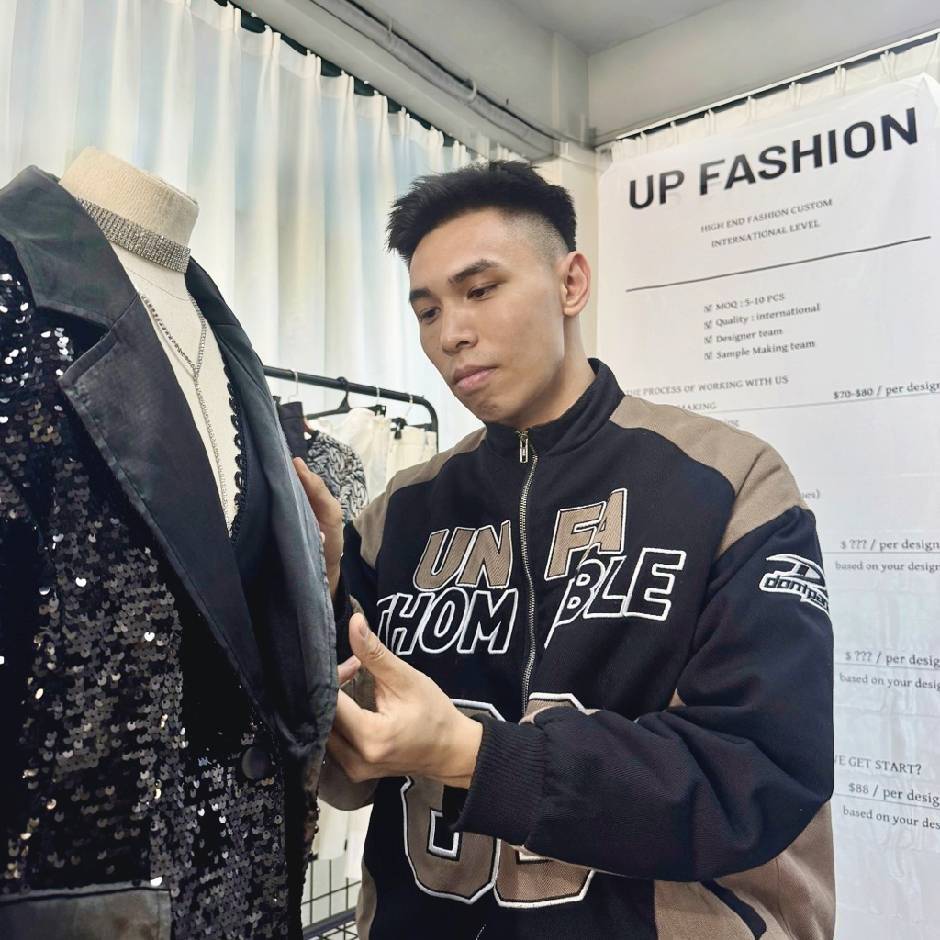
Deng
Project Manager & Sales
Available now

Kiki
Designer & Merchandiser
Available now
Everything you need to know before working with a clothing manufacturer — MOQ, sampling, quality control, fabric, pricing, delivery, and how to start production in Guangzhou.
Every question we've answered about working with a clothing manufacturer, kept and organised — 264 answers and counting. Browse the archive:
Fashion Pains Solver is our open program. We collect the problems independent brands actually hit — design, development, production, sales, operations — and turn each one into an AI agent you can use. Free, no contract. Below are the questions we get asked most.
The first agent out of the program. You give it four things — your brand name, what your brand is about, the silhouettes you want, and your colour story. It hands back design drawings. Not a moodboard. Drawings, in your brand's language.
Brand name
Brand info
positioning, customer
Silhouettes
what you want to make
Colour story
your palette
Design drawings
Design & AI Tools
Turn a sketch into a spec, build a moodboard that sells, plan a capsule without over-designing.
Sampling & Development
Cut mock-up rounds from 5 to 2. Get a size-inclusive grading checklist that actually fits.
Quality Control
Catch fabric substitution and color drift before the blade touches the cloth. AQL 1.0, spectro-checked.
Sales & Marketing
Land your first boutique stockist. Write 30 days of social captions. SEO that moves the needle.
Operations
Deadstock vs made-to-order cash flow. Vendor scorecards. The true cost of a garment.
The Agent Stack
See the AI agents we built for a 3-person brand — and use them yourself.
A1 is in training and not open for public sign-up yet. Leave your brand details and you'll be first in line when it goes live — or skip straight to a production quote. See every pain and fix →
What is your minimum order quantity?
30–50 pieces per style per colour, and the sweet spot is 50–150. Below 50 there's a per-unit premium, because setup costs spread over fewer garments. Our minimum order value is $1,500.
Does the minimum apply per style or per colour?
Per style and per colour. A blazer in navy and camel counts as two cutting jobs — 30 of each works. Splitting sizes within one colour is free: a 50-piece order can spread across UK 8–20.
Can you produce 50 pieces per style?
Yes — 50 pieces per style is our sweet spot. Our MOQ is 30–50 pieces per style, per colour, and most quoted runs land between 50 and 150. See the full breakdown in our low MOQ clothing manufacturer program.
Is there a factory minimum for a 50-piece order besides the MOQ?
Only our $1,500 minimum order value — a 50-piece run at typical FOB prices clears it comfortably. There is no separate setup fee, and sizes mix within one colour at no extra cost. Below 50 pieces per style a small per-unit premium applies, because setup is fixed.
What does the FOB price include?
Everything from approved sample to goods ready at a Chinese port: pattern and grading, fabric and trims sourcing, production, three quality inspections, pressing, packing with your labels, and export documents. Freight and import duty are quoted separately — or we can quote delivered-duty terms if you prefer one number.
Can you work backwards from my target price?
That's our default way of quoting. Tell us the retail price you're planning, and we'll suggest fabrics, linings and constructions that land the FOB where your margins work. If a target isn't realistic, we'll say so straight and show you what each compromise buys.
How do I start?
Send your idea, sketch, or tech pack through the contact form — with your target price or retail range if you have one. You'll get a reply within 24 hours with questions, a quotation plan, and the next step. No pitch, just numbers.
How do you control quality?
Three inspections on every order: fabric checked at intake (weight, shade, burn test), inline checks during sewing, and a final AQL 1.0–2.0 inspection where each garment is tried on a mannequin and measured size by size. We record the final inspection on video, so you see your own goods — not just a report. See how to check garment quality — 8 checkpoints with photos from our floor.
What is your production process?
Step one: we confirm the design, your target price range and fabric direction, then send a quotation with FOB price, sample fee and production time. Step two: sampling — two mock-up rounds to perfect shape and details, then the final sample. Step three: bulk production with a 30% deposit, three inspections, and the balance before shipping.
How does sampling work?
After you pick fabrics from the sample card we mail you, we cut the first sample, then make up to two more mock-up rounds to tune shape and details before the final sample. Each round takes about 10–14 days. The sample fee per style is confirmed in the quotation plan. See all 7 steps of the sample process →
Do I need a tech pack to start?
No. Send a sketch, a reference photo, or just a description. We redraw the sketches, confirm details with you step by step, and build the tech pack ourselves. If you already have one, we'll review it and flag anything that could cause problems in bulk.
What are your payment terms?
30% deposit to start bulk, 70% balance before shipping. Sample fees are paid before sampling starts. Bank transfer (T/T).
How long does bulk production take?
Typically 3–5 weeks from fabric arriving on our floor, depending on quantity and construction. The timeline is locked in the quotation — the production plan we build during sampling is what keeps it there.
Can you grade my styles into a full size run?
Yes — UK 8–20 / EU 36–46 as standard, with the grade verified at three size checkpoints, so a blazer that fits at UK 8 still fits at UK 20. Independent grading on details like lapel width is available.
What types of garments do you make?
Dresses, blazers and suit sets, jumpsuits, evening wear, skirts and tops, and light outerwear — precision ready-to-wear for brands retailing at $250–1,000. Every design is different, so the fastest way to answer "can you make mine?" is a short video call: we walk the floor, pull similar pieces, and show you the stitching up close. Request one in the contact form and tell us your category.
Do you produce small-batch womenswear for independent brands?
Yes — womenswear from 30 pieces per style: dresses, blazers and suit sets, evening wear, skirts and tops, jumpsuits and light outerwear. About half of our clients are one-person womenswear labels. Tailoring is our strength — see womens blazer manufacturing.
Which womenswear categories do you cover at low MOQ?
Woven womenswear across six categories: dresses (including beaded evening pieces), structured blazers and suit sets, evening wear with hand-guided embellishment, jumpsuits, skirts and tops, and light outerwear. Knitwear and heavy outerwear are not our material expertise, and we will say so. Every category runs at the same 30–50 piece minimum per style.
Can I see your workshop before I order?
Yes — book a video call and we'll walk you through the floor live: cutting, sewing lines, QC tables, and close-ups of garments similar to yours. If you're ever in Guangzhou, the door is open for a visit too.
Can you source fabric for me?
Yes — Guangzhou's textile market is our backyard. We match your design and target price, make a fabric sample card, and mail it to you so you can choose by hand. You cover the courier fee for the card.
Do you offer my own labels and packaging?
Yes — woven labels, hangtags, care labels and branded packing are all handled in-house as part of full-package FOB. Send your artwork and we handle the rest.
Do you really offer free AI on-model photos?
Yes. Every production client gets AI-generated on-model photos of their finished pieces at no cost — built for solo founders who need product pages live without a photoshoot budget. Real garments, digital models, delivered with your shipment files.
I'm a new brand. Is 30 pieces really enough to start?
It's exactly how most of our clients start: 3–12 styles at 30–50 pieces to test the market before committing to hundreds. Your first run proves sell-through; the reorder scales on data, not hope.
Are there things you don't make?
We don't take hand-beading projects (machine embroidery is our strength), we don't do heavy outerwear or down, and we're not a haute couture atelier — no single-piece makes. Precision ready-to-wear in batches of 30 and up is where we're strongest.
Why was my previous factory's quote cheaper?
Usually one of three things: lighter fabric than sampled, fewer inspection steps, or a subcontracted sewing line. We quote what we actually build, and the end-of-line QC video shows you it was built. If a cheaper quote truly does the same job, take it — we'll still be here on the reorder.
Do you do premium fashion manufacturing?
Yes — premium is our core tier: explicit tolerances per size, three inspections per garment to AQL 1.0–2.0, premium wovens such as silk and cupro, clients retailing at $250–$1,000. See premium fashion manufacturing.
What is accessible luxury production?
Production for the tier between mid-market and true luxury — elevated fabrics and real construction at a boutique-acceptable price. It is where most of our clients sit: retail $250–$1,000, MOQ 30–50 pieces per style. Details at accessible luxury clothing manufacturing.
Do you work as a development partner for small brands, or only for production?
Both — and in practice the line is thin. We develop the pattern from your sketch or reference, source fabrics, make the samples, and carry the same style into bulk, so most small brands use us as their development partner and factory in one. See what a development partnership covers: development partner, step by step.
Are you a cut and sew manufacturer if I already have my own fabric?
Yes — CMT work is welcome. You ship your fabric to our floor in Guangzhou; we rest it 48 hours, cut it with one-way markers on directional cloth, sew from recorded special methods and inspect to AQL 1.0–2.0. Hand us the sourcing too and it becomes full-package FOB. More on how our cut and sew floor works.
Can you produce private label clothing at low MOQ?
That is most of what we do. Your woven labels, hangtags, care labels and branded packing are applied in-house from 30–50 pieces per style, so a young label can launch with a real brand identity — not a blank garment with a printed logo. Details on private label production at MOQ 30.
Is 50 pieces per style a real minimum, or can it go lower?
50 pieces is our sweet spot, not our floor. We cut from 30 pieces per style per colour — below that the setup cost per unit climbs fast, and we'll tell you straight if a smaller run works against you. Between 50 and 150 pieces per style is where unit price and flexibility balance best.
I'm starting my first collection. How many pieces should I order per style?
Most first collections we cut run 30–50 pieces per style across 3–12 designs — enough to test sell-through at markets, pop-ups and your own site without tying up cash in stock. When a style sells, the reorder scales on real data. Planning help in our first collection production guide.
Share your tech pack — or just a sketch. Our team responds within 4 hours. No obligation.
Start a ConversationYour message goes straight to Deng, the founder. A written reply within 24 hours — with a plan and real numbers, not a sales pitch.
Questions about your own styles?
Talk directly to Deng or Kiki — replies within 4 hours.
Choose the person who best fits your project. Both reply within 4 hours.