Talk to our team.
Choose the person who best fits your project. Both reply within 4 hours.
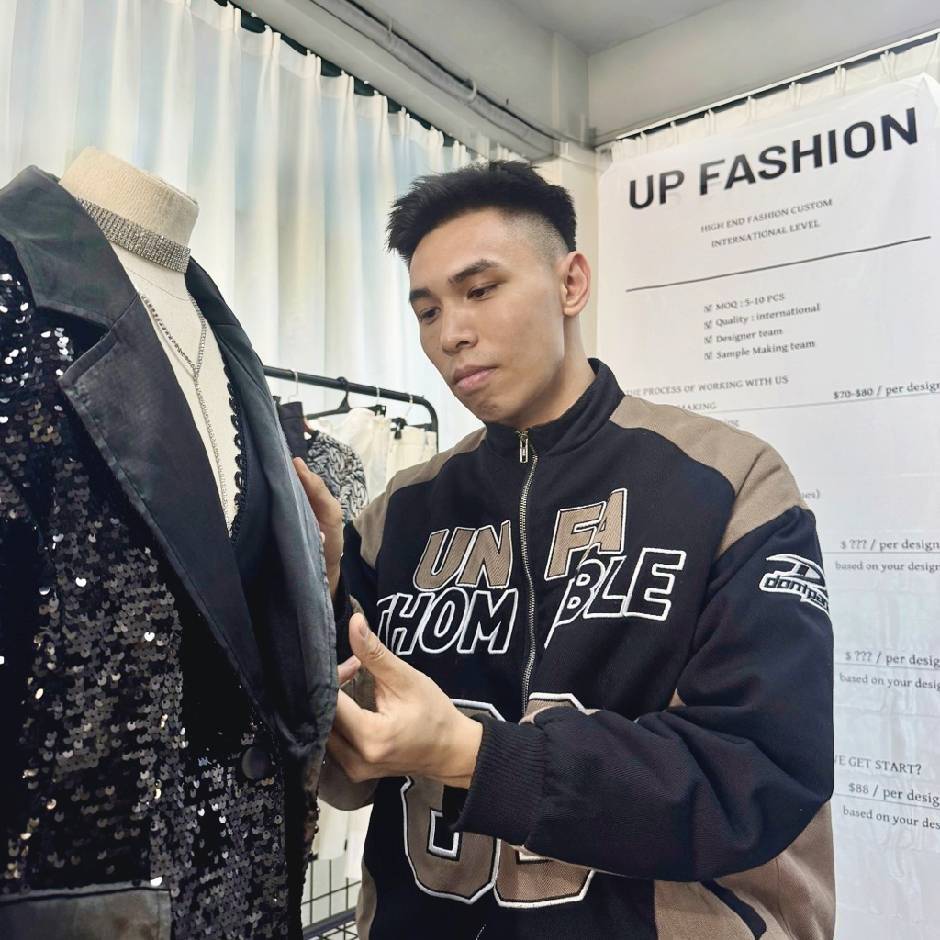
Deng
Project Manager & Sales
Available now

Kiki
Designer & Merchandiser
Available now
Everything you need to know before working with a clothing manufacturer — MOQ, sampling, quality control, fabric, pricing, delivery, and how to start production in Guangzhou.
What does a luxury finish actually look like on a $900 dress?
It's visible in the places nobody photographs: a hand-rolled hem at 3mm instead of a turned one, seams pressed open and flat with no puckering on silk, a zip set without ripples, and buttons anchored to a tape rather than just the cloth. We inspect for exactly these details three times per garment, because a $900 retail price is a promise about the inside of the dress too.
Do you use hand-canvassed construction or fusible interfacing?
Both, and the choice belongs in the tech pack, not a guess. Tailored jackets get a hand-sewn chest canvas when the retail price supports it; simpler pieces use precision-cut fusible. We'll tell you which one the construction needs — a fusible jacket retailed at $900 will fail at the collar in a season, and we'd rather say so up front.
How do you stop delicate silk from pulling at the seams?
Three controls: the right needle and thread for the weight, seam tape or a French seam where the drape demands it, and pressing that sets the seam before it can distort. We also cut bias panels on the true 45-degree with the grain marked on the spread — most silk pulling starts with panels cut off-grain, not with the sewing.
Why did my last order cost more than the quote?
The usual causes: fabric substituted after quoting, trims bought at premium because they were approved late, re-sampling charged again, and freight quoted without duties. A quote that lists fabric, CMT, trims, sampling and freight as separate lines prevents most of it. Ours does, and we flag mill minimums and re-dye fees before you commit.
How much deposit do you need to start production?
30 to 50% to start, balance before shipment, with the milestones written into the quote. The deposit covers fabric purchase and line booking — if a factory asks for more than half before cutting, ask what it is paying for. On a first order we'd rather take a smaller deposit and earn the rest at inspection.
If I order 30 pieces now and 30 next month, do I get the 60-piece price?
No, and we'd rather you know why: two separate runs pay the setup twice, so the per-piece rate is the 30-piece rate both times. Ordering 60 at once pays setup once, and the rate drops. What we can do is hold a style's setup for 30 days, so a fast reorder of the same style skips re-sampling and keeps most of the saving.
Can I combine several 30-piece reorders into one shipment to save freight?
Yes, within reason. If two or three styles finish in the same week, we consolidate them into one carton load, and you pay freight once instead of two or three times. The limit is the season: waiting a week to combine is fine, waiting a month usually costs more in lost selling time than it saves.
Does your MOQ change for a beaded gown versus a plain silk top?
No — MOQ 30 holds across our range, but the price and the timeline do not. A beaded evening gown carries more hand work, so it costs more per piece and needs longer sampling; a plain silk top moves faster. What we won't do is quote a top's price for a gown and surprise you later.
When is MOQ 30 the wrong choice for a brand?
When you already know the style sells and you need stock depth for wholesale or a launch. Below 50 pieces you pay a per-piece premium for setup that buys nothing on proven ground. We regularly talk clients up from 30 to 50 or 150 once a style has sold, because the money you save is real.
How do I know a factory's photos and videos are real?
Ask for a live video walkthrough with your name on a card held up to the camera — the floor, the machines, today's date. Then ask for video of a garment in your category being measured against a spec. A real factory can do this in one call; a trading office forwarding someone else's footage cannot keep the story straight.
Should I work through an agent or contact the Guangzhou factory directly?
For a small batch with a quality spec, direct is usually better. Agents add a layer, take a margin, and cannot control the floor when something goes wrong — which is the exact failure we see in projects that arrive after an agent. Talk to the factory directly, ask for the licence, and keep the QC gates in writing; if you still want an agent for logistics, that is a separate service.
How do I compare quotes from three different factories fairly?
Ask all three to split the quote into the same lines: fabric, CMT, trims, sampling and freight. Then compare what is included at each MOQ, not just the bottom number. A factory that hides setup inside the unit price looks cheaper than one that shows it — until the second order arrives.
Do you handle SABER certification for shipments to Saudi Arabia?
We prepare the export side and coordinate with your Saudi importer, who holds the SABER account, because the certificate is issued on the importer's registration. The process runs 5 to 10 working days, so we start it before the goods ship, not after. Same for the UAE and Kuwait equivalents — the paperwork starts the week we confirm the order.
Can I pay you in GBP as a UK brand?
Yes. We invoice in USD or GBP, and most UK clients pay by T/T: 30 to 50% to start, balance before shipment. If you pay in GBP we use the agreed rate and state it in the quote, so currency moves do not change the number you approved.
Can you drop-ship a 30-piece order to my US customers?
Yes — we can split one 30-piece run into individual parcels and ship them direct to your customers with your label and a packing note in your name. Each parcel carries its own customs paperwork and tracking. The per-parcel shipping cost is higher than one consolidated box, so we only recommend it when the retail margin carries it.
How do you stop beaded fabric from scratching the skin?
Beading that touches skin should sit on a panel that is lined or underlaid, never against bare skin at the armhole or neckline. We cut a fine silk or cupro underlayer and finish every bead side facing the fabric, not the body. If a design cannot be lined without changing the drape, we tell you before sampling.
How do you press silk without leaving shine marks?
Silk is never pressed directly with a hot iron. We press through a press cloth with steam and low heat, or use a clapper to set seams flat without pressure marks, and seams are pressed open on a needle board so the texture does not flatten. If a fabric is too delicate to press at all, we use finger pressing instead and say so.
Do you fix prices in USD, and what happens if the yuan moves?
Yes, quotes are fixed in USD and we honour them for the agreed validity, usually 30 days. Fabric and labour are paid in yuan, so a sharp move can squeeze us on a long production window — which is why reorders quote fresh. For most clients the risk is small, and a fixed number is worth more than a floating one.
Will you put a late-delivery penalty in the contract?
Yes, we write the delivery date and a penalty into the quote for orders on a fixed calendar — Eid, wedding season, a signed wholesale drop. The penalty is real money, typically 0.5% of the order value per week late, capped at 5%. We offer it because the calendar is where small batches win or die.
Can a Guangzhou factory really do 30 pieces of a beaded evening dress?
Yes — MOQ 30 is per style per colour, and beaded dresses are regular work at that size. Sampling runs two to three mock-up rounds in 14 to 21 days, and bulk takes 6 to 10 weeks after fabric confirmation. The beading is priced per garment after a density sample, so the cost stays predictable at small volume. A 30-piece pilot caps your cash risk while you test the style, and the reorder closes the unit-price gap.
Why does a 30-piece order cost more per dress than 500 pieces?
Fixed costs — pattern, grading, sampling and line set-up — spread over fewer units, so the per-piece price runs 15 to 40 percent higher at MOQ 30. Labour itself barely moves from 30 to 300 pieces; the fixed lines are what thin out. The higher unit price still saves money when you are testing a style, because 30 pieces risk far less cash than 500 that may not sell.
Can you split MOQ 30 across two colours of the same style?
Yes — we quote per style per colour, so two colours at 15 pieces each count as 30. We will tell you honestly when a colourway needs more than 15 pieces to keep the dye and fabric purchase sensible. Sharing compatible styles in one production slot is often cheaper than running them separately, because set-up is spread across the same line time.
What is included in a Guangzhou factory quote at MOQ 30?
A line-by-line quote splits fabric, trims, labour, pattern, sampling and QC, and names the MOQ, the AQL level and the node dates in the same document. Fabric is usually the largest line, at 35 to 45 percent of a dress. If a supplier gives you one round number with no breakdown, that is a price, not a quote.
How do I know a quote from a clothing manufacturer is realistic?
Ask what the number is made of. A realistic quote names fabric, trims, labour, sampling and QC as separate lines, and states the MOQ and AQL in writing. Compare quotes at the door — add freight, duty and inspection to every factory price before you compare them. We re-confirm the unit price and the duty treatment in writing at confirmation, so the number does not move later.
What should I verify before paying a deposit to a Guangzhou factory?
Verify the workshop address and licence, ask for a live video call from the cutting floor, and check that the MOQ, AQL and node dates are in the contract. A real factory walks you through cutting and pattern rooms; a trading company shows a showroom. Sample fees should be quoted in writing and credited against bulk. We seal, sign and date every sample, and bulk is measured against it.
Do I need to visit Guangzhou to start production with you?
No — most of our clients have never visited. We run the process on weekly batches with video at every gate: fabric intake, inline inspection and final check. Your sealed sample, the inspection report and the shipment video are the evidence you approve against, wherever you are.
Can you ship 50 pieces to Amman, Jordan, for a modest wear drop?
Yes — Jordan is a regular destination for us. Air freight from Guangzhou to Amman runs 6 to 9 days door to door, and we prepare the commercial invoice, packing list and certificates of origin with commodity codes verified against the Jordanian tariff, so clearance at Queen Alia stays short. For an Eid or Ramadan drop, start four to five months out.
What do US brands pay in duty on a Guangzhou order?
Most dresses sit in tariff chapter 62 at roughly 16 percent, and additional tariffs on goods from China have changed several times in recent years. The rate depends on your exact commodity code, so verify it with a broker before committing. We write the code into the export documents and can quote DDP when you want one fixed landed number.
How long does air freight from Guangzhou to London take?
Five to eight days door to door on a small batch, which is why 30-piece orders still work for UK brands that need a selling window. Sea takes 25 to 30 days and only pays off above roughly 200 pieces. We ship at commercial weight, not inflated volumetric figures, so your freight bill matches the cartons.
Every question we've answered about working with a clothing manufacturer, kept and organised — 264 answers and counting. Browse the archive:
Share your tech pack — or just a sketch. Our team responds within 4 hours. No obligation.
Start a ConversationYour message goes straight to Deng, the founder. A written reply within 24 hours — with a plan and real numbers, not a sales pitch.
Questions about your own styles?
Talk directly to Deng or Kiki — replies within 4 hours.
Choose the person who best fits your project. Both reply within 4 hours.