Talk to our team.
Choose the person who best fits your project. Both reply within 4 hours.
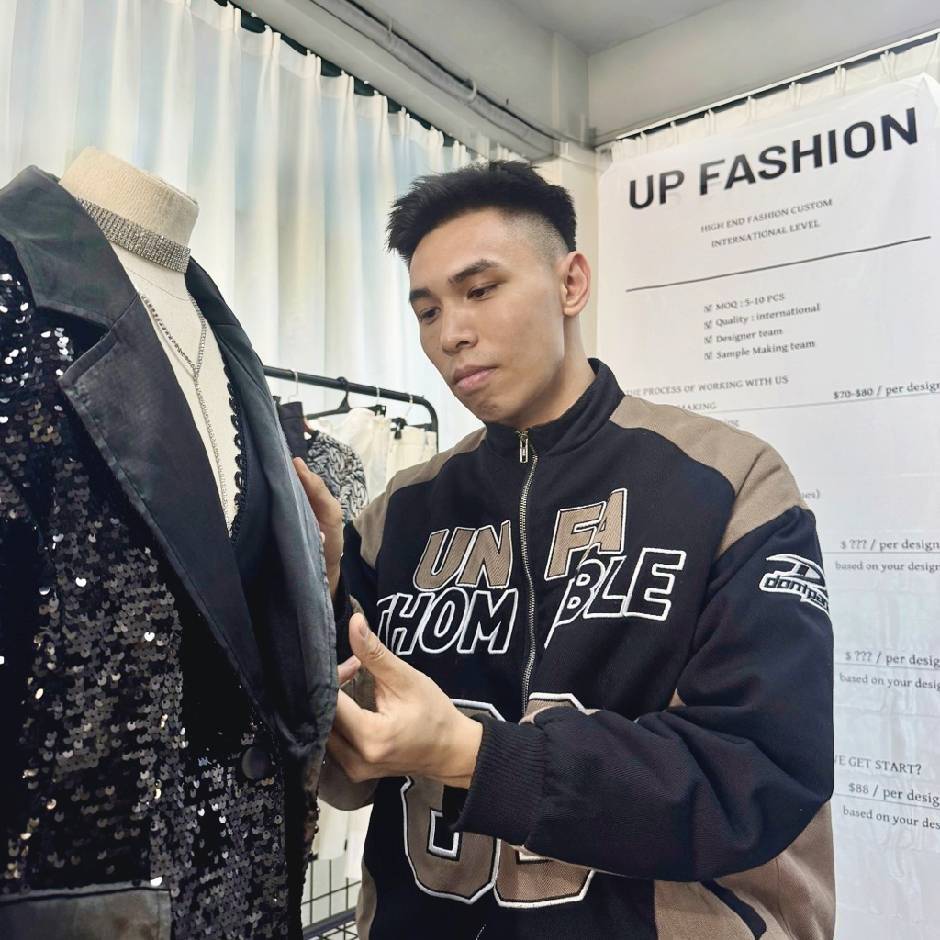
Deng
Project Manager & Sales
Available now

Kiki
Designer & Merchandiser
Available now
Everything you need to know before working with a clothing manufacturer — MOQ, sampling, quality control, fabric, pricing, delivery, and how to start production in Guangzhou.
Can you grade for Italian and French sizes when my brand sells in Milan and Paris?
Yes. We grade to the size standard of your market — IT 38–48 and FR 34–46 map closely to a European size set — and we build the block from your fit model rather than a US chart. Size-inclusive runs keep the same garment length across the set, which is the detail buyers notice. Past runs for Paris and Milan are on our case studies page.
What are the biggest red flags when auditing a garment factory?
Photos without a live video walk, an address that maps to an office building, and vague answers about the sewing floor. Ask who issues the fabric invoice and who owns the patterns — a factory answers with documents, an agent does not. We offer any client a live video walk of our Guangzhou floor before a deposit.
Can I place one paid trial style before committing a whole collection?
Yes — most of our clients started with one style. A 30-piece trial of a single style shows you the sampling rhythm, the inspection reports and the shipping experience for roughly USD 1,500 to 3,000 all in, and the sampling fee is credited when you confirm. If the trial works, the next capsule runs on the same sealed blocks.
Can I refuse a shipment if the final inspection misses the agreed standard?
Yes. The acceptance level is written into the order before production — we work at AQL 1.0 on most runs — and the final report is sent with photos before the cartons leave. If the inspection fails the agreed level, we rework or re-cut at our cost rather than ship a borderline lot. This is in every contract, not a promise.
How do you reverse-engineer a garment to hit my target price?
You name the number and we build the spec backwards: fabric weight first, since it runs 30 to 45 percent of a small-batch quote, then lining, then trims. If the design needs a lighter cloth or a simpler seam to land at your number, we show both options on paper before sampling. The target and the spec are locked together at sealing, and nothing moves without a written change order. If the number cannot work honestly, we tell you with the arithmetic.
At USD 60 a piece, what kind of dress can I actually produce?
USD 60 ex-works buys a lined dress in cupro, viscose or a light silk blend at MOQ 30 — think a slip or a bias-cut crepe style with clean seams and a good zip. It does not buy 19 momme charmeuse or hand-rolled hems; those push a dress toward USD 75 to 110. Tell us the retail price and we show you which fabric and finish the number honestly carries.
Can one budget cover my whole five-style capsule?
Yes, and that is usually the better way to plan. Set the total and we allocate it — the hero style gets the silk, the basics get the stock cloth — instead of five styles each fighting their own number. We quote the capsule as one order with one marker plan, which usually saves 8 to 12 percent on fabric. If one style pushes the total over, we move that fabric choice before sampling, not after.
My quote is USD 95 but my target is 75. What makes up the gap?
Usually the fabric and the construction you asked for. A 16 to 19 momme silk with a half-lined bodice can sit USD 20 above a cupro twill with a simplified facing, at the same silhouette. We do not just report the gap — we show a second spec at USD 75 so you see exactly what the lower number removes. Then you choose honesty over hope.
When you say my target is unrealistic, what are my options?
Three, and we lay them out with the arithmetic before sampling: a lighter or lower-cost fabric, a simpler construction detail, or a corrected target that reflects the real floor. A full-canvas wool blazer at USD 55 is not a promise we will make, but a fused-front version on a lighter cloth can be. We never quietly downgrade the spec to hit a number.
What does upgrading from a fused blazer to a half-canvas one cost?
At MOQ 30 expect the half-canvas upgrade to add roughly USD 15 to 35 per blazer over a fused front, depending on the wool — the canvas, the pad-stitching and the extra pressing time are real labour. It is the difference between a lapel that rolls flat after two wears and one that holds its shape. We quote it as a named line, so the choice is yours before sampling.
Can I order more trousers than jackets in my suit-set run?
Yes. The jacket and the trouser are graded as separate blocks, so you can cut a run that is 60 percent trousers and 40 percent jackets when your sales show the trouser outsells the set. Both pieces come from the same cloth order, so the price stays close to a matched set. We just need the split written before the marker plan is made.
If my jumpsuit needs a longer torso, does the whole pattern change?
No — the torso is one block inside the jumpsuit pattern, so a length change adjusts the body panels and re-checks the crotch curve, not the whole garment. We fit the torso length on the size extremes before bulk, because lengthening at the middle size only fixes the middle. Expect the adjustment inside a mock-up round, not a full re-draft.
How much does a lining add to a dress at MOQ 30?
A full lining adds roughly USD 8 to 15 per dress at MOQ 30, depending on the fabric — cupro at the lower end, silk at the higher. An unlined or partially lined dress saves that cost but changes how the garment hangs and how it wears against the skin. We quote both versions so you see the difference in dollars before you decide.
What is the safest way for a US brand to pay a Guangzhou deposit?
A bank wire to the company's own corporate account, with the invoice number in the reference line, is the standard. We do not ask for payment to a personal account or to a third country. Our terms are 30 percent deposit, 40 percent at fabric confirmation and 30 percent before shipment, each tied to a document. If a factory insists on full payment up front or a personal account, treat it as a red flag.
Do you ship 30-piece orders to Sweden and Poland, and how long does it take?
Yes. Air freight from Guangzhou reaches Sweden and Poland in 6 to 9 days, and customs clears in one to three days when the commodity codes are pre-classified, which we do before the cartons close. We quote DDP so the VAT and duty are settled and the border cannot surprise you. From sample approval, an EU delivery typically runs 8 to 11 weeks in total.
Who handles EU import VAT on my first order, and when do I pay it?
On DDP terms we handle the process, and the VAT is settled inside the delivered price, so you pay nothing at the border. The rate depends on the destination country — roughly 19 to 25 percent across the EU — and it is calculated on the customs value. We pre-classify the commodity codes and show the VAT figure in the DDP quote before you approve.
What documents prove a Guangzhou factory owns its floor?
Ask for three things: the business licence in the legal entity's name, a factory lease or property record held by that same entity, and a live video walk of the cutting and sewing floor on a working day. A trading company can produce an invoice but rarely a lease in its own name. We send all three to any client before a deposit.
What does it mean when a factory turns down my 30-piece order?
It usually means the factory is built for volume lines, not that your order is wrong — a 500-piece floor cannot make money at 30. That is useful information: it saves you from a factory that would say yes and then batch your small run in with other brands. Look for a floor that runs 30 to 150 pieces per style as its normal work.
A factory quoted low, then raised the price after sampling. How do I prevent it?
Lock the price in writing at the same moment you seal the sample, tied to the exact spec — fabric mill, weight, every trim. If the factory will not write the number down, that is your answer. Our quotes name the price at sealing, and any later change requires a written change order. A deposit tied to a written price protects you both.
What happens if your production quote comes in below my target price?
Then you approve the lower number and we lock it at sealing like any other price. The gap is not added back, and nothing is upgraded without a written change order; some clients use the room for a better lining or a stronger zip, others keep it as a buffer against freight and duty. We quote honestly either way, which is why below-target quotes are as common in our records as above-target ones.
How much of my FOB price is fabric, roughly?
Thirty to 45 percent on most small-batch garments, which is why it is the first lever in any budget conversation. A lined dress uses 1.3 to 1.6 metres of body fabric before the lining is counted, and a blazer can use 1.6 to 2.2 metres plus its interlining. On a USD 85 FOB dress, fabric usually sits between USD 26 and 38 of that number.
Can one 30-piece order carry a USD 40 style and a USD 140 style together?
Yes. Each style is quoted on its own spec, and the two share one order, one cloth-buying session and one shipment, which is where the saving is. A capsule often mixes an unlined cupro slip at the low end with a half-canvas wool blazer at the high end, because each style answers to its own retail price. We just need the two specs separated on the order sheet so neither subsidises the other.
If I never place the bulk order, do I lose my sampling fee?
The sampling fee is not refunded, because it paid for real work: pattern, grading, mock-ups and the fabric for the samples. What you keep is the sealed samples and the digital patterns in your name, so the style is never lost. What we advise instead is a single paid style as a trial before a whole capsule, which is how most of our clients start.
How long is a quote valid, and can I lock the price for a reorder?
A quote is held for 30 days from issue, and the price is locked in writing the moment you seal the sample, tied to the exact spec. Reorders on the same sealed blocks quote in 48 hours and skip sampling, which is why a second run usually lands below the first. If fabric prices move sharply between seasons, we confirm the change before invoicing rather than after.
Why does a blazer lapel roll flat after a couple of wears?
It is usually structure, not fabric. A fused front flattens over time, while a canvassed lapel with pad-stitching keeps its roll because the canvas holds the shape. At MOQ 30 the half-canvas upgrade runs roughly USD 15 to 35 per blazer, and we seal the lapel roll on a mock-up in the real wool so the bulk holds it. If a budget forces a fused front, we tell you what that means for the lapel before sampling.
If jackets outsell trousers, can I reorder just one side of a suit set?
Yes. The jacket and the trouser are separate blocks, so a reorder can be 20 jackets with zero trousers, or the reverse. We reorder the cloth against the sealed shade standard so the new side matches the first run, and the 48-hour quote applies to either half. Your stock data decides the ratio; we cut what the order sheet says.
Why are my size 14 jumpsuits too short in the body when the sample was perfect?
Because the torso was probably graded on a straight scale. A size 2 to size 14 body does not grow evenly at the shoulder, the waist and the crotch, so a uniform scale lengthens the body faster than reality. We grade the crotch curve and the outer leg separately and check body length on the size extremes in the mock-up, which usually catches this before bulk rather than after.
Why is a bias-cut dress pricier than a straight-cut one at the same MOQ?
Bias cutting uses more cloth and more care. Panels are laid on the diagonal, which can push fabric consumption 30 to 40 percent higher, and the fabric has to relax before sewing or the hem distorts. Add the hand-rolled hem and the extra handling, and a bias dress typically quotes USD 15 to 30 above the same style cut straight. A budget cut should come from the fabric choice, not from the bias itself.
What does air freight cost for a 30-piece order from Guangzhou to New York?
On a small batch of dresses, air freight adds roughly USD 3 to 6 per piece, or USD 120 to 220 for a 30-piece order, and transit runs five to eight days once the cartons leave. Heavier garments like coats cost more per kilo. Sea freight is cheaper but slower and rarely makes sense below a few hundred pieces, so most of our US clients fly the first run and move to sea on reorders.
Do I need an EORI number if you deliver my UK order DDP?
No. On DDP terms our side handles the UK customs entry and the VAT is settled inside the delivered price, so you do not need an EORI for that shipment. If you plan to import other goods yourself later, a UK EORI is free to apply for from HMRC. We pre-classify the commodity codes before the cartons close, which keeps a DDP delivery from becoming a border surprise.
What labels and compliance do my garments need to sell in France or the EU?
The essentials are a fibre-content label under EU Regulation 1007/2011, care symbols, a size label and the country of origin, and the trims must meet EU chemical limits such as REACH. We sew the label set your market needs and keep the mill and trim test documentation on file. Tell us your markets before bulk and the label spec goes into the tech pack, so nothing is stitched twice.
In which currency do you quote, and can the price change with exchange rates?
We quote in USD as standard and can quote EUR or GBP at the day's rate. The price is locked in the quoted currency at sealing, and we hold that number for the order; if the exchange rate moves sharply before fabric is bought, we confirm any adjustment in writing before invoicing. Most clients prefer USD because it removes one variable from the comparison.
What is your policy if a fault appears after the order has been delivered?
Send photos and we review the pieces against the sealed sample and the inspection report. Claims covered by our workmanship warranty — which our contract states before production — are remade on the next run or credited, and we agree the handling before anything ships back. We have remade styles for clients whose stockists found faults we missed; the warranty is written, not a promise.
How do you stop my designs being copied or shown to other brands?
Three ways. Our floor runs 30 to 150 pieces per style on our own line, so your garments are not batched into another brand's order. Patterns and sealed blocks are held in your name and never resold, and we sign NDAs on request. We also decline lookalike requests from other buyers who ask for a version of an active client's style, and we say so on the first call.
Every question we've answered about working with a clothing manufacturer, kept and organised — 264 answers and counting. Browse the archive:
Share your tech pack — or just a sketch. Our team responds within 4 hours. No obligation.
Start a ConversationYour message goes straight to Deng, the founder. A written reply within 24 hours — with a plan and real numbers, not a sales pitch.
Questions about your own styles?
Talk directly to Deng or Kiki — replies within 4 hours.
Choose the person who best fits your project. Both reply within 4 hours.