Talk to our team.
Choose the person who best fits your project. Both reply within 4 hours.
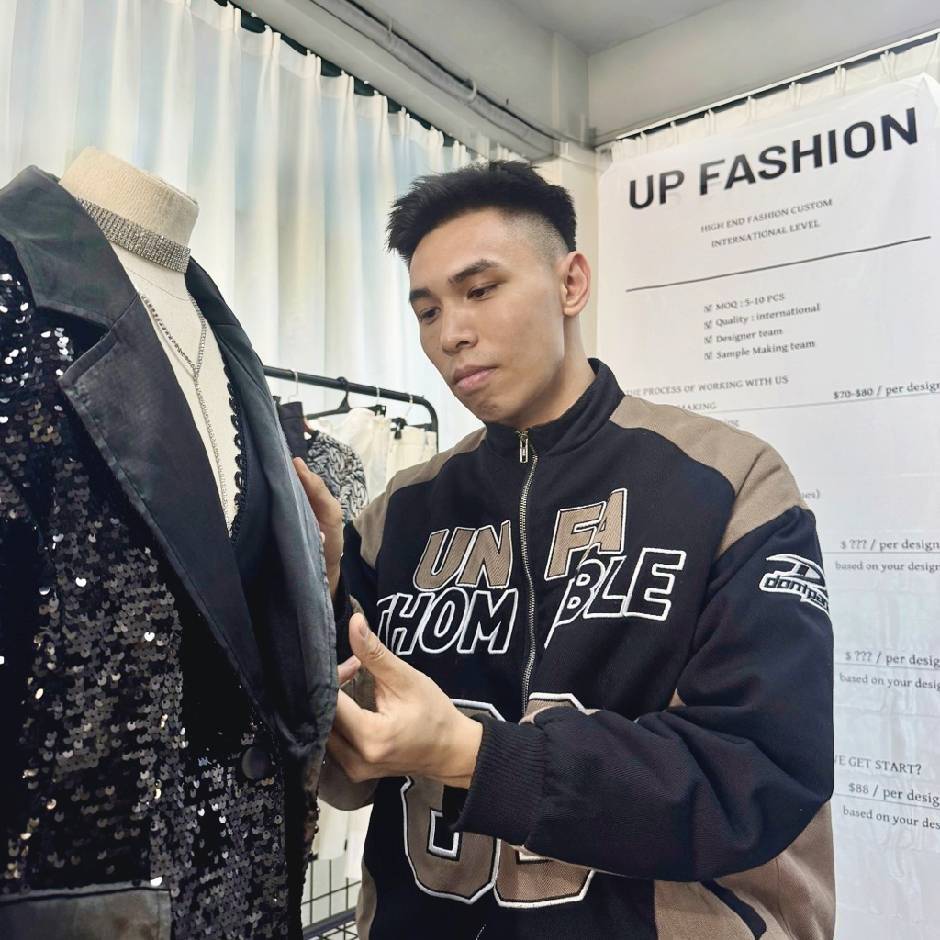
Deng
Project Manager & Sales
Available now

Kiki
Designer & Merchandiser
Available now
Everything you need to know before working with a clothing manufacturer — MOQ, sampling, quality control, fabric, pricing, delivery, and how to start production in Guangzhou.
What makes a luxury garment manufacturer different from a fast-fashion factory?
It isn't better machines — it's what happens before cutting and who checks at each stage. A luxury garment manufacturer verifies fabric by weight and composition at intake, fits on a live model and a mannequin per size, inspects every piece three times, and keeps a sealed sample for the whole run. That work is visible in the seam, not in the brochure.
Can you do hand embroidery on a 30-piece run?
Yes. We run machine-guided embroidery at 12 to 14 stitches per centimetre and seal the thread against the fabric so shade stays constant. For hand-embellished pieces we specify density per square inch and pull-test anchors at 8N on 10% of the run. What we don't take is hand-beading at any quantity — we say so on the first call.
How do you keep quality consistent across a small luxury run?
Consistency at 30 pieces comes from the same three gates we use at 500: a sealed approved sample, a first-piece check off the line, and three inspections per garment with measurements at every size. Small runs make it easier, not harder — we can inspect every piece rather than sampling.
What's the typical cost breakdown for a small batch of evening wear?
Fabric is usually the largest line, then cut-make-trim, trims, sampling and freight. For a beaded silk gown retailing around $900, production runs roughly 22 to 30% of retail at 50 pieces. Every style differs, so we quote itemised within 24 hours of a tech pack — a round figure is a guess and we won't send one.
How early should I start production for a seasonal launch?
Work backwards from the drop date: two to three mock-up rounds in 14 to 21 days, a final sample in 28 to 42 days, bulk production 6 to 10 weeks after fabric confirmation, plus 2 to 4 weeks if we source the fabric. For a first order, start 5 to 6 months before you want goods in hand.
Can you make 30 pieces of a sequined evening gown?
Yes. Sequined gowns are regular work at 30 to 60 pieces per style. We spec bead and sequin density per square inch, use a dedicated alignment jig so the pattern matches across panels, and pull-test every anchor at 8N on 10% of the run so stones stay on the garment, not in the carton.
What does a 30-piece first order actually include?
Two to three mock-up rounds in similar fabric, one final sample in your actual fabric, then bulk production with three inspections per garment. Sampling is charged separately and deducted from the production invoice, so the first order shows you every cost before you commit.
Why does the price drop so much at 150 pieces?
Because the fixed lines stop moving. Pattern making, grading, marker and line setup cost the same at 30 or 500 pieces, so a $1,500 setup is $50 per garment at 30 units and $10 at 150. Our price tiers step down at 150, 300 and 500, and we'll show you the exact lines.
Can 30 pieces cover my full size range?
Yes, but plan it. 30 pieces across six sizes is five units per size — enough to test the market, thin for a full wholesale launch. Most clients order one hero colour at 30 and a second colour at 30, then reorder the winner at 50 to 150 where pricing sharpens.
How do I check a factory's quality before my first order?
Three checks: ask for past orders in your category and the client type, request a size-set mock-up rather than one sample in one size, and ask what QC standard they run on paper — we use AQL 1.0 with size-by-size measurement. A factory that can't answer all three is guessing.
How do I send my designs to a factory in China?
Reference photos, sketches, measurements and your target retail price are enough to start. We build the tech pack ourselves — digital pattern, full size grading included — and quote within 24 hours. Rough sketches work; the more measurements you give, the closer the first mock-up lands.
What size should my first production order be?
For a new silhouette or market, 30 pieces per style per colour — a capsule that funds itself. For a style you have already sold at volume, go 50 to 150, because the per-piece premium below 50 buys nothing on proven ground. We talk people out of 30 regularly, and it is the right conversation.
Do you ship to Israel and Jordan?
Yes. Air to Tel Aviv or Amman runs 6 to 9 days from Guangzhou, and both are regular destinations. Israel and Jordan have their own tariff schedules, so we check the commodity code with each client before shipping and prepare certificates of origin on our side.
How long does air freight to London take?
Five to eight days door to door from Guangzhou, which is why small batches still work for UK brands that need stock in season. Sea freight at 25 to 30 days only pays off above roughly 200 pieces, where the freight saving beats the calendar cost.
Can a UK startup without a tech pack work with you?
Yes — most of our UK clients start without one. Send reference photos, measurements and a target retail price, and we build the tech pack with grading included. Sampling is charged separately and deducted from bulk, so the startup risk is one sample round, not a whole order.
What's the difference between machine and hand embroidery?
Machine-guided work at 12 to 14 stitches per centimetre is repeatable and affordable — right for runs of 30 or more. Hand embroidery is slower, roughly 2 to 4 times the cost, and each piece is unique. We run machine embroidery with hand-placed accents, and we'll tell you which fits the retail price.
How do you stop sequins from shedding?
Density is specified per square inch, every sequin is double-anchored so one broken thread doesn't shed a line, and we pull-test anchors at 8N on 10% of the run. The test is simple: we try to pull a sequin off before you wear it, not after.
Can you produce bridal pieces at a 30-piece MOQ?
Yes. Bridal and occasion wear at 30 to 60 pieces per style is regular work — silk, beading, hand-rolled hems at 3mm. The calendar matters most: two to three mock-up rounds in 14 to 21 days, a final sample in 28 to 42 days, then bulk, so start 4 to 5 months before the wedding season.
What does air freight to the Middle East cost?
On a 30 to 60 piece order of evening wear, air freight to Kuwait, Saudi or the UAE typically runs 5 to 8 days and adds roughly $3 to $6 per piece depending on volume and weight. It costs several times sea freight, and on small runs it is usually worth it — the extra buys a whole selling window.
Why is your quote higher than a Vietnamese factory?
Because the work is different. Basic knitwear and commodity cut-and-sew is 10 to 20% cheaper in Vietnam, and we won't argue with that. Our strength is embellished silk and wool at small MOQ — hand embroidery, beading, bias cutting — where Vietnamese volume factories often won't take 30 pieces at all.
Is MOQ 30 per style or per colour?
Per style per colour, not per order. A style in two colours is two runs of 30, not one of 15. What we can do is combine two styles with compatible fabrics into one production slot, which is how most clients test a small capsule without doubling setup costs.
How many pieces do I need for a first collection of five styles?
For a debut capsule of five styles, plan 150 to 300 pieces total: 30 per style per colour at one or two colours each. That funds a real market test without betting the season. Most of our first-time clients order 30 per style and reorder the winners at 50 to 150, where the per-piece rate drops because setup is already paid.
If I order 30 pieces split across three colours, is that one order or three?
One production run, three mini-lots — and we'd rather you didn't split it that way. Cutting a single 30-piece style into three colours gives you 10 units per colour, which is thin for wholesale. A cleaner test is one hero colour at 30 plus a second at 30, holding the third colour for a reorder.
What does MOQ 30 look like for a tailored blazer?
A blazer carries more fixed cost than a dress: canvas, fusible, shoulder pads, more pressing time, and a jacket pattern that takes longer to grade. At 30 pieces it works, but you pay the setup premium, and below 50 we'd usually suggest a simpler silhouette for the test run. Wool blends from Biella handle the structure best at small volume.
How do I spot a factory that inflates its MOQ to 500?
Ask what the fixed costs are. A factory quoting 500 as the minimum usually can't separate pattern, grading and setup from the unit price — or doesn't want to. Any factory can state its setup line in writing; if the number is real, a 30-piece run is just a matter of dividing it by 30 and deciding if you'll pay it.
How long should a factory take to reply to my first enquiry?
Within one business day, and with questions, not a price. A good reply asks about fabric, quantity, season and price point before quoting. If a supplier answers with a number in the first email, they are quoting you without reading your brief — which is exactly how the run will go.
Should I pay a sample fee to a factory I've never worked with?
Yes — a sample fee is normal, we charge one, and it should be quoted in writing and deducted from your production invoice. What you should not do is pay a large deposit before sampling is defined. The sample round is your cheapest test of a factory's level, worth more than any brochure.
Can you ship a 30-piece order to Riyadh before Ramadan?
Yes, if we start early enough. Air freight from Guangzhou to Riyadh runs 5 to 8 days, but the real clock is production: two to three mock-up rounds in 14 to 21 days, a final sample in 28 to 42, then bulk 6 to 10 weeks after fabric confirmation. For an Eid drop, start 4 to 5 months out — a delivery that lands after Eid is not late, it's unsellable.
What US sizes do you grade for?
From your spec, not a house standard. For US brands that usually means US 2 to 14, and we check both extremes on a size set because that's where grading drifts. Send your size chart and we build the grade table from it, including stretch adjustments for the upper sizes.
How do payments work for a Middle East client paying in USD?
Most Gulf clients pay by T/T: 30 to 50% deposit to start, balance before shipment, both quoted in writing. Letters of credit work for larger orders and take 3 to 5 working days to confirm. Wire transfers from Gulf banks sometimes route through correspondent banks, adding 1 to 3 days, so we confirm receipt before cutting fabric — the clock starts when the money is in hand.
Every question we've answered about working with a clothing manufacturer, kept and organised — 264 answers and counting. Browse the archive:
Share your tech pack — or just a sketch. Our team responds within 4 hours. No obligation.
Start a ConversationYour message goes straight to Deng, the founder. A written reply within 24 hours — with a plan and real numbers, not a sales pitch.
Questions about your own styles?
Talk directly to Deng or Kiki — replies within 4 hours.
Choose the person who best fits your project. Both reply within 4 hours.