Talk to our team.
Choose the person who best fits your project. Both reply within 4 hours.
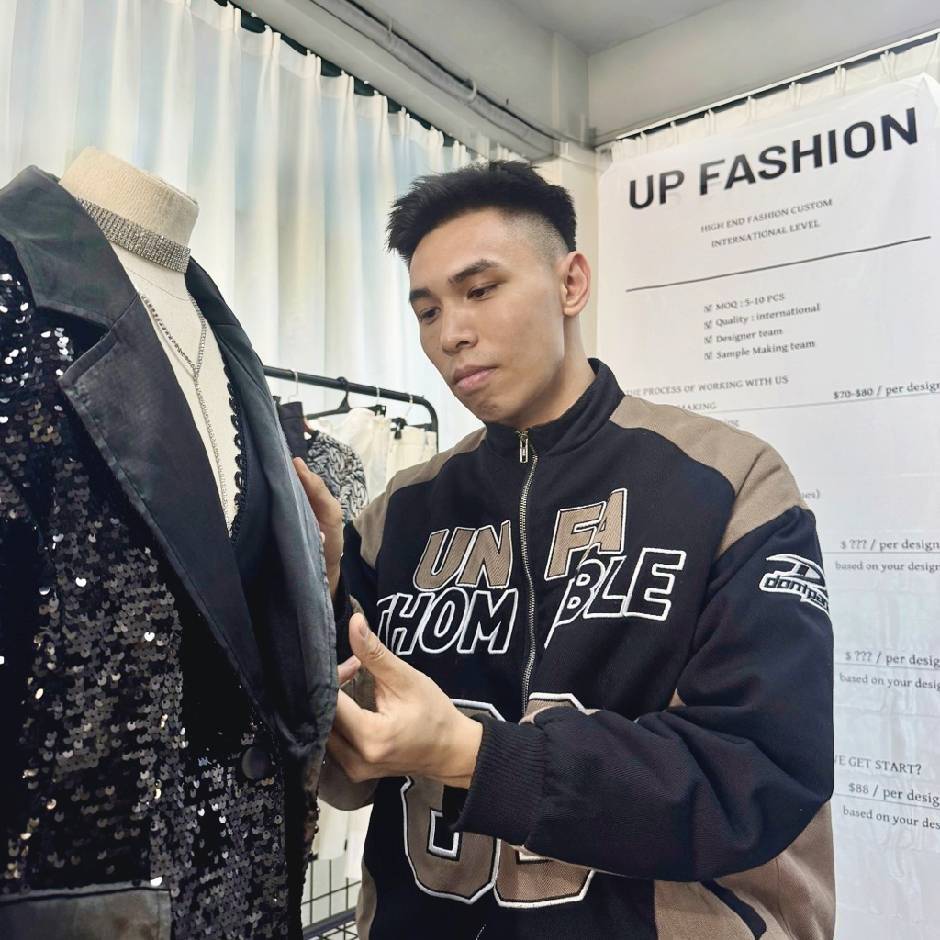
Deng
Project Manager & Sales
Available now

Kiki
Designer & Merchandiser
Available now
Everything you need to know before working with a clothing manufacturer — MOQ, sampling, quality control, fabric, pricing, delivery, and how to start production in Guangzhou.
What should I ask a clothing manufacturer on the very first call?
Ask who owns the patterns, where the sample will be sewn and whether you can see the floor on video, who issues the fabric invoice, and what the MOQ is in writing. Add one question about quality level and one about what gets credited if you confirm. An agent answers vaguely; a factory answers with documents and numbers.
Do I need to hire a separate QC agency, or does your inspection count?
For a 30 to 150-piece order our three inspections per garment usually cover it: first piece, inline and final, with reports and video you can check. If you still want a third party, Guangzhou has good agencies at roughly USD 200 to 350 per day, and we welcome them on the floor. On a short line you can also check every piece yourself from the photos before we pack.
Can I get references from brands that ordered from you at 30 pieces?
Yes, from clients who consent — many small brands prefer to stay discreet, so we respect that. What we always offer instead is verifiable proof: video of the actual floor, past inspection reports and packing lists for similar runs. Our case studies page documents 30-piece orders across the UK, the Gulf and the US.
My last order was sewn in Turkey — what changes if I move it to Guangzhou?
The main change is who owns the floor. We cut, sew, inspect and pack in our own Guangzhou workshop, so there is no agent between you and the sewing — and no 15 to 30 percent markup. Fabric is verified at intake by weight and burn test against the sealed sample, and air freight to London takes 5 to 8 days. Lead times run similar to Turkey; the difference is line-of-sight.
Do you ship 30-50 piece orders to Kuwait often, and what is the customs wait?
Yes, regularly. Evening-dress and occasion-wear runs at MOQ 30 to 50 are standard work for us in Kuwait. Air freight from Guangzhou runs 5 to 8 days, customs in Kuwait typically clears in 2 to 4 days with the commodity codes prepared in advance, and we prepare the invoice, packing list and certificate of origin so the paperwork is not the delay. Plan the production clock at 3 to 5 weeks and the total door-to-door at 5 to 6 weeks.
Can you courier one sample dress to New York so my local fitter can check it?
Yes. A sealed sample ships by express courier in 3 to 5 days for roughly USD 40 to 80, and most US designers use it for a local fitting before bulk. You send the fit notes back and we adjust the pattern on the next mock-up. This is the normal rhythm for our New York clients who have never visited the workshop.
Do you underline sheer fabrics so seams and facings never show through?
Yes — sheer silks such as georgette and chiffon are underlined with a fine cupro or silk organza layer before sewing. That keeps seams, facings and pockets invisible from the outside and stops the garment clinging at the wrong points. The underlining fabric is named in the quote so the look does not change at the sample stage.
How heavy can a beaded bodice get before it tears the shoulder seams of silk?
The safe answer depends on the silk weight, which is why we weigh the beadwork per square metre before sampling. For a lightweight silk ground we add an interlining or cupro layer under the beading so the stones do not pull the shell. Every stone is double-anchored, and we pull-test at 8 newtons on 10 percent of the run.
Do you use silk thread or polyester for embroidery, and does it matter?
Yes, it matters. Machine embroidery on silk is stitched with a high-quality polyester thread matched to the fabric sheen, because silk thread frays at machine speed. Real silk thread is reserved for hand couching and visible hand accents where the lustre is the point. We state the thread choice in the quote so the finish does not drift.
What is the all-in landed cost of 30 silk dresses in London, freight and duty included?
Take a dress at USD 60 ex-works Guangzhou: air freight adds about USD 4 to 5 per piece, UK clothing duty is roughly 12 percent, and VAT of 20 percent applies on the landed value. That works out to about USD 87 to 90 per dress at your London door on DDP terms. The exact duty rate depends on the commodity code, which we confirm in writing before you commit.
Which stage of a 30-piece order slips most often: sampling, fabric, or sewing?
In our records fabric is the stage that slips most — mill delays and dye lots move dates more than sewing ever does. That is why we confirm stock cloth and seal the shade before sampling, and why the calendar is fixed at fabric confirmation. Sewing is the most predictable stage on our own floor, because we control the schedule and the operators.
Is UP Fashion a budget factory or a premium one?
Neither cheap nor couture. We sit in the light-luxury tier — the quality level you see in first- and second-line premium brands. Our clients retail at $500–$2,000, MOQ starts at 30 pieces, minimum order value is $1,500. If you are chasing the lowest possible unit price, we are not the right factory. If you want premium quality that survives a boutique price tag, that is exactly what we do.
Can you work within my budget or target price?
Yes — this is how most of our quotes start. Tell us your target price per piece and we reverse-engineer the plan: fabric weight, lining, construction choices, where to spend and where to save. You get the best quality possible within your number. If your target is not realistic for the design, we say so and show you why — we do not quietly downgrade the fabric.
Should I share my budget when I first contact you?
It helps a lot. With a budget range we can quote accurately in one round instead of three. Without it we quote at our standard spec, which sometimes sits above what you had in mind — then the whole plan has to be redone. Sharing your target price saves days and gets you a production plan built for your actual situation.
Do you offer full-package FOB production?
Yes, FOB is our standard service. Sample development, fabric sourcing, bulk production, three QC inspections per garment, pressing and export packing — all handled by our team in Guangzhou. You approve the sealed sample and the final inspection report; we handle everything in between and hand over at the port. You keep your focus on brand and sales.
Do you provide AI model photos for my products?
Yes, as a free supporting service. We generate realistic AI on-model photos from your finished garments — useful for your online store, lookbook or line sheet before a real photoshoot. It is part of the package for one-person brands and small teams who need launch-ready visuals without a shoot budget. Real photography we leave to your photographer; AI images we include.
Are you a good fit for one-person brands and solo founders?
Roughly half of our clients are one-person companies. MOQ 30, full-package FOB service, free AI model photos, and a contact who answers in English within one working day — the whole setup exists so a solo founder can run production without hiring anyone. What we ask for in return: realistic timelines and decisive feedback during sampling.
What quality tier do you produce at?
Three tiers, all premium. Light-luxury ready-to-wear is our core: dresses, blazers, suit sets and jumpsuits retailing at $500–$2,000. Second, full OEM for established first- and second-line brands. Third, luxury-tier craftsmanship — hand-guided embroidery, embellishment, and delicate fabrics like silk and cupro. What we do not do: fast-fashion basics at $8 per piece.
What is your MOQ per style and per color?
MOQ is 30–50 pieces per style. Per color, the usual minimum is 30 pieces; orders below 50 pieces per style carry a small per-unit premium because line setup cost is spread over fewer garments. Mixing sizes within one color is free. The $1,500 minimum order value applies on top.
If my dress retails at $600, what should the factory price be?
Roughly USD 70 to 110 FOB from our floor for a light-luxury dress, and here is the reasoning: boutique retail usually works back through wholesale, and the factory number has to leave margin for freight, duty and your own costs in between. On a USD 600 dress, a USD 85 FOB price lands near USD 95 to 100 in New York after freight and duty, which leaves a workable margin for a solo founder. The exact number depends on fabric and construction, which is why we quote against your target instead of a guess.
What gets cut first when a quote comes in over my target price?
In our order, fabric weight goes first — it is 30 to 45 percent of a small-batch quote — then construction details nobody touches, then trims. We would rather move a dress from 19 mm charmeuse to a 14–16 mm cupro twill than shorten a seam allowance or drop a finish that affects how it wears. Every cut is shown to you on the quote before anything is removed, and nothing is cut twice.
Do you show two fabric options at different prices when I give a range?
Yes — a price range is how we prefer to work. We return two honest specifications: the best fabric your bottom number carries, and the step-up at your top number, with the difference named in dollars per metre. You approve one and the rest of the plan locks to it. What we never do is quote the top option and sew the bottom one.
Can you hit a $60 target price on a lined blazer?
At USD 60 we would plan a fused-front blazer in a lighter wool blend or wool-cupro, semi-lined, with no hand canvas — honest tailoring at a reduced spec, not a fake version of the expensive garment. If the design needs a half-canvas front and a full lining, the honest floor is USD 95 to 135 at MOQ 30, and we show you the arithmetic before sampling. Structure is a named line in our quotes, never a silent saving.
How do you stop the price creeping up after the samples are approved?
The price is locked in writing at sealing, together with the spec it was quoted on — fabric mill and weight, every trim, the construction notes. After that, any change goes through a written change order with its own price, so nothing moves silently. We have held sealed prices across late seasons, and the deposit terms are set out before production starts.
Why does a blazer quote cost more than a dress at the same MOQ?
Because construction, not markup, drives the gap. A tailored blazer carries 25 to 35 pattern pieces, a structured front, a set sleeve eased by hand and twenty or more pressing stages, where a dress carries six to ten pieces. Expect a half-canvas blazer at MOQ 30 to quote about 30 to 60 percent above a dress on similar fabric.
Can jacket and trouser sizes be mixed within one suit-set order?
Yes. We grade the jacket and the trouser as two separate blocks, so you can order jackets in one size run and trousers in another — common when the fit differs across the set. Both cut from the same cloth order, which keeps the price close to a matched set. Mixing sizes within a color is free at our MOQ.
Why do jumpsuits need more fitting rounds than dresses?
Because three measurements have to agree — rise, torso length and crotch curve — and each behaves differently as the size grows. A dress hides an inch; a jumpsuit shows it as a wedgie or a sag. We build the jumpsuit block from the rise up and fit it on the real fabric, which usually holds the rounds at two instead of four.
On an evening dress, is beading or embroidery the pricier finish at 30 pieces?
At 30 pieces, hand-applied beading usually costs more per garment than machine embroidery because it is labour-dense: roughly USD 25 to 120 per garment for hand accents depending on the motif, against USD 6 to 18 for machine embroidery once the programme is set. Dense bead layouts also carry a placement-sample cost. We quote the finish as a named line, so the choice is visible before sampling.
Will you take a weekly call during US hours while my order is in production?
Yes. Our client-facing team works a schedule that overlaps US mornings — roughly 8 pm to midnight Guangzhou time — and we hold a short weekly call on request for every bulk run. You also get a written progress note after each inspection gate: fabric intake, first piece and final check. Founders who have never visited the workshop tell us the calls replace the visit.
What do US brands most often get wrong on their first Guangzhou order?
Three things: quoting a landed price as if it were FOB, skipping the sealed-sample sign-off, and working through an agent who cannot show you the floor. Duty on clothing from China varies by commodity code, so we pre-classify before production rather than at the border. A first order done properly — target price, sealed sample, three inspections — usually runs smoother than the brand expected.
Every question we've answered about working with a clothing manufacturer, kept and organised — 264 answers and counting. Browse the archive:
Share your tech pack — or just a sketch. Our team responds within 4 hours. No obligation.
Start a ConversationYour message goes straight to Deng, the founder. A written reply within 24 hours — with a plan and real numbers, not a sales pitch.
Questions about your own styles?
Talk directly to Deng or Kiki — replies within 4 hours.
Choose the person who best fits your project. Both reply within 4 hours.