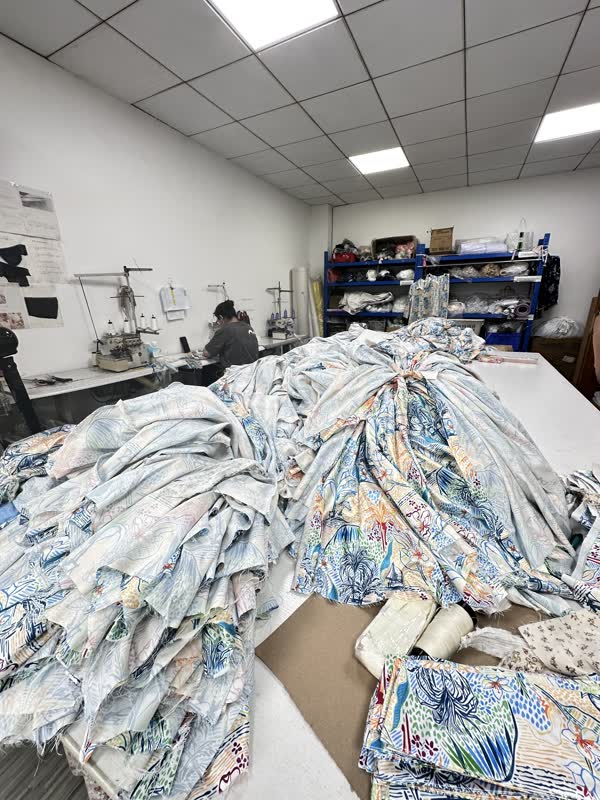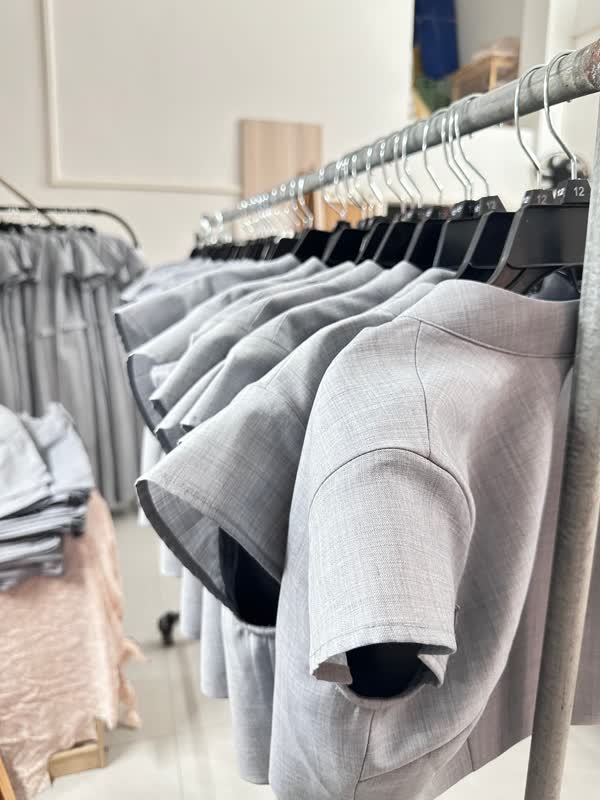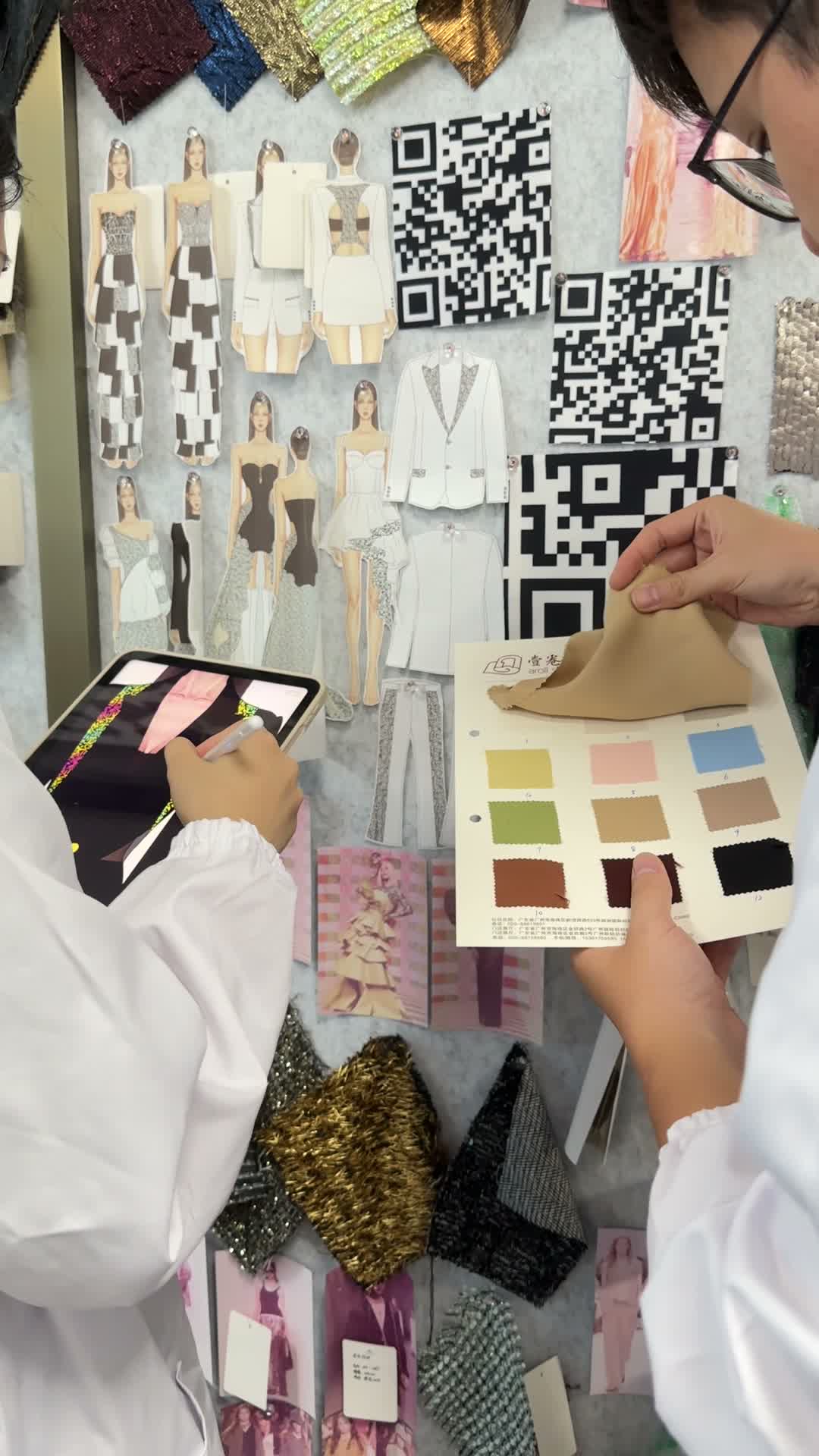
A private label clothing manufacturer sees the same seven fabrics on nearly every first order, and the same four mistakes.
The seven are viscose, polyester, linen, cotton-linen, satin, spun rayon and TR suiting. Four of them we say yes to for a 30-piece run without a conversation. The other three need a reason.
The constraint is not the 30-piece garment minimum. It is the fabric minimum, usually 100 m, and that is what actually decides a first collection.
The 7 fabrics we run, and the minimum each one needs
Stock colours: 50 m. Dyed to order: 100 m, and 300 m if the mill has to match a Pantone on a new base cloth.
30 dresses at 1.6 m each is 48 m. You are under the minimum before you start, which is why the first decision is colour, not style.
We keep about 40 stock colourways across these seven fabrics for exactly this reason.
Viscose: the drape you want and the 4% shrink you pay for
Viscose at 135 gsm is the fabric most first collections should start with. It drapes, it takes colour, it presses, and it is $3.20 to $5.50 a metre.
It also shrinks 4% to 6% on the first wash. We buy 6% extra and cut after a wash test, not before.
A viscose dress cut without a wash test comes back 3 cm short at the hem. We have seen it, we have fixed it, and we now refuse to skip the test.
Polyester: the honest case for it at 30 pieces
Polyester at 120 gsm is $2.20 to $3.80 a metre, holds colour, does not shrink, and travels well. For a first run on a tight budget it is not a compromise.
What it does badly is breathe. A polyester dress in a humid market feels wrong within ten minutes.
We suggest polyester for linings, travel pieces and anything under $150 retail. Above that, the customer notices.
Linen and cotton-linen: the crease you design around
Pure linen at 190 gsm is $7 to $11 a metre and creases from the first hour. Cotton-linen at 55/45 and 175 gsm creases less and costs $5 to $8.
Both shrink 3% to 5%, and both need a relaxed silhouette. A fitted linen dress looks tired by lunchtime, and that is a design problem, not a fabric defect.
We cut linen 2 cm longer in the body and 1 cm wider in the seam allowance to absorb the shrink.
Satin: when the face is the product
Satin is the only fabric on the list where the surface is the design. If the style needs shine, nothing else substitutes.
19 momme silk is $18 to $21 a metre and 120 gsm polyester satin is $7 to $9. Both need French seams and careful pressing.
We wrote a separate guide on how satin fails at 30 pieces, because it will find every weak point in a run.
Spun rayon and TR suiting: the two workhorses
Spun rayon at 140 gsm is $3.00 to $4.50 and behaves like a softer viscose with less shine. It is our default for printed styles.
TR suiting at 65/35 and 240 gsm is $6 to $9 and holds a crease. It is the only fabric here that will make a $180 jacket look like a $180 jacket.
Both are stable, both are cheap to test, and both reorder cleanly.
Fabric for a first collection: the 4 questions that decide it
One, what does the garment have to do: drape, hold a shape, or shine. Two, what retail price are you defending.
Three, can you accept 4% to 6% shrinkage and design for it. Four, will you reorder in the same colour within 8 weeks.
Those four answers eliminate three of the seven fabrics in about five minutes.
How fabric choice moves a quote by 40%
A 30-piece dress run in polyester satin at $8 a metre uses 48 m, about $384 in fabric. The same run in 19 momme silk at $20 uses $960.
On a $58 garment that is $13 against $32 of fabric, before cutting, sewing or trims. The retail price cannot be the same.
This is why we ask for a target retail price before we quote fabric. It is a faster conversation than three rounds of samples.
What we say no to in a first run
Sequinned fabric, heavy stretch knits, and anything with a 300 m minimum. All three are real fabrics, and none of them belong in a first 30-piece order.
We also say no to a fabric we cannot test. If we cannot wash it, press it and measure it inside a week, we cannot quote it honestly.
The alternative is a stock colourway in one of the seven. It is less exciting and it ships.
How much fabric for 30 dresses
48 m at 1.6 m a garment for a sleeveless dress, 62 m at 2.05 m for a long sleeve with a lining. Add 8% cutting loss and 6% shrinkage allowance.
That is 55 m and 71 m of usable cloth, which is why a 100 m minimum is less wasteful than it sounds when it covers two styles.
Two styles from one fabric order is the single best cost decision a first collection can make.
We quote from 30 pieces across all seven fabrics, and our private label program covers fabric sourcing, labels and packing as one scope.
The FAQ covers minimums and lead times, and the case studies show a first collection built from two fabrics.
Our A1 assistant, in training and coming online later this year, is being taught to match a tech pack to the closest stock fabric before a human reads it.
Go deeper: how a small brand buys 100 metres · choosing a weight before you order · cotton-linen at 30 pieces
Questions we get about this
Can I buy my own fabric and send it to you?
Yes, and about a third of our clients do. Send 10% more than the consumption we quote, plus a 1 m test piece. We inspect it on arrival and we tell you within a day if it will not run.
What if I only need 40 metres?
Then we work from a stock colourway, where the minimum is 50 m. A dyed-to-order 40 m is usually not possible, and we would rather say so than take the order and delay it.
Quick Take
100 m. The dyed-to-order fabric minimum, and the real limit on a first collection, not the 30-piece garment MOQ.
4% to 6%. How much viscose shrinks on the first wash, which is why we buy 6% extra and test before cutting.
40%. How far the fabric line moves a quote between polyester satin and 19 momme silk at the same 30 pieces.
About UP Fashion
UP Fashion is a Guangzhou garment manufacturer founded in 2016, run by a team with 20+ years of OEM experience in silk, viscose and tailoring. We quote from 30 pieces, show the rate we used, and inspect three times before shipping.