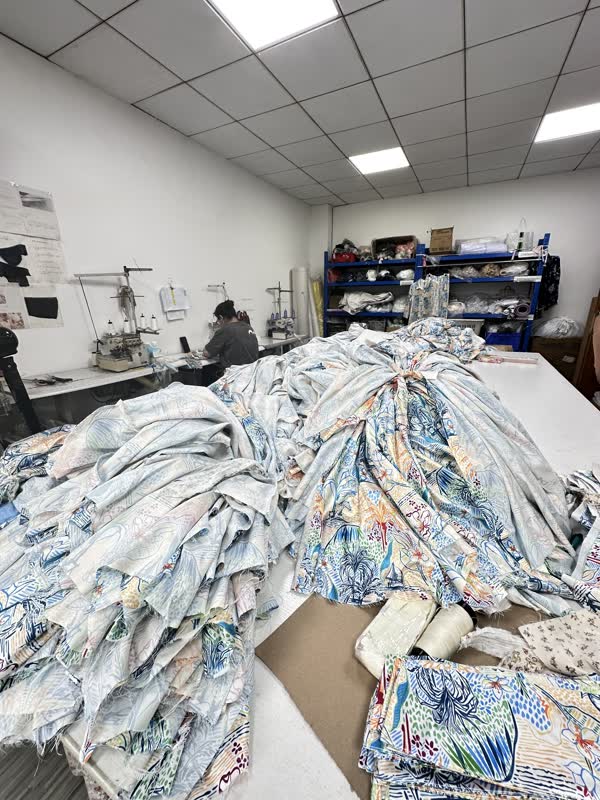
Fabric is 30 to 45 percent of your garment cost, and it is the part a small batch clothing manufacturer cannot fix for you. Mills sell by the roll, not by the dress, and a brand with a 50-piece order needs about 120 metres, not 1,000. Here is how to buy at that size without paying a penalty for it.
The short answer: buy stock fabric from a mill or a trading house, accept a roll minimum, and skip custom dyeing until your reorder. Custom dyeing at 100 metres does not exist at a fair price. If your design truly needs a colour that is not on the market, plan for 300 metres minimum and a five-week lead time.
Why mill minimums exist and what they really are
A mill does not sell cloth. It sells machine time. Setting up a loom or a dye bath takes hours, and the mill charges for the run rather than the metre, so 100 metres costs almost as much to produce as 600.
Real minimums in Guangzhou today: stock fabric, no minimum, sold by the roll or cut by the metre. Dyed-to-order in a mill's existing quality, 300 metres per colour, sometimes 600. Custom weave or knit, 800 to 1,500 metres. Custom print, 500 metres per design.
Stock fabric vs dyed-to-order: three fabric minimums
Stock fabric is cloth the mill already runs and keeps. You choose from a card, pay by the metre, and can often take 100 to 150 metres next week. The trade-off is that you do not pick the exact shade, and another brand can buy your fabric the week after.
Dyed-to-order means the mill dyes a base quality to your colour. You get the shade you asked for and a lab dip record on file, but you commit to 300 metres minimum and three to five weeks.
Custom fabric means the construction is yours, whether a specific weave, weight or blend. This is where the 800-metre minimum lives, and it belongs on a second order, not a first one.
How to buy 100 metres without paying mill prices
Three routes work. Buy a full roll of stock fabric, usually 50 to 100 metres, and take the whole roll so you get one dye lot. Or buy from a trading house that stocks mill qualities and sells cut lengths at a small premium, often 6 to 10 percent.
Or buy from the fabric market. In Guangzhou, a 100-metre order at the market runs about $4.20 a metre for a mid-weight viscose, against $3.80 at 300 metres and $3.40 at 600. The market also lets you buy 20 metres in three colours to test, which is a real advantage at your size.
One warning: the same "viscose" at $2.80 and at $4.20 is not the same cloth. Check weight in GSM, shrinkage after one wash, and whether the shade holds. Ask for a half-metre swatch cut from the exact roll before you commit to 100 metres.
What a sampling charge is and when it comes back
Mills charge for a lab dip or a sample metre, usually $80 to $200, and most credit it back if you order above 300 metres. Below that, the charge stays. Budget it as a cost, not a deposit.
Ask for the swatch to be cut from the production roll and kept on file with a lot number. If the bulk does not match the swatch, that lot number is your evidence. Without it, the conversation becomes an opinion, and opinions cost weeks.
Deadstock and job lots: the honest trade-offs
Deadstock is leftover cloth from another brand's run, sold cheap. It can be excellent, a $9 silk-blend at $3.50, and it arrives with three problems: you may only get 80 metres, the shade may drift across the roll, and there is no reorder, ever.
We made this mistake with a client in 2022. They bought 60 metres of deadstock linen to save $1.10 a metre. The shade ran two tones from one end of the roll to the other and the last 12 garments did not match the first 20. We should have inspected the roll before it shipped and told them to walk away.
Deadstock works when the style is a limited drop, the colour is close to something you can live with, and you never plan to reorder. It fails the moment a stockist asks for the same dress in six weeks.
What to do if you cannot find your fabric at 100 metres
Change the fabric, not the factory. There are thousands of stock qualities in viscose, polyester, linen, cotton-linen, satin, rayon and TR suiting. A 5 percent weight change or a half-shade difference is usually invisible to a customer and very visible on your invoice.
Or split the order. Make 50 pieces in one stock colour now, then place the 300-metre dyed-to-order in the colour you actually wanted once the style has sold. You pay the setup twice, but you pay it with money instead of risk.
Start with our small batch program if you want the quantity side worked out, and our cut and sew service page if you plan to supply your own cloth. The FAQ page answers the sourcing questions we get most, and the case studies page lists orders with the fabric and metre counts behind them. Our production process page shows where fabric approval sits in the three stages. The Fashion Pains Solver we are bringing online soon is built to catch a sourcing problem before it becomes a production problem.
Go deeper: fabric sourcing: the 6 places your order goes wrong · why two rolls from the same dye lot don't match · cost per garment: the 6 lines your quote won't show
Questions we get about this
How much fabric should I order for 50 pieces?
Start from consumption per garment, not from a rule of thumb. A lined viscose dress takes about 2.1 metres including marker allowance, so 50 pieces needs roughly 105 metres. Order 120 to allow for a faulty roll or a small cutting error, and keep the balance labelled with its lot number.
Can I send my own fabric to a factory?
Yes, and it changes the relationship. When you supply the cloth, the factory is not responsible for a shade or weight fault in it, only for cutting and sewing it correctly. Send a metre to test first, confirm the roll count on arrival, and ask for a fabric inspection record before cutting starts.
Quick Take
Buy stock first, dye later. Dyed-to-order starts at 300 metres per colour. Stock fabric has no minimum and gets your first 50 pieces made this month.
Price falls in steps. A mid-weight viscose runs about $4.20 a metre at 100 metres, $3.80 at 300 and $3.40 at 600. Know the step before you negotiate.
Deadstock is cheap for a reason. No reorder, drifting shade and short metres. It suits a one-off drop, not a style you plan to restock.
About UP Fashion
UP Fashion is a Guangzhou garment manufacturer founded in 2016, run by a team with 20+ years of OEM experience in silk, wool and embroidery. We run small MOQ production from 30 pieces per style in viscose, polyester, linen, cotton-linen, satin, rayon and TR suiting, and we work with brands that buy their own fabric as readily as brands that ask us to source it. Every order is quoted line by line and inspected three times before it ships.





