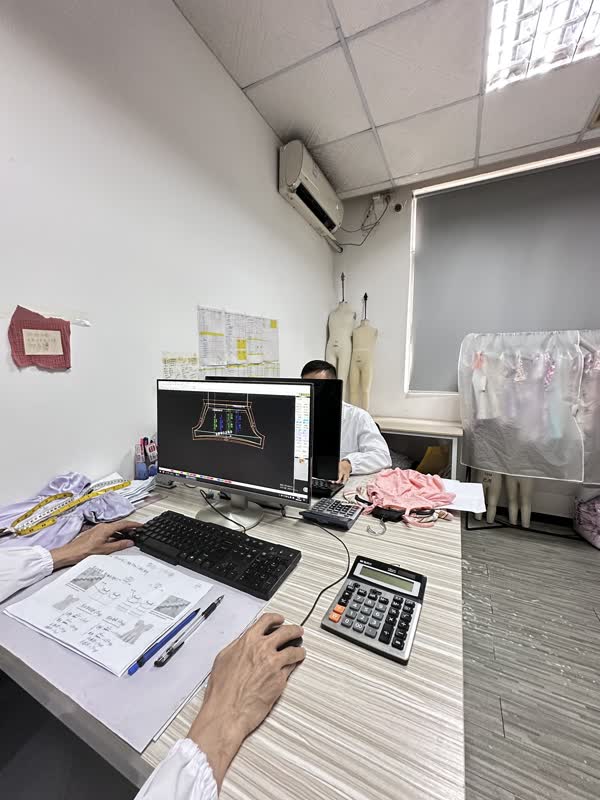
Sample fits beautifully at size 8. Bulk arrives and size 14 is unwearable. Same pattern, same factory, same fabric.
This is the most common failure in small batch production, and it's almost never a sewing problem. It's grading.
Grading is not scaling
Software can scale a pattern. Type in a percentage, get a bigger version. Fast, free, and wrong for anything past one or two sizes either side of the sample.
Bodies don't scale proportionally. A size 14 isn't a size 8 multiplied by 1.2, the proportions change. Bust to waist ratio shifts. Shoulder slope changes. Rise behaves differently from inseam. A grade table that applies one rule across all points will drift further the further you go from the base size.
Hence: fine at 8, acceptable at 10 and 12, broken at 14.
The drift is measurable
We check grade increments point by point, not as a single number. A grade increment table should specify, per measurement point, how much is added per size, and those increments should not be uniform.
Where it usually breaks:
- Armhole and sleeve crown. Uniform grading shrinks the armhole relative to the body. Size 14 ends up tight under the arm even though the chest measures right.
- Rise on trousers. Grade rise and inseam with the same increment and the seat pulls on larger sizes.
- Ease. This one is subtle. Ease, the gap between body measurement and garment measurement, is a design decision, not a constant. Grade it as a constant and a size 14 wears like a size 38 with the same nominal spec.
- Extremes on stretch. A standard grade table on elastane fabric compounds error. The fabric recovers differently at different widths, so the same increment produces different results across the size run.
Size sets exist for this reason
One mock-up tells you nothing about grading. You need a size set, samples at the base size and at both extremes, made in the actual production fabric, after the grade table is applied.
It costs more and it takes longer. It also catches the problem when it's still a pattern adjustment, not 400 finished garments.
What to measure
Agree a measurement standard before sampling, in writing. Which points, how measured, tolerance per point. Sounds pedantic until you discover your "across chest" is measured flat and the factory's is measured on the round, and every garment is 2cm "wrong" in both directions depending on who's holding the tape.
We use a fixed point list and record every size on every order. It's a boring document. It ends arguments.
Inclusive sizing is a separate discipline
If you're running past a straight size range into extended or inclusive sizing, grade from a separate block. Extending a size 8 block to a size 22 rarely works, because the body proportions diverge too far from the base. It's more pattern work up front. It's the difference between a size range that sells and one that generates returns.
We'll tell you if a range you've planned is going to fight you. Better in week one than week ten.
Go deeper: 5 production mistakes: skipping the size set
Questions we get about this
Why does my size 14 not fit when size 8 fits perfectly?
Almost always grading. Software scales a pattern proportionally, but bodies don't scale that way, bust-to-waist ratio and shoulder slope change. The error grows the further you go from the base size.
What is a size set and do I need one?
Samples at the base size and both extremes, made in production fabric after grading. Yes, you need one, a single mock-up tells you nothing about how the size run behaves.
Can I use one grade table for stretch and woven fabrics?
No. Elastane recovers differently at different widths, so the same increment produces different results. Stretch needs its own calibrated grade table.





