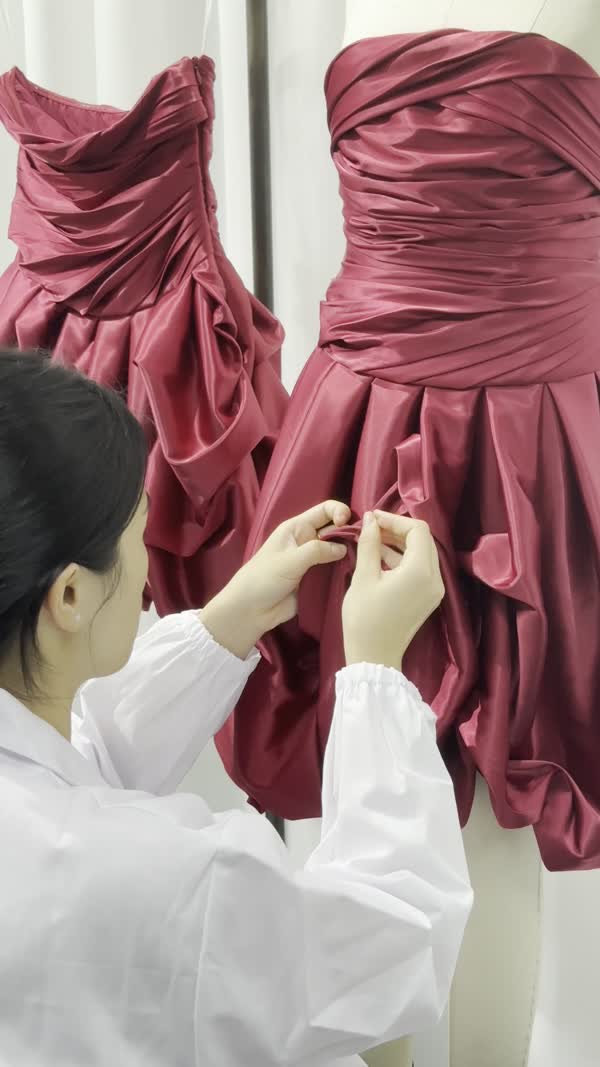
Ask a high end clothing manufacturer for 30 evening gowns and most will quote 300. The reason is rarely the sewing. It is the lining, the structure, the length and the fabric minimum: four decisions that get expensive at small quantity, and four you can settle before you ask for a price.
What does a 30-gown run actually need? One fabric decision, one lining decision, one structure decision, one length decision. Fix those four and the number usually comes down by a quarter to a third without changing how the gown looks on a body.
Lining choice: silk, cupro or viscose on a 30-gown run
Lining is the first lever and the one brands resist. Silk lining runs $9 to $14 a metre, cupro $6 to $9, and a good viscose or polyester lining $3.50 to $5.50. A floor-length gown takes 1.6 to 2.2 metres of lining.
Moving from silk to cupro saves roughly $5 to $8 a gown and keeps the breathability and the drape. Moving to viscose saves more, and it is a real downgrade on a garment a customer wears against bare skin for four hours.
Our default on evening wear is cupro. It presses cleanly, it does not squeak under satin, and at 30 pieces the saving pays for one mock-up round.
Structure and boning: what a small run can and cannot do
Boned bodices are normal work for us at 30 pieces. Spiral steel in a channel is not a minimum-quantity item: the channel is sewn, the boning comes by the roll, and the cost is labour rather than material.
What a small run cannot do is hand beadwork. We do not offer hand beading at any quantity, because the labour is unpredictable and a 30-piece order has no way to absorb a 40-hour overrun. Machine embroidery we do run, and it is quoted per 1,000 stitches so you can see the cost before you commit.
If your design depends on dense hand embellishment, we are the wrong factory. Say so on the first call and save us both a month.
Length and hem: where an evening gown eats fabric
Length is the quiet cost. A floor-length gown cut from 140 cm wide fabric needs 2.6 to 3.2 metres per garment once you allow for nap, matching and the hem. A midi needs 1.9 to 2.3 metres.
That 0.8 metre difference is $3 to $6 per gown in fabric and a visible change in how much cloth you must buy. Across 30 gowns it also decides whether you sit under a 100-metre order or over it.
Ask for the marker before you approve the length. We send the marker lay for approval on evening wear, because a 4 cm hem change can move the fabric requirement by 12 metres across a run.
Fabric minimums and dye lots at 30 pieces
Stock satin, crepe and viscose have no minimum. Dyed-to-order starts at 300 metres per colour, which is ten times what 30 gowns need. That single number is why small evening wear brands should design around stock cloth first.
If you must dye, use one colour across two styles. Splitting 300 metres between a gown and a slip dress brings the deadstock down and gives you a second SKU from the same dye lot.
Ask for the dye lot on the invoice. We held a satin delivery four days in 2021 over a double shade on one roll, and four days beats 30 gowns that do not match each other under stage light.
What we refuse to make
Two categories, so you can rule us out early: wool outerwear and knitwear. Hand beading we also decline at any volume. Our fabrics are viscose, polyester, linen, cotton-linen, satin, rayon and TR suiting.
We do not take single-piece couture either. The three-stage process we run depends on a bulk run behind the sample, and a one-off gown is a different trade with different skills.
Cost at 30 gowns, line by line
A viscose or crepe column gown with cupro lining and no boning: roughly $52 to $70 per piece at 30 units, 8 to 10 weeks including two mock-ups. A satin gown with a boned bodice and a full lining: roughly $78 to $110.
At 300 pieces the same satin gown falls to about $58 to $80, and the gap is setup rather than sewing. Pattern making, grading, two mock-ups and a final sample cost the same at 30 as at 300.
We got this wrong once. In 2020 we ran a 30-piece gown order and did not test the boning under the finished lining weight until the second mock-up. Six gowns had to be re-cut. Structure now gets tested on mock-up one, every time, before the lining is attached.
How to brief an evening wear run
Send the reference, the target retail price, the market, and the four decisions you have already made. If the lining is not chosen yet, say so, and we will quote both options side by side instead of picking one for you.
Then ask for the marker and the trims minimums before you approve the sample. Both are cheaper to change on paper than on a cutting table.
Our high end production page lists the standards we hold on every order, including 30-piece runs. The FAQ page answers the questions we get most often, and the case studies page shows delivered evening wear orders with their numbers attached. Our production process page maps the two mock-up rounds and the three inspections. The Fashion Pains Solver we are bringing online is being built to catch a structure or lining mismatch before a sample is cut.
Go deeper: evening wear manufacturer for Gulf brands: the checklist · what a luxury clothing manufacturer does differently · fabric minimums: how a small brand buys 100 metres
Questions we get about this
Can you make 30 gowns in three different colours?
Yes if the cloth is stock, because colour then comes from the mill's existing range. If it is dyed-to-order, three colours means three 300-metre minimums, which is 900 metres for 30 gowns. Use stock cloth for a multi-colour first run and save dyeing for a style that has already sold.
How many mock-up rounds does an evening gown need?
Two on our floor, and the first one is about structure rather than decoration. Bust, waist and hip fit get checked in round one, along with the boning under the finished lining weight. Round two is the final fit and finish before the bulk run.
Quick Take
Four decisions set the price. Fabric, lining, structure, length. Settle them before you ask for a quote and a 30-gown run stops looking like a 300-piece job.
Cupro is the sensible lining. $6 to $9 a metre against $9 to $14 for silk, and it saves $5 to $8 a gown without touching the hand of the garment.
Length is a fabric decision. A floor-length gown takes 2.6 to 3.2 metres against 1.9 to 2.3 for a midi, which is where a 4 cm hem change turns into 12 metres.
About UP Fashion
UP Fashion is a Guangzhou garment manufacturer founded in 2016, run by a team with 20+ years of OEM experience in silk, wool and embroidery. We run small MOQ production from 30 pieces per style, including evening wear, in viscose, polyester, linen, cotton-linen, satin, rayon and TR suiting. Every order is quoted line by line, sampled over two mock-up rounds, and inspected three times with each garment fitted on a dress form before it ships.





