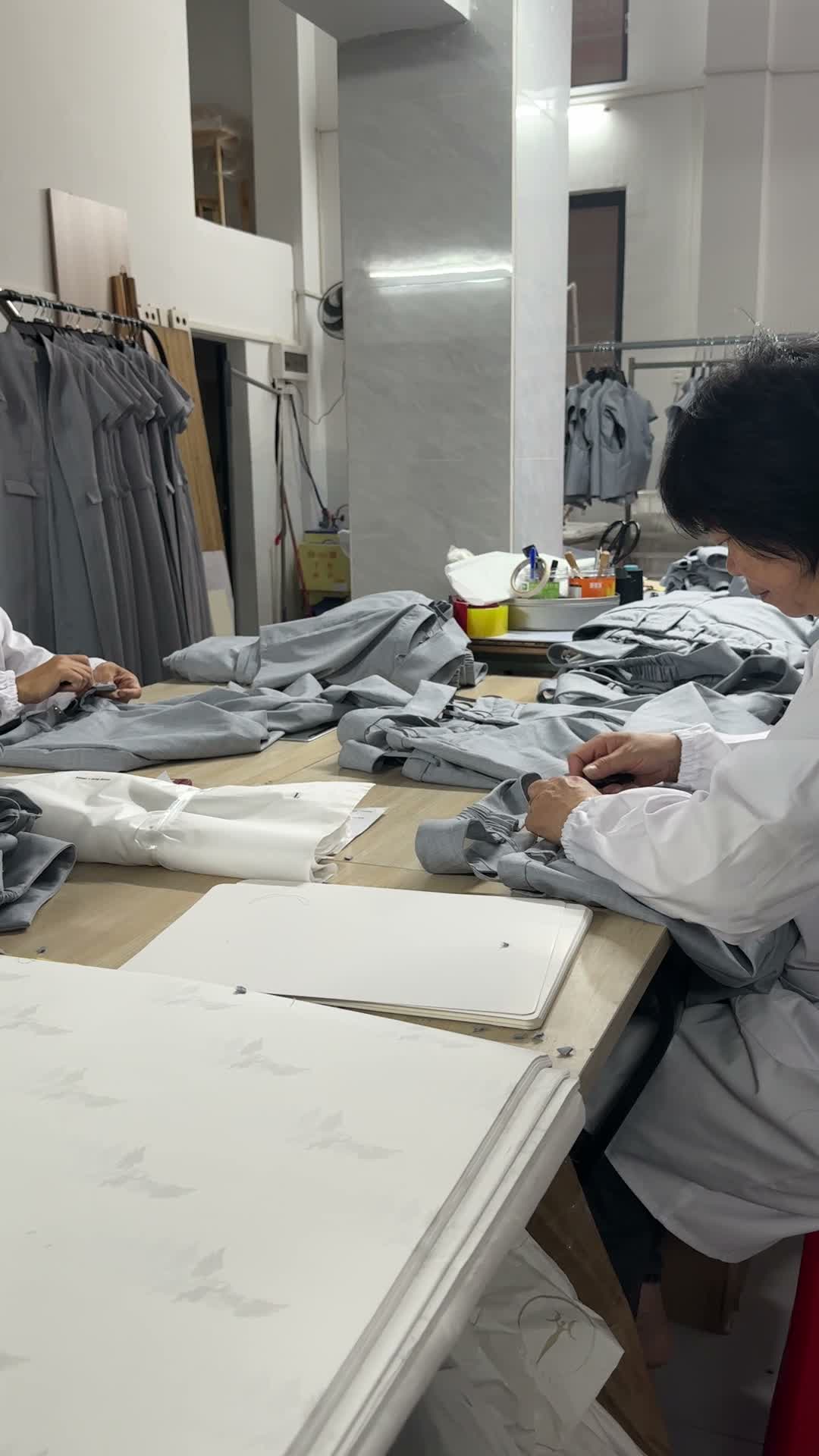
Every private label clothing manufacturer gets the same email. A buyer forwards an Alibaba listing at $6.80 and asks why our quote came back at $14.20. Both numbers are real, and neither one is a lie.
The listing is a 500-piece price for 140 gsm polyester with a printed neck label. Your quote is 30 pieces in 180 gsm viscose with a woven label, a graded size run and three inspections. Put both on the same bill of materials and the gap usually lands between $1.10 and $2.40 a piece, not $7.40.
Here is where that gap is built, the five checks that separate a factory from a trading desk, and the one case where the listing price really is the better answer.
What an Alibaba clothing supplier price actually covers
A listing price is a unit price at a quantity, and the quantity is almost never 30. Read the tier table on the page: most Guangzhou listings are built on 300 to 500 pieces, one colour, one size ratio, fabric already in the warehouse.
The word custom in those listings means your label and your hangtag. It does not mean your pattern, your grade or your fabric.
Watch the trade term as well. A listing quoted EXW leaves freight, export paperwork and port charges to you, which on 30 dresses is another $180 to $320 by air. Our quotes are FOB Guangzhou unless you ask otherwise, and the term sits on the first page.
So ask one question before you compare anything else: what quantity and what fabric weight does this price assume? Nine times out of ten the answer ends the comparison on the spot.
Why a 30 piece order breaks a listing price
Two kinds of cost sit inside a quote. One scales with quantity and one does not, and the second kind is what hurts at 30.
Pattern making, grading, two mock-up rounds and one final sample cost the same at 30 as at 500. Call that fixed cost $1,500 and it is $3 a piece at 500 and $50 a piece at 30. Same work, divided sixteen times thinner.
Fabric has a floor of its own. The mills we buy from sell 200 metres minimum, and 200 metres of 150 cm viscose yields roughly 180 dresses. At 30 pieces you are buying for 180 whether you want to or not.
Trims have floors too. Woven labels arrive in 1,000s, custom zips in 500s, and the surplus sits on a shelf with your name on it until the reorder.
Five checks that separate a factory from a trading desk
Roughly a third of the suppliers you will meet on a sourcing platform are trading companies. That is not automatically bad, but the price and the accountability are different.
- A single unbroken video call. Ask to walk from the cutting table to the sample room to the sewing floor without hanging up. A trading desk cannot do that and will offer a photo album instead.
- The style number and date on a pattern card. A factory keeps one for every style it has made. Ask to see one from a style that is not yours.
- What they refuse to make. We say no to hand-beading and to knitwear on the first call. A supplier who says yes to everything has not read your garment yet.
- The mill and the price per metre. Ask which mill the fabric comes from and what they paid for it. A trading company quotes you a fabric price, a factory quotes you a mill.
- The business licence scope. Chinese licences carry a scope line, and 生产 (manufacture) reads differently from 贸易 (trade).
A $4,100 mistake we made in 2021
A brand sent us a spec sheet copied from a listing and we quoted from the sheet without asking for a physical swatch. The bulk fabric arrived 22 gsm lighter than the sample we approved.
We re-cut 30 dresses in the correct weight and ate $4,100 and nine days. The sheet was not wrong. We were, for trusting a document over a piece of cloth.
No quote leaves this building now without a named mill, a gsm figure and a swatch photo with the date written on it.
When the Alibaba price is the right answer
Sometimes it is. If you need 120 pieces of a stock style in a stock fabric in three weeks, a listing will beat us on both price and speed, and we will say so.
That is a wholesale purchase rather than a production run. You are buying someone else's design decisions, and you will meet your neighbours selling the same dress at a lower retail.
What you give up is the rework clause. A listing will replace a defective garment, and it will rarely re-cut 30. If the style is a test and the loss is survivable, that is a fair trade.
How to compare two quotes without a spreadsheet
Ask both suppliers for the same 12 lines: fabric with gsm and mill, lining, interlining, thread, labels, hangtags, packing, cutting, sewing, finishing, QC, freight.
Then ask how many times each garment is inspected. A quote that inspects once and a quote that inspects three times are not competing on the same product, whatever the total says.
If a supplier will not break the price into lines, you are not comparing quotes. You are comparing two numbers and hoping.
One more line is worth asking for: what the quote excludes. Sampling, third-party inspection and the sample courier are the three items most often left off a listing price and added back at deposit.
What to send us for a real number
Send the tech pack or a clear photo set, the size run, your target retail price and the ship date. We quote from 30 pieces and we print the rate we used on the quote itself.
Our private label programme starts at one style and 30 pieces. The FAQ covers fabric minimums line by line, and the case studies show what a 30-piece run actually cost.
Go deeper: why three factories quote three prices · why most factories say 300 pieces · the 12 lines that stop a fabric swap
Questions we get about this
Is Alibaba always cheaper than a Guangzhou factory?
No, but it is often cheaper per piece from 300 pieces up, because listings are built on stock fabric and stock patterns. At 30 pieces the fixed costs dominate and the two prices converge. What never converges is who owns the pattern, who inspects the garment, and who answers the phone when the fabric arrives 22 gsm light.
How can I tell if a supplier on a sourcing platform is a real factory?
Ask for four things: one unbroken video walk from cutting table to sewing floor, a pattern card for a style that is not yours, the name of the fabric mill and the price paid per metre, and the manufacture-versus-trade line on the business licence. A real factory answers all four inside a day. A trading desk answers two and substitutes photographs for the rest.
Quick Take
$1.10 to $2.40. The real per-piece gap once both quotes sit on the same 12 lines. The $7.40 difference lives in the spec, not the margin.
200 metres. Typical mill minimum, which yields about 180 dresses at 150 cm width. At 30 pieces you buy the minimum anyway.
$4,100. What quoting from a copied spec sheet instead of a swatch cost us in 2021, plus nine days.
About UP Fashion
UP Fashion is a Guangzhou garment manufacturer founded in 2016, run by a team with 20+ years of OEM experience in silk, viscose and embroidery. We quote from 30 pieces, show the rate we used, and inspect three times before shipping.





