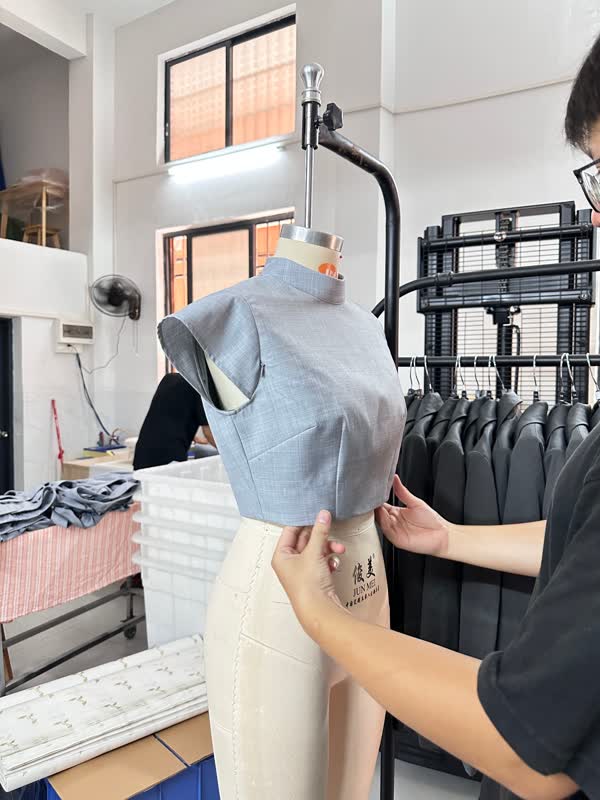
Ask any factory floor about silk and watch the room change. Silk moves under the presser foot. It slips, it snags, it shows every mistake twice. Most factories quietly raise the price or quietly decline the order.
We don't. Not because silk became easy, it didn't, but because the difficulty was never yours to carry. It's ours, and we built the whole process around that one idea.
Your part takes about twenty minutes in total
Send us your design images, front, back and side, with your target retail price. That starts fabric selection: we screen silks that match your design and price range, and mail you swatch cards. You hold them, feel them, pick one. One reply.
We quote in three to four working days. The price fits, you proceed. It doesn't, we bring different fabric options, not more homework for you.
Then the mock-up arrives. You look at it, wear it, react. Satisfied or not satisfied. If not satisfied, tell us where. If you can't say exactly where, that's fine. We diagnose it ourselves, propose the fix, and you answer one word: yes or no.
Bulk follows the approved sample. Three quality inspections, documented. Packed. Shipped. At every stage, the decision you make is the same size: one confirmation.
Our part is where silk actually gets handled
The fabric screening you never see: momme weight, filament grade, weave behaviour, we filter before any swatch card reaches your desk. You choose by hand and eye; the technical sorting already happened.
Every metre of the silk you choose is inspected at intake, and every roll is tested against a sealed colour standard before cutting. Silk takes dye unevenly, lot-to-lot variation is real, so we buy enough the first time and check each roll that arrives.
On the floor: a dedicated machine set-up before a single stitch, presser foot, feed dog, thread density, tuned to the exact thickness of your silk. Slow speed by design, because pushing silk fast puckers the seam. The iron never touches the fabric; pressing goes through a protective cloth wrap, because direct heat damages the fibre. And after every joined panel, that panel is pressed, mid-pressing (中烫), the step that keeps your bulk identical to the approved sample. Silk, wool, cotton, blends, the rule never changes.
The Yes/No principle
Here is what we've learned from the brands that scale with us: they didn't learn production. They got good at confirming.
Every stage of a silk order ends with one decision that belongs to you, satisfied or not. Everything between those decisions belongs to us: sourcing, testing, machine tuning, slow sewing, wrapped pressing, inspections, dye-lot control. You never have to learn production language to get production done.
Marketing is your job. The brand is your job. The silk is ours. That division is the whole point.
Go deeper: How every metre of fabric is checked at intake
Questions we get about this
Do I need to understand silk fabric types before ordering?
No. We screen the silks that match your design and price range, then mail you swatch cards. You choose by hand and eye, the technical filtering already happened before the cards reached you.
What do I need to send to start a silk order?
Design images (front, back and side) and your target retail price. That starts fabric selection. We quote in three to four working days once the brief is complete.
What happens if I'm not satisfied with the fabric or the mock-up?
Tell us you're not satisfied, and where. If you can't articulate exactly what's wrong, we diagnose it ourselves and propose the fix, then you answer yes or no.
Why do silk orders take longer than cotton orders?
Dedicated machine set-up per silk thickness, slow-speed sewing, cloth-wrapped pressing, and mid-pressing after every joined panel. None of these steps can be skipped without quality loss, so we quote the time honestly instead of compressing it.
Who handles dye-lot risk on small silk orders?
We do. Every metre is inspected at intake, every roll is tested against a sealed colour standard before cutting, and we tell you the colour risk upfront rather than after delivery.

Build your next collection with us.
From tech pack to delivery, we manufacture high-end dresses, blazers, and suit sets with atelier precision. MOQ 30. AQL 1.0-2.0. $250-$1,000 retail-ready garments.
Request a quote from our Guangzhou garment factoryKeep reading



Talk to our team.
Choose the person who best fits your project. Both reply within 4 hours.

