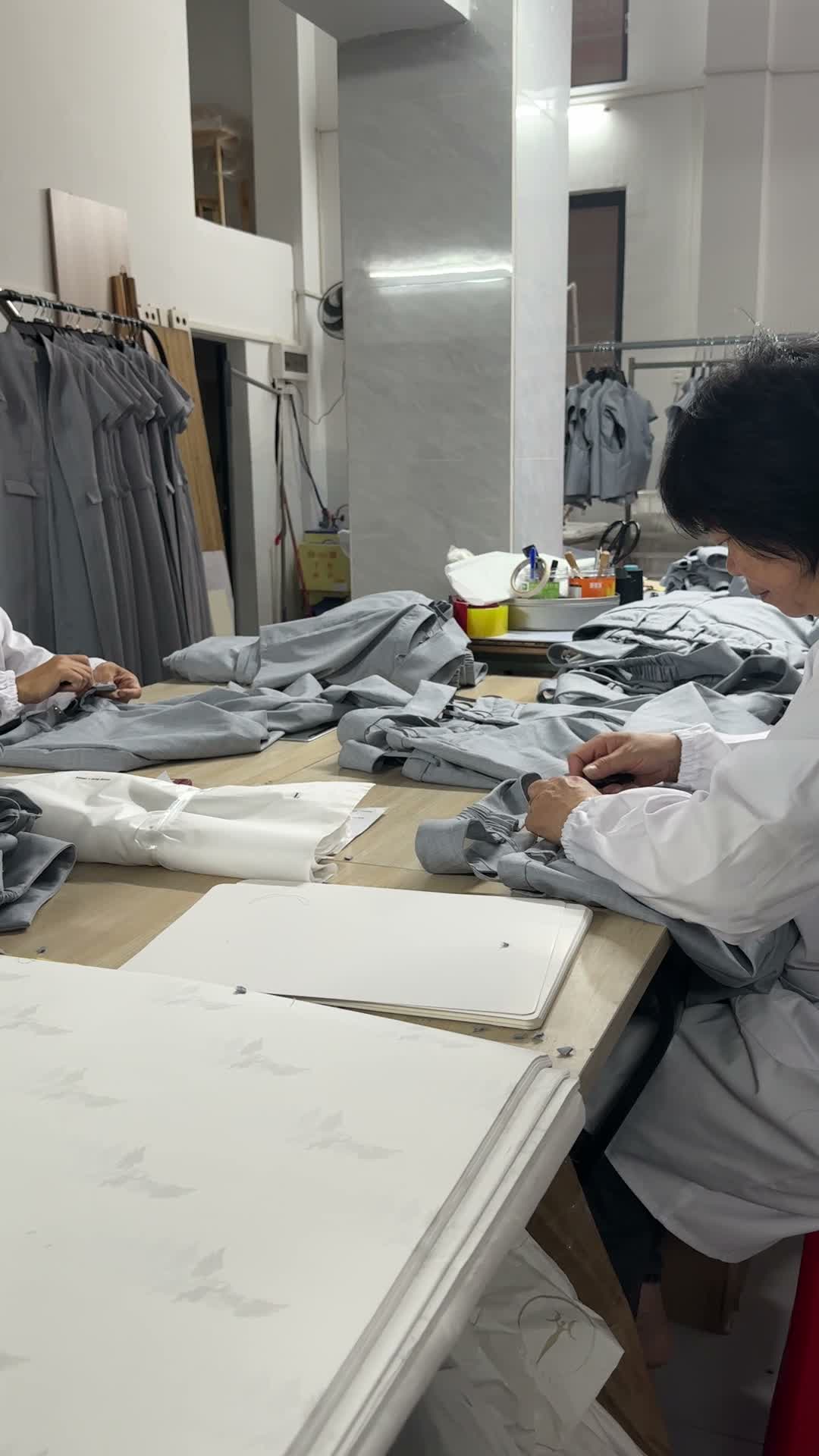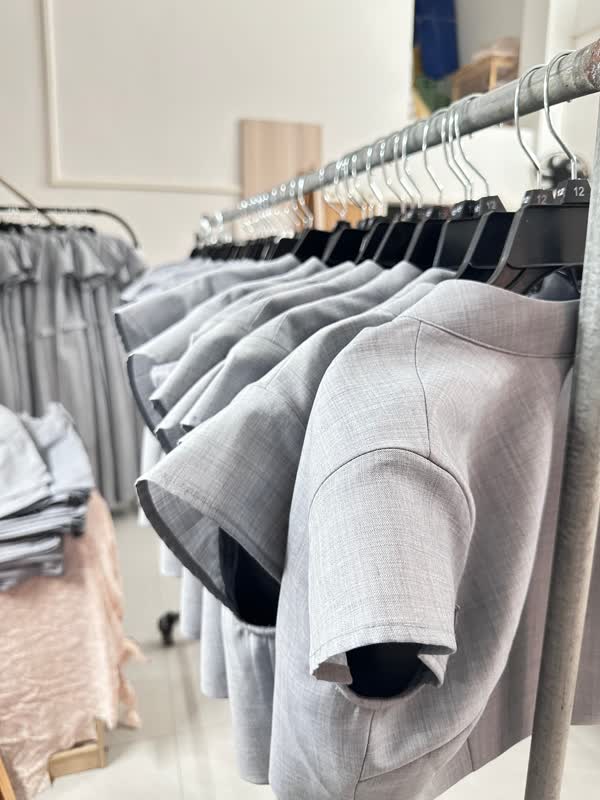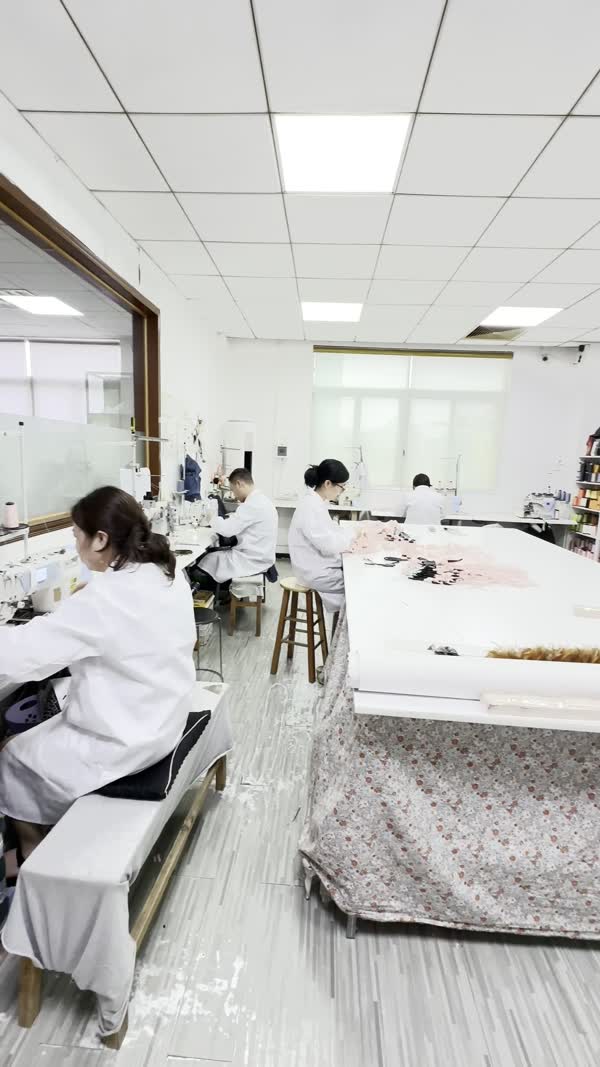
A cut and sew manufacturer charges more per piece at 30 than at 300, and sewing is not why. Cutting is. Spreading 30 pieces across four sizes takes 45 minutes of setup for about 9 minutes of blade time.
The setup does not shrink with the order. That is the whole answer. A 2,000-operator plant in Dongguan will decline your 30 pieces or quote it at double, because the same preparation runs for 600.
We cut 30-piece orders four to six times a week. Here is where the hours go, with the numbers from our own table.
What a cutting room does in the first 45 minutes
Fabric is relaxed, then laid flat and left for at least four hours so a viscose stops moving. Then it is spread in layers, squared to the selvedge, and checked for a shade bar.
The marker is plotted and pinned. On a 30-piece order that is one marker per colour, because colours are cut separately.
None of that is sewing. All of it happens before a single machine starts.
Spreading 30 pieces across four sizes
Eight to twelve layers is what a 30-piece run in four sizes needs. Spreading those layers takes 30 to 40 minutes on a viscose and longer on a satin that slides.
A 300-piece run spreads 30 to 40 layers in 70 to 90 minutes. Ten times the output for less than twice the setup.
That ratio is the entire economics of small batch, and it has nothing to do with skill.
Why a small marker wastes 15 percent of the fabric
Marker efficiency is how much of the cloth the pattern actually uses. On a 30-piece lay we run 78 to 82 percent. On a 300-piece lay we run 88 to 91 percent.
The reason is simple: fewer pieces mean fewer chances to nest a sleeve into a gap beside a bodice.
That 8 to 10 point gap is 1.5 to 2 metres per garment, and it is the largest single reason a 30-piece price sits above a bulk price.
Cost per piece at 30 pieces: the cutting share
Cutting labour on a 30-piece viscose dress is 6 to 9 RMB a garment. At 300 pieces it is 1.50 to 2.50 RMB.
Add the fabric waste and the real gap is 18 to 26 RMB a piece, before sewing is even discussed.
So when a factory quotes 30 pieces at 40 percent above the 300-piece price, roughly two thirds of that gap is the cutting table.
Why big factories decline instead of quoting high
A production line of 40 operators wants one style running for eight to twelve days. A 30-piece order occupies that line for half a day and blocks a slot.
Some plants quote double to make you go away. Others say yes, cut it, and hand it to a small unit inside the building, which is where quality drifts.
Neither is dishonest. Both are the same arithmetic: your order is small, and the setup is not.
What a small factory does differently
We cut four to six small orders a day on one table instead of one large order a week. The table is the unit of capacity, not the line.
One cutter and one helper handle the whole spread, so there is no handover between preparation and blade.
Our table is 12 metres, which is short. It caps us at about 60 layers, and it is why 300 pieces is close to our comfortable ceiling on a single colour.
Where the cutting bottleneck actually hurts you
It hurts when a brand adds a colour after approval. A fifth colour means a fifth spread, a fifth marker and a fifth 45 minutes, for maybe eight pieces.
It hurts again on a reorder of 30 in a new size range, because grading changes the marker even when the fabric does not change.
Both are normal. Both cost a day. Neither shows up until the invoice does.
Where we get it wrong
We have mis-marked a 30-piece cut and lost 6 metres, which was two garments and a week.
We have also spread a satin too fast and cut four panels off grain, which only showed after pressing.
Every marker is now plotted on paper and checked against the lay before the blade goes down. It adds 15 minutes and removes the class of error that cannot be fixed.
What to ask a factory about its cutting room
Four questions separate a factory that cuts small orders from one that tolerates them.
- How many layers can your table hold, and how many small orders run a day.
- Who plots the marker, and do you keep it for the reorder.
- What marker efficiency do you get on my fabric and my size run.
- Do you cut each colour separately, or combine.
The last one matters most. A factory that combines colours to save a spread will hand you a shade difference you cannot explain to a buyer.
Why this is good news for a 30-piece order
Cutting is fixed cost. Fixed cost is predictable, and predictable cost can be quoted honestly instead of guessed.
It also means the cheapest place to save money on a small run is the marker and the size run, not the sewing rate.
Ask for a 3-size run instead of 5 and you will see the quote move more than any negotiation over minutes.
Our cutting and sewing scope is written out on the cut and sew production page. Minimums and lead times are in the FAQ, and a 30-piece blazer run with its lay plan is on the cases page.
Our A1 assistant is in training and coming online later this year. It will estimate marker efficiency from a size run before a quote goes out.
Go deeper: how many pieces a line really sews in a day · eleven hours of sewing and nineteen days of waiting · why 8 cm of cuttable cloth changes the quote
Questions we get about this
Why is a 30-piece order more expensive per piece than 300?
Mostly the cutting table. Spreading 8 to 12 layers and plotting a marker takes 45 minutes whether the lay is 30 pieces or 300, and a small marker wastes 15 to 18 percent of the fabric against 6 to 8 percent. Sewing time per garment barely changes.
Can I cut two colours together to save money?
You can, and some factories will offer it. The risk is a shade difference between the two colours in the same lay, which is hard to explain to a buyer and impossible to fix after sewing. We cut each colour separately.
Quick Take
45 min. Setup to spread and mark a 30-piece lay, for about 9 minutes of blade time.
78-82%. Marker efficiency on a small lay, against 88 to 91 percent at 300 pieces.
18-26 RMB. The real per-garment gap at 30 pieces, before sewing is discussed.
About UP Fashion
UP Fashion is a Guangzhou garment manufacturer founded in 2016, run by a team with 20+ years of OEM experience in silk, viscose and tailoring. We quote from 30 pieces, show the rate we used, and inspect three times before shipping.