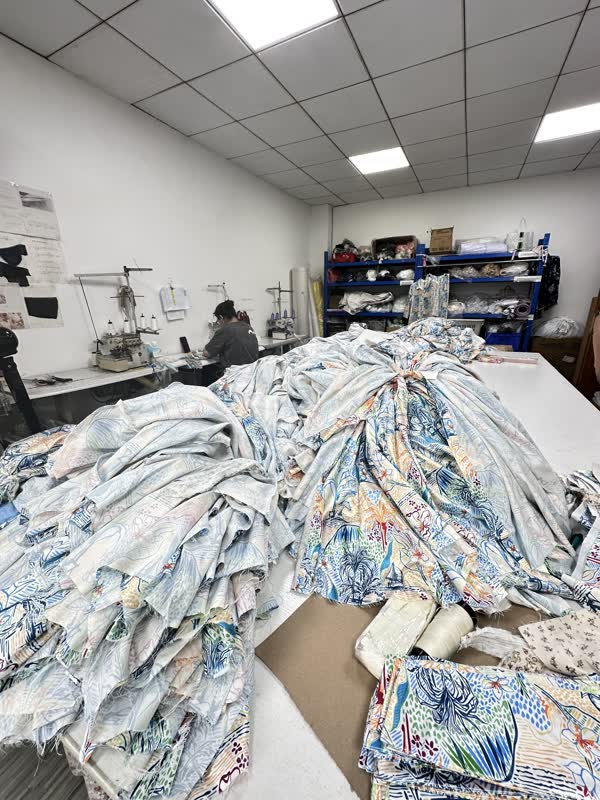
A cut and sew manufacturer quotes from the width it can actually cut, not the width printed on the roll ticket. The gap between those two numbers is usually 3 to 6 cm, and at 30 pieces that gap is real money.
Why does it matter so much? Because fabric is bought by the metre and used by the square metre. Lose 8 cm of width on a 1.9 m dress and you need 2.2 m of cloth, which is 16% more fabric for the same garment.
What cuttable width means, and why 150 cm is never 150 cm
Nominal width is what the mill prints: 150 cm. Cuttable width is what survives the selvedge, the pin holes and the edge curl, and on a 150 cm roll it is typically 147 cm.
Then shrinkage comes off. A viscose that shrinks 5% in the wash gives you 139.6 cm of usable cloth after finishing, and the marker has to be planned on that number.
Ask for cuttable width after shrinkage in writing. A supplier who cannot give you the figure has not measured the roll, and you will find out at the cutting table.
How 8 cm of width moves fabric consumption per garment
An A-line dress in our block uses 1.85 m at 150 cm cuttable. At 142 cm the same pattern needs 2.20 m, because the skirt panel no longer fits two-up across the marker.
That is 0.35 m per garment. On 30 pieces it is 10.5 m, or about $63 at $6 a metre, before any wastage allowance.
On a bias-cut slip dress the effect is worse. Width loss forces a split panel, and a split panel on bias adds a seam that shows through the drape.
Marker efficiency: where 12% of a 30-piece lay disappears
Marker efficiency is the share of the cloth that becomes garment pieces. At 30 pieces we plan on 82% to 86%; at 500 pieces the same style reaches 90% to 92%, because there are more sizes to nest together.
Narrower cloth drops efficiency before it drops anything else. The marker cannot rotate a panel to save 4 cm if the grain line forbids it, so the loss goes straight into consumption.
This is one reason a small run costs more per piece, and we show the efficiency figure on the quote rather than hiding it inside the fabric line.
Shrinkage allowance: the 5% that sits inside the width
Viscose and rayon move 4% to 6% in length and 2% to 4% in width after the first wash. Cotton-linen moves less in width and more in length.
We add the allowance to consumption, not to the pattern. Shrinking the pattern instead gives you a garment that fits before washing and does not after.
On 30 pieces of viscose at 1.9 m each, a 5% allowance is 2.85 m of extra cloth. Small in isolation, and the reason a quote without it comes back short.
Selvedge and holes: the 2 cm you pay for twice
Selvedge is 1 to 1.5 cm each side and cannot be used: it is tighter, thicker and often printed with the mill's own marks. Pin holes from the stenter add another 5 mm.
So you buy 150 cm and cut 147 cm, and the 3 cm you paid for goes in the bin at the end of the lay. On 400 m that is 12 square metres of cloth nobody wears.
Some mills will quote a lower price on 140 cm goods. Run the consumption maths before you accept it, because the cheaper metre is often the dearer garment.
Directional prints and nap: when width stops mattering
On a directional print or a nap fabric like velvet, every panel must run the same way. Rotation is off the table, so the marker loses the flexibility that width normally buys.
In that case 10 cm of extra width may return nothing at all, and you should plan consumption from the panel count instead of the width figure.
We flag this at quotation. A print that reads fine on a swatch can add 18% to a dress order, and nobody wants to discover that after the deposit.
Bolt-to-bolt variation: why two rolls of one article differ
The same article from the same mill can arrive at 148 cm and 145 cm in one shipment. Finishing tension differs between dye lots, and width is the first thing to drift.
We measure three places on every roll at goods-in and record the narrowest. The marker is planned on the narrowest roll, not the average, or the last 8 metres of a lay come up short.
On a 30-piece run with four rolls, that single check has saved us a re-order twice this year.
The 2023 run where we bought 142 cm cloth
A client specified a 100% viscose crepe at a price we could only hit on 142 cm goods. We quoted consumption at 150 cm because that was the width on the swatch label.
At cutting we were 38 m short on a 400 m order. We bought an emergency roll at a different lot, which meant a visible shade difference on 11 dresses, and we remade them.
The cost was $410 and nine days. The lesson was cheap compared with what a shade difference does to a stockist relationship, and since then width is confirmed on the proforma, not the swatch card.
What to put in writing before you buy fabric
Ask for cuttable width after finishing, shrinkage by direction, and the narrowest roll in the shipment. Put all three on the purchase order.
Ask whether the article is piece dyed or yarn dyed. Yarn-dyed stripes lose more width to skew than solid piece-dyed cloth, and the marker has to allow for it.
Then ask your factory for consumption at that width, not at the nominal one. If the number does not move, the factory is quoting from habit rather than from a marker.
Our cut and sew program quotes consumption from a real marker at the confirmed width, and the FAQ explains what we need from you to do it. The case studies include the viscose run we had to remake.
Go deeper: where 12% of your cloth goes in the cutting room · why a bias slip dress needs 30% more fabric · the 4-point inspection that rejects 100 metres
Questions we get about this
Can you quote fabric consumption before I choose a mill?
We can, from an assumed 147 cm cuttable width and a 5% shrinkage allowance, and we mark it as an estimate. The number firms up once you send the mill's spec sheet with cuttable width and shrinkage, and it can move 8% either way.
Is it cheaper to buy 140 cm fabric and accept the waste?
Usually not. A 140 cm cloth at 6% less per metre still costs more per garment when consumption rises 16%. The only case where it wins is a style whose panels already fit inside 140 cm, like a straight skirt or a simple top.
Quick Take
147 cm. What a 150 cm roll actually cuts after selvedge and edge trim, before shrinkage.
0.35 m. Extra cloth per A-line dress when cuttable width drops from 150 to 142 cm.
$410 and nine days. What quoting from a swatch label instead of a measured width cost us in 2023.
About UP Fashion
UP Fashion is a Guangzhou garment manufacturer founded in 2016, run by a team with 20+ years of OEM experience in silk, viscose and embroidery. We quote from 30 pieces, show the rate we used, and inspect three times before shipping.





