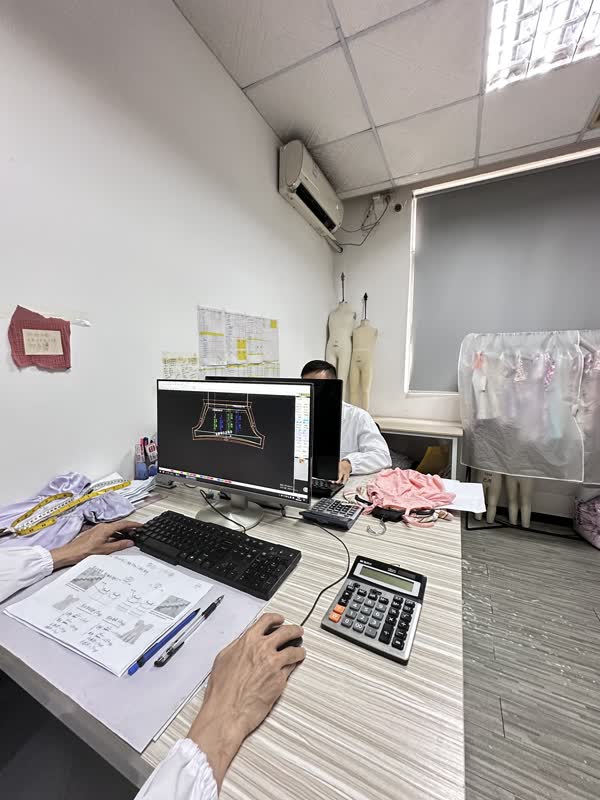
How much fabric does a bias-cut slip dress really need? About 30 per cent more than the same style cut straight, plus 48 hours of hanging before the hem is levelled. A high end clothing manufacturer should give you both numbers before you approve a quote, because both are real costs.
Why does a bias dress cost more at 30 pieces? The fabric is laid at 45 degrees, the marker wastes more, and the dress keeps growing for two days after it is sewn. None of that shows in a photo. All of it shows on the invoice.
Bias cutting: what 45 degrees does to a marker
On grain, a marker uses 82 to 88 per cent of the fabric you buy. On bias, the same panels use 62 to 70.
You cannot mirror a bias panel. Every piece must run the same way, so the lay has gaps that no nesting will fill.
A straight-cut slip in 140 cm satin takes about 1.9 metres. The same slip on bias takes 2.6.
At $6 a metre that is $4.20 a dress, or $126 across 30 pieces. It is the cheapest part of the difference.
Why a bias-cut slip dress grows after it is sewn
Viscose and satin relax on the bias. A 120 cm dress can hang 2 cm longer in the first day and another 5 mm in the second.
We hang every bias garment on a rail for 48 hours before the hem is marked. Heavy viscose gets 72.
If a factory hems at the machine and ships, the customer gets that growth instead of you.
Ask for the hanging time in the sample notes. If it is not written down, it did not happen.
Seam twist and the 6 mm stay tape
Bias seams twist because the two panels pull in different directions. A centre back seam can walk 8 mm off line by the hem.
The fix is directional cutting plus a 6 mm clear elastic or stay tape in the neckline and armhole.
Without the tape, a bias neckline opens 1 to 2 cm after two wears and no amount of pressing brings it back.
We tape every bias style, samples included. It costs about $0.25 a garment.
Fabric choice: satin, viscose and crepe on the bias
Not every fabric wants 45 degrees. Poly satin slips beautifully and holds a clean drape, but it shows every needle mark.
Viscose crepe is the most forgiving on the bias and the least stable in length.
A tight polyester is the worst case: it has no give, so you pay the bias waste and get none of the movement.
We cut a 20 cm square on the bias, hang it 24 hours and measure. Above 3 per cent growth, we add to the pattern.
Cutting a 30-piece bias run in our own room
A 30-piece bias run is one lay, and parts of it are cut single ply. That is slower than a stacked lay, not faster.
The table time is 6 to 8 hours for a style that would take 2 on grain.
We cut, hang, then mark hems. The schedule carries three days for that and we do not compress them to win a date.
On 30 pieces the extra cutting is about $3 a garment, before the extra fabric.
Prints, stripes and why bias hates a repeat
A print on the bias cannot match at the side seam. The repeat runs at 45 degrees, so it lands differently on every panel.
Stripes are worse. They will chevron at the centre front whether you planned it or not.
If the design needs matching, it is not a bias style. We say that at quote stage, not after the mock-up.
Solids and tonal textures are where bias earns its money.
Bias cut and the size chart: where measurements drift
Measure a bias dress the day it is sewn and it will read 2 cm longer a week later. That is not a grading error, it is physics.
We measure after the 48-hour hang and write the hang date on the spec sheet, so a later check compares like with like.
Grading on the bias is not linear. A size 14 grows more than a size 8 because there is more bias length in the panel.
Our tolerance is 1 cm on length for bias styles, against 6 mm on a straight cut. Anything tighter is a measurement argument, not a fit problem.
If a buyer measures the sample against a straight-cut size chart, every size will look long at the hem and short at the waist.
The 40 slips we hemmed too early
In 2018 we cut 40 viscose slips on bias for a London label and hemmed them the day they came off the line.
They grew 2.3 cm in the carton. All 40 went back to the table, and the launch slipped a week.
The rework cost us about $6 a piece and the client lost her first stockist appointment.
Now the hanging rail is written into the production sheet before the cutter starts.
What to ask before you approve a bias sample
Four questions: how much extra fabric, how long is it hung, what holds the neckline, and where is the hem marked.
A factory that answers all four without checking has probably not cut much bias.
Ask to see the hanging rail. It is a length of pipe and some hooks, and it tells you more than any brochure.
Our high end production line cuts bias single ply and hangs every piece before hemming, the case studies show a 30-piece slip run from marker to carton, and the FAQ answers who pays when a bias garment arrives long.
Go deeper: how much fabric one garment takes · why panels twist after washing · what a mock-up round should prove
Questions we get about this
Can you cut a bias slip from 30 pieces without a hanging rail?
No. Without hanging, the hem is a guess. We would rather add three days to the schedule than ship a dress that grows in the carton.
Does bias work on a print if I accept mismatched seams?
It can, if the print is small and all-over. Large motifs will break at every seam and the dress will read as a mistake rather than a choice.
Quick Take
30 per cent more fabric. A 1.9 m straight slip becomes 2.6 m on bias.
48 hours on a rail. Viscose grows up to 2 cm after sewing. Hem after the hang, never before.
6 mm stay tape. $0.25 a garment, and the only thing that keeps a bias neckline closed.
About UP Fashion
UP Fashion is a Guangzhou garment manufacturer founded in 2016, run by a team with 20+ years of OEM experience in silk, viscose and embroidery. We quote from 30 pieces, show the rate we used, and inspect three times before shipping.





