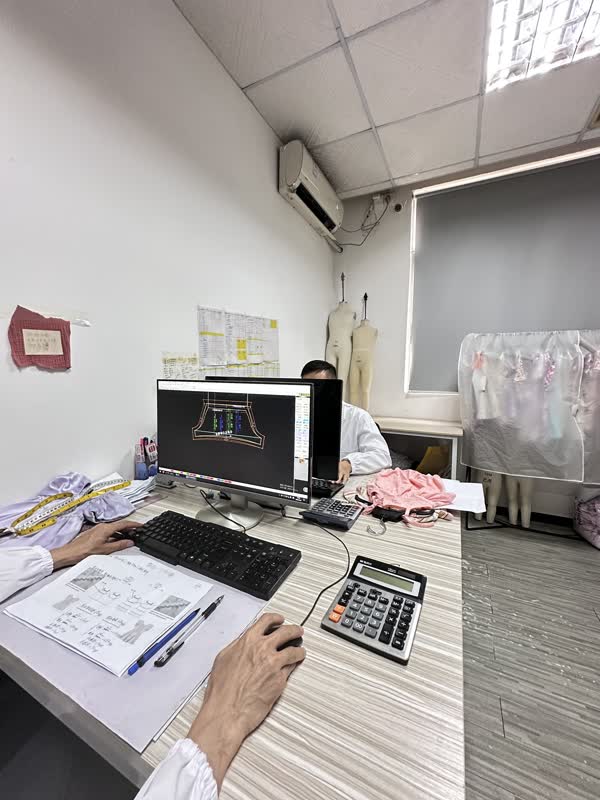
A peplum is a flared band joined at the waist, and where that join sits decides the proportion of everything above and below it. Brands arrive at a cut and sew manufacturer with a sketch and a line drawn at the hip, and our first note is usually to move that line up 3 cm.
What does a peplum add to a 30-piece order? $2.20 to $3.60 a garment lined, plus 0.2 m of cloth, plus one seam that carries four layers. It is a cheap idea and an expensive seam.
Here is where the join should sit, why the waistline drops after a day on a hanger, and the blazer where it dropped 7 mm.
Where a peplum should sit on the waist
At the natural waist it defines a waist. Two to three cm above the natural waist it lengthens the leg, which is what most sketches actually want.
Below the natural waist it starts hiding the hip, and on a 165 cm fit model that reads as a dropped waist rather than a peplum.
We mark all three heights on the toile and photograph them side by side. The difference is obvious in a photo and invisible in a flat drawing, which is why brands approve the wrong one.
How much flare reads as a peplum
8 to 14 cm of extra circumference at the hem, measured against the waist seam. Under 8 cm it reads as a seam, over 14 cm it reads as a skirt tier.
The flare is usually split across four to six seams so the cloth falls in folds rather than a cone. A single flared panel at 12 cm looks like a lampshade.
Cloth decides the rest. On a stiff TR at 240 gsm, 10 cm of flare stands away from the body. On viscose at 120 gsm the same 10 cm collapses. Same number, different garment.
Four layers at one seam: where the bulk goes
Bodice, bodice lining, peplum and peplum facing all meet at the waist. That is eight layers at the seam allowance, and it shows as a ridge on a light fabric.
Three ways out: a 6 mm turn instead of a full facing, a separate waistband that covers the join, or graded allowances that stack in different places.
We default to the 6 mm turn on silk and viscose, and a 3 cm waistband on TR. The waistband costs $0.30 and hides more than any amount of pressing.
Why the waist seam drops after 24 hours
A lined TR peplum adds 150 to 200 g hanging from one seam. Cloth creeps under that load, and the waistline drops 5 to 8 mm in the first day on a hanger.
We cut the bodice 5 mm short to compensate, and add a 6 mm grosgrain stay inside the waist seam on anything over 180 gsm.
Without the stay the drop keeps going: 7 mm on day one, another 3 mm by the end of the first week of wear. The garment is not wrong on the day it is approved, which is the trap.
Peplum length: 15 cm or 25 cm
15 to 18 cm sits at the high hip and reads as a ruffle on a fitted dress. 20 to 22 cm is the classic peplum jacket proportion.
Past 25 cm it becomes a tier, and a tier needs its own flare ratio or it looks like a mistake rather than a design.
Length is measured from the waist seam, not from the hem of the garment. Two brands have sent us the second number and received a peplum 6 cm short.
Bias peplum: it swings, then it grows
A bias peplum moves with the body and photographs beautifully. It also grows, about 1 cm per 20 cm of length after a day of hanging.
We cut bias peplums 8 mm short and let them hang 24 hours before levelling the hem. That is a day in the schedule, and it is not negotiable.
On a 30-piece run that day is cheap. On a 300-piece run it is a planning problem, and we will say so at quotation rather than after cutting.
What a lined peplum costs at 30 pieces
$2.20 to $3.60 a garment in labour: four pieces cut instead of two, one seam with graded allowances, and a press done on a curved ham.
Cloth is 0.15 to 0.3 m a garment for the peplum and its facing, so $2 to $4 at $12 a metre.
Total $5 to $7.60 on a $120 wholesale dress. The peplum is rarely the line that breaks a budget, and it is often the line that makes the dress read as a $300 dress.
The blazer where the waist dropped 7 mm
In 2022 we ran 30 TR blazers with a lined peplum at the natural waist. After 24 hours on a rail, the waist seam had dropped 7 mm on 11 of them.
The pattern had no stay, the peplum was 22 cm long, and the cloth was 250 gsm. That seam was carrying 190 g.
We re-pressed, took up 6 mm at the seam on eleven jackets, and lost two days. Every peplum over 180 gsm now gets the grosgrain stay, which costs $0.40 and is invisible.
What to send us for a peplum spec
Six numbers: waist join height above the natural waist, peplum length from the seam, hem circumference, how the flare is split, cloth weight, and whether it is lined.
Add the grain direction if you care about swing. A straight-grain peplum falls in folds, a bias one swings, and they are different garments at the same measurements.
One photo of the reference with a tape across the waist join settles height faster than a technical drawing. We measure the photo, confirm, then cut the toile.
Our cut and sew program toiles every peplum at the three waist heights before the pattern is graded. The FAQ covers construction pricing, and the case studies include the eleven re-sewn waist seams.
Go deeper: why a 30-piece skirt never swings the same · who tries on your sample · the 65/35 blend behind a $180 jacket
Questions we get about this
Should a peplum sit at the natural waist or above it?
Two to three cm above the natural waist suits most sketches, because it lengthens the leg and still defines the waist. At the natural waist it reads more tailored and works better on a jacket. Below the natural waist it starts hiding the hip and reads as a dropped waist. We mark all three heights on one toile and photograph them, because the difference does not show in a flat drawing.
Why does my peplum waistline sag after a few days?
Weight. A lined TR peplum adds 150 to 200 g hanging from one seam, and cloth creeps under load, so the waist drops 5 to 8 mm in the first day on a hanger. Cut the bodice 5 mm short and add a 6 mm grosgrain stay inside the waist seam on anything over 180 gsm. Without the stay the drop continues into the first week of wear.
Quick Take
3 cm. How far above the natural waist most peplums belong. Below it, the design starts hiding the hip instead of defining it.
8 to 14 cm. The flare range that reads as a peplum. Under 8 cm is a seam, over 14 cm is a tier.
7 mm. How far eleven waist seams dropped in 24 hours in 2022. A $0.40 grosgrain stay now goes into every peplum over 180 gsm.
About UP Fashion
UP Fashion is a Guangzhou garment manufacturer founded in 2016, run by a team with 20+ years of OEM experience in silk, viscose and embroidery. We quote from 30 pieces, show the rate we used, and inspect three times before shipping.





