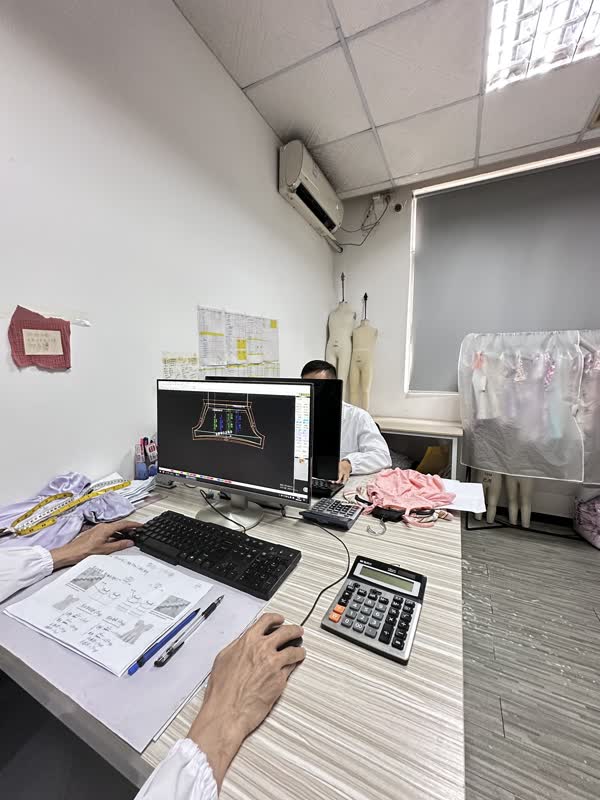
A cut and sew manufacturer cuts the yoke before anything else on a shirt, and a 2 cm error there is not a 2 cm error on the body. It becomes a shoulder that pulls, a back that billows and a collar that stands away from the neck.
What does a yoke actually control, and why does the same pattern fit two brands differently? Depth, slope and the split. Get those three right and a $180 shirt sits like a $400 one. Get them wrong and no amount of pressing helps.
This is the spec we write, the numbers we check, and the run where 2 cm cost us 30 shirts.
What a shirt yoke does that a shoulder seam cannot
A yoke is the double layer across the back shoulders, running shoulder seam to shoulder seam, usually 11 to 13 cm deep at centre back.
Its job is structural. It carries the weight of the shirt from the shoulders instead of from a single seam, and it hides the shoulder seam allowance so the inside looks finished.
It also holds the back width. Without a yoke, a shirt back stretches across the blades and the side seams walk forward. That is why a cheap shirt feels tight in the back and loose at the waist at the same time.
One-piece or split yoke: the cost difference at 30 pieces
A one-piece yoke is cut as a single panel with no centre seam. A split yoke is two mirrored halves joined at centre back.
The split costs about 8 minutes of extra machine time and 0.12 m more cloth per shirt. At 30 pieces that is roughly $46 across the order, and we show it as a line.
What you buy for it is fit. Two mirrored halves let the pattern be cut on a slight bias each side, which follows a sloping shoulder instead of fighting it.
The second thing you buy is pattern matching. On a stripe or a check, a split yoke is the only way to get a chevron that reads deliberate rather than accidental.
Yoke depth: 11 cm against 13 cm, and what moves
Depth is measured at centre back, from the neck seam to the bottom edge of the yoke. Eleven centimetres is a casual shirt. Thirteen is a dress shirt and a blazer-style overshirt.
Two centimetres changes where the back seam sits relative to the blades. At 11 cm the seam crosses the shoulder blade and any drag line lands in the middle of the back. At 13 cm it sits above the blade and the drag disappears.
It also changes the collar. A deeper yoke pulls the neck seam back, which lifts the collar stand 2 to 3 mm off the neck at the sides. On a soft cotton-linen that reads relaxed. On a poplin it reads broken.
Shoulder slope and the 3.5 cm most tech packs miss
Most tech packs give shoulder-to-shoulder width and nothing else. Width tells a pattern maker where the seam ends, not where it should sit.
What we need is the drop. On a standard adult block the shoulder falls about 3.5 cm over 12 cm of width. A square shoulder is 2 cm, a sloping shoulder is 5 cm.
If the drop is wrong the yoke tilts and the whole shirt rotates. You see it as a collar that gapes at one side and a front placket that swings off centre after three washes.
We ask for two photos now: front and side, arms down, in a shirt that fits. That is enough to set the drop within 4 mm without a physical fit session.
Why cotton-linen needs a deeper yoke than poplin
Cotton-linen at 55/45 has almost no recovery. It does not spring back after it stretches, so the yoke has to carry the load with depth rather than elasticity.
We run cotton-linen at 13 cm minimum, and we interface the yoke with a 40 gsm fusible rather than the 25 gsm we use on poplin. Without it the yoke softens after two washes and the shoulder line collapses.
Poplin is the opposite. It holds shape on its own, so an 11 cm yoke with no interlining reads crisp and stays crisp. Adding the heavier fusible there makes the back boardy and it shows through in photographs.
Viscose shirting is the third case. It drapes, so a deep yoke disappears into the fold and the shirt looks sleeveless from behind. We keep viscose at 10 to 11 cm.
Stripe matching across a yoke: 3 mm and a whole panel
A yoke is the hardest place on a shirt to match a stripe. The panel is cut across the grain of the body, so the stripe runs at 90 degrees unless you plan for it.
Our tolerance is 3 mm at the join. Beyond that the eye reads it as a mistake rather than a design choice, and on a 6 mm Bengal stripe 3 mm is half a stripe.
Matching costs cloth. On a 30-piece run in a striped cotton we allow 0.4 m extra per shirt, which is 12 m across the order.
If the budget will not carry it, the honest answer is a plain yoke on a striped body. That is a design decision you can defend. A misaligned chevron is not.
Grading a yoke from size 8 to size 14
Yoke depth grows about 0.4 cm per size in our blocks. That is small, and it is exactly why it gets missed.
When a pattern is graded on body width alone, the yoke stays the same depth while the back gets wider. At size 14 the yoke is proportionally too shallow and it pulls across the blades.
We grade yoke depth and shoulder drop together, never separately. On a 30-piece run split across five sizes, that is the difference between size 14 selling and size 14 coming back.
The run where 2 cm made 30 shirts unwearable
In 2022 we ran 30 cotton-linen overshirts with a 10 cm yoke. The sample was a size 8 and it looked right. Bulk went out across sizes 8 to 16.
Every size 14 and 16 pulled 6 mm across the back when the wearer raised an arm, and the side seam walked forward by a centimetre. Nine shirts were returned by the stockist.
The fix was a re-cut yoke at 13 cm for the top three sizes, which meant re-cutting 12 shirts from new cloth. We absorbed the cloth and the sewing.
The lesson was not about linen. It was that we approved a yoke on one size and shipped five. Now every yoke is checked on the largest graded size before bulk.
How we check a yoke on the fit model
Arms down, we measure the distance from the neck seam to the yoke edge at centre back and at both shoulder points. The three should agree within 4 mm.
Arms raised, we look for lift. A correct yoke allows 2 cm of lift before the hem moves. If the hem moves first, the yoke is too shallow.
Then we sit down. A yoke that is too deep folds at the neck and pushes the collar up under the chin, which is the failure nobody catches standing.
Finally we photograph the back under a raking light. Drag lines show there before they show to the eye, and a photo settles arguments six weeks later.
What a yoke costs in fabric and machine minutes
A one-piece yoke uses 0.18 m of cloth on a 145 cm width. A split yoke uses 0.30 m because the two halves cannot share a marker line.
Machine time is 5 minutes for a one-piece and 13 for a split, including the centre seam, topstitch and press.
Across 30 shirts the whole yoke operation is between 2.5 and 6.5 hours. It is not where your money goes, which is why it is where attention usually stops.
Our cut and sew service writes yoke depth, shoulder drop and split detail into the pattern block, not the spec note. The FAQ covers what we need to grade a style, and the case studies show a shirting run we graded across five sizes.
Go deeper: fit comments that get fixed in one round · why pattern versions drift · the shirt collar band
Questions we get about this
How deep should a shirt yoke be?
Eleven centimetres at centre back for a casual shirt, thirteen for a dress shirt or an overshirt. Cotton-linen needs the deeper end because it has no recovery and the yoke has to carry the load with depth. Viscose shirting goes shallower at 10 to 11 cm, or the yoke disappears into the drape.
Is a split yoke worth the extra cost at 30 pieces?
About $46 across a 30-piece order, for 8 extra minutes and 0.12 m of cloth per shirt. It is worth it on a sloping shoulder, because the two mirrored halves can each be cut on a slight bias. It is also the only way to get a deliberate chevron on a stripe or check. On a plain poplin, a one-piece yoke is fine.
Quick Take
11 to 13 cm. Yoke depth at centre back. Two centimetres decides whether the back seam lands on the blade.
3.5 cm over 12 cm. The shoulder drop we need and most tech packs leave out.
9 of 30 returned. Our 2022 overshirt run, approved on size 8 and shipped to size 16.
About UP Fashion
UP Fashion is a Guangzhou garment manufacturer founded in 2016, run by a team with 20+ years of OEM experience in silk, viscose and embroidery. We quote from 30 pieces, show the rate we used, and inspect three times before shipping.





