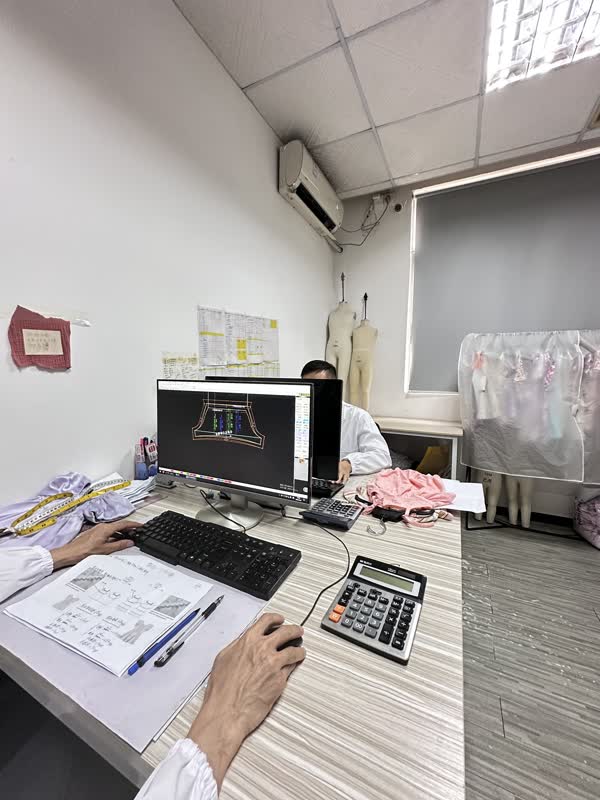
As a private label clothing manufacturer the question we answer most often at 50 pieces is the size split. Ten of each is where almost every brand starts, and it is usually the wrong answer.
Sell-through is not flat across sizes. When 60% of your sales land in M and L, a flat split sells out in the middle and leaves you holding the edges. At 50 pieces you cannot fix that with a reorder inside the season, so the split is a one-time decision.
The retail size curve: why a flat split loses money
Across the womenswear we produce, the curve that repeats is roughly XS 5%, S 15%, M 30%, L 30%, XL 20%. On 50 pieces that is 3, 7, 15, 15 and 10.
That is a starting point, not a rule. A brand selling to a younger customer skews to S and M; a brand selling into a market where sizing runs generous skews to L and XL.
Ask your stockist what they sold last season before you ask us to cut. Their answer is worth more than any published curve.
What 50 pieces can and cannot cover in sizes
Fifty pieces across five sizes is ten each, and ten each sounds balanced. Add a second colour and it becomes five per size per colour, and the cutting room is laying a marker for five units.
Below about eight pieces per size per colour, the per-piece cost climbs faster than the retail price of the garment justifies. That is arithmetic, not policy.
What 50 pieces cannot do is cover five sizes and three colours with any depth anywhere. Something has to give, and the cheapest thing to give up is a size, not a colour.
Cutting constraints: markers, lays and the cost of one more size
Every size adds a grade and a block on the marker. A four-size marker at 50 pieces uses around 88% of the cloth. A five-size marker at the same quantity drops to about 84%.
Four percent on a 50-metre order is 2 metres, roughly $14. That is not the real cost. The real cost is the extra grading step and the extra set of measurements in quality control.
Grading runs $35 to $55 per size step at a pattern room, so a five-size run carries one more step than a four-size run. On 30 pieces that is $40 spread across ten garments.
Grading cost: the $35 to $55 that arrives before any cloth
Grading is priced per size step, not per garment, which is why the fifth size is disproportionately expensive on a small run.
If your first order is 50 pieces, four sizes is often the honest answer: 12, 14, 14 and 10. You cover the middle properly and you learn your curve from real sales.
The second run then buys the fifth size with data instead of a guess.
Packing ratios: what a stockist actually orders
Stockists buy in ratio packs, not single units. A common pack is 1/2/2/2/1 across five sizes, eight pieces. If your split cannot be packed that way, your stockist re-packs it and charges you the handling.
Design the split so it divides into the pack you want to sell. Fifty pieces does not divide into eights, so the last pack is short and somebody absorbs it.
We flag this before cutting, because a short pack discovered at packing is a conversation nobody enjoys.
Two colours, three sizes: the trade 50 pieces forces
If the style needs two colours at 50 pieces, drop to three sizes and put 16, 18 and 16 into each colour. You lose the edges and gain depth where it sells.
If it needs five sizes, run one colour at 3, 7, 15, 15 and 10. Depth in the middle is what pays for the run.
There is no version of 50 pieces that gives you five sizes, three colours and depth. Anyone offering all three is quoting a number they cannot cut.
What we recommend for a first run of 50
Four sizes, one colour, 12/14/14/10, with the fifth size graded but not cut. The pattern is ready, the grade exists, and the second run adds it in a week.
If the brand already has a stockist asking for a specific pack, build the split around that pack instead. A confirmed order beats a curve every time.
Our A1 agent is still in training, being built to read a sell-through file and suggest the next split. It is not online yet, so today this is a fifteen-minute conversation with us and a spreadsheet.
When the split is wrong, what it costs to fix
In 2020 a brand ordered 50 pieces flat at ten per size. M sold out in 19 days, and 14 XS units sat for nine months before being marked down 40%.
The loss was not the markdown. It was the cash that could have been 14 more M units in the week the style was working.
We now ask for a sell-through estimate in writing before cutting a first run. Half the time it changes the split, and asking costs nothing.
Our private label program grades five sizes as standard and cuts from 30. The FAQ covers minimums per size, and the case studies show the runs where we re-cut a split.
Go deeper: what grading does to a size 14 · who tries on your sample · bags, tags and cartons at 30 pieces
Questions we get about this
Can I order different quantities per size?
Yes, and you should. We cut by size, so the split is yours to set. The only constraint is that each size needs enough pieces to justify its own marker block and its own measurement check.
What if I only want three sizes?
Then 50 pieces buys you real depth: 16, 18 and 16. Most first-time brands are better served by depth in three sizes than by a thin spread across five, because a sold-out middle size is the one thing you cannot recover from.
Quick Take
3 / 7 / 15 / 15 / 10. A 50-piece run on a normal womenswear curve, instead of ten flat.
88% vs 84%. Marker use at four sizes and five sizes on the same 50 pieces.
14 XS, nine months. What a flat split left one brand holding in 2020.
About UP Fashion
UP Fashion is a Guangzhou garment manufacturer founded in 2016, run by a team with 20+ years of OEM experience in silk, viscose and embroidery. We quote from 30 pieces, show the rate we used, and inspect three times before shipping.





