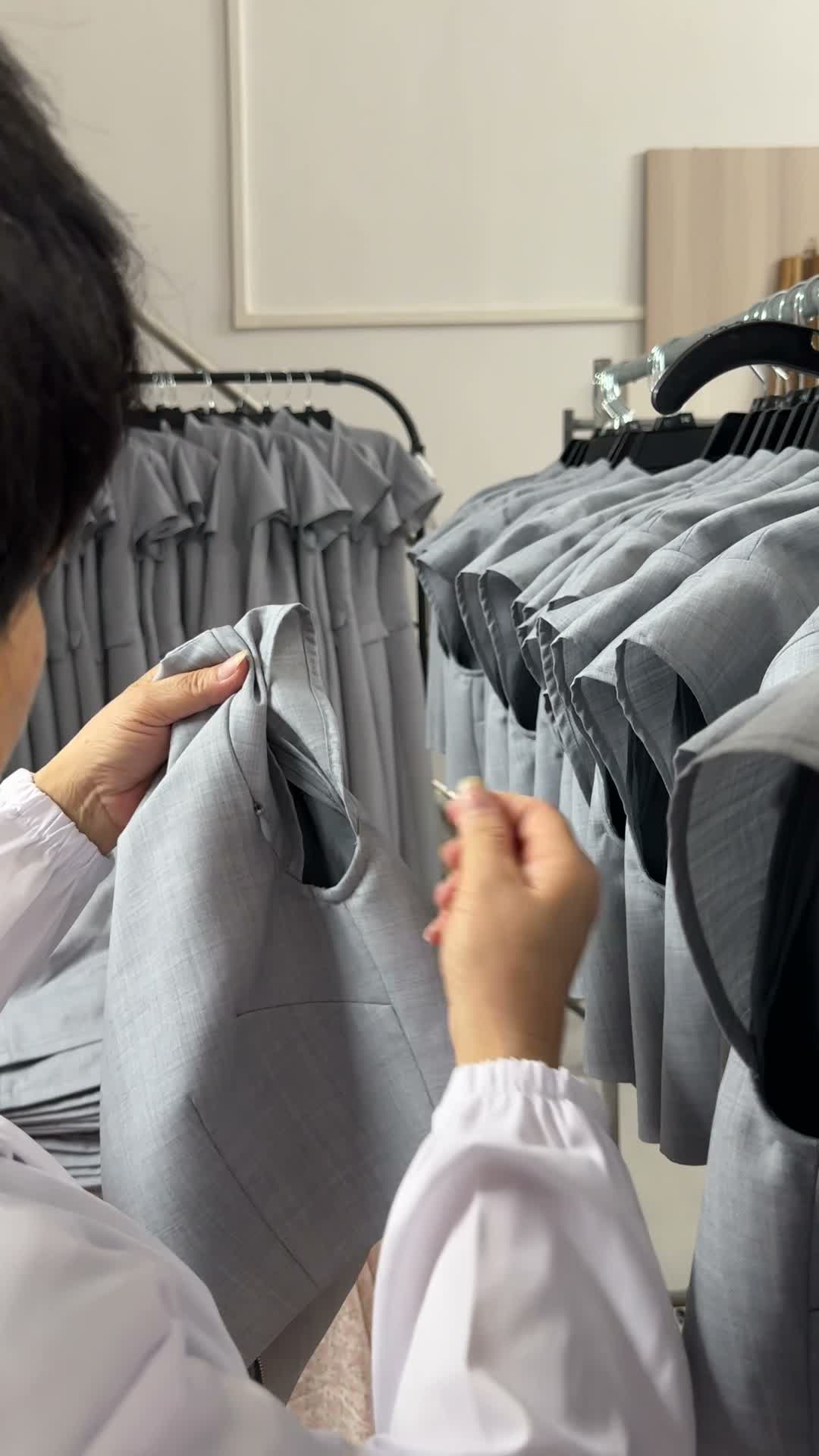
How a private label clothing manufacturer packs your order decides what your first stockist sees. A garment can be perfectly sewn and still arrive looking tired, because packing is where small brands quietly lose presentation points. The rules are not ours; most of them come from retailers and customs.
So what does packing actually involve on a small order? A polybag, a hangtag, a fold, a carton and a label. Five items, and each one has a rule attached that you can check before you approve.
Here is what we do, what it costs, and the packing mistake that cost us money at destination.
Folding, pressing and polybags: why garments arrive creased
Every piece is pressed on a board and folded to a fixed size before it is bagged. The fold size matters. A stockist with standard shelving wants a consistent rectangle, not whatever shape the garment falls into.
We use 30 micron LDPE as standard, with recycled LDPE available on request. A bag with an opening of 12.7cm or more needs a suffocation warning printed on it for the US market, and we print it as standard rather than waiting to be asked.
Creasing is where fine fabric punishes you. Satin and viscose mark along a fold and hold the mark. We tissue-paper the fold line on both, and leave polyester and TR suiting without it because they recover on their own.
In 2021 we shipped forty viscose dresses flat with no tissue. They arrived with visible lines across the bust and the retailer asked for a re-press. That cost RMB 12 a piece at destination, more than the tissue would have cost for the whole run.
Hangtags, barcodes and care labels: the retail rules
Hangtag attachment is a small decision with a visible result. A plastic barb is fast and cheap, but on fine knits it can pull a hole. String loops take longer and sit better on silk and light viscose.
Your barcode is yours, not ours. A GTIN comes from GS1, costs roughly $250 to set up, and stays with your brand. We print it on the tag, about 1cm from the edge, on the back.
Care labels are a legal line, not a design line. Fibre composition and the care symbols have to be in the language of the market you sell into, which in the EU means the member states you actually ship to. We ask for that list before the tags go to print.
On a 30-piece run, 500 is often the smallest quantity a tag supplier will print. The leftovers are normal, and it is the same pattern that catches clients on woven labels and custom bags.
What packing costs per piece on a small run
Packing is small money per piece, and it adds up. Our typical 30-piece breakdown: polybag and sticker $0.06 to $0.12, printed hangtag $0.15 to $0.40, attach labour $0.05 to $0.10, tissue and folding $0.03 to $0.06, carton and tape about $0.10.
That is roughly $0.40 to $0.80 a piece, and it is worth budgeting before you fall in love with a box. A rigid luxury box with ribbon adds $1.50 to $4.00 per piece, plus volume in the carton, which air freight charges you for twice.
The tag is usually the largest line, because it carries a print minimum. One tag design used across a whole season is the cheapest way to hold that number down.
Cartons, weights and how thirty pieces leave the building
A standard 60 by 40 by 40cm carton holds about fifteen dresses or eight lined blazers. We keep gross weight under 23kg so one person can lift it without a trolley.
Thirty dresses is normally two cartons. Each one gets a label with the SKU, colour, size ratio, quantity, gross and net weight, and a carton number, so carton 1 of 2 can be identified without opening it.
Air freight bills on volume weight, calculated as length times width times height in centimetres divided by 5000. A half-empty carton costs the same as a full one, which is why we consolidate before sealing rather than after.
The packing list and the photo that ends arguments
Every carton ships with a packing list: SKU, sizes, quantities, weights and dimensions. We photograph the open carton before it is sealed, and that photo goes into the file beside the packing list.
It is the reason a claim about a missing size or a wrong label gets settled in one email instead of two weeks. We started doing it in 2019, after a client found four cartons with mismatched labels and neither side could say where it had happened.
Packing sits at the end of a run, but it is decided at the start. Our private label service page covers what we handle, the case studies page shows finished orders, the FAQ page answers labelling questions, and the production process page shows where packing falls in the schedule.
Go deeper: how a small order actually ships · the trim minimums nobody warns you about · what to check before you release payment
Questions we get about this
Do you pack flat or on hangers?
Flat as standard. Hanger packing is possible but it costs more in freight because of the volume, and it rarely pays off below a few hundred pieces.
Can I send my own polybags and hangtags?
Yes. Send them with the fabric and we will pack to your spec. If you send fewer than we need, we will tell you before we start rather than after.
Quick Take
Tissue the fold on satin and viscose. Fold marks do not come out at destination without a re-press.
Your barcode comes from GS1. Roughly $250, in your name, and it survives a factory change.
Photograph every open carton. It settles a missing-size claim in one email.
About UP Fashion
UP Fashion is a Guangzhou garment manufacturer founded in 2016, run by a team with 20+ years of OEM experience in silk, viscose and embroidery. We quote from 30 pieces, show the rate we used, and inspect three times before shipping.





