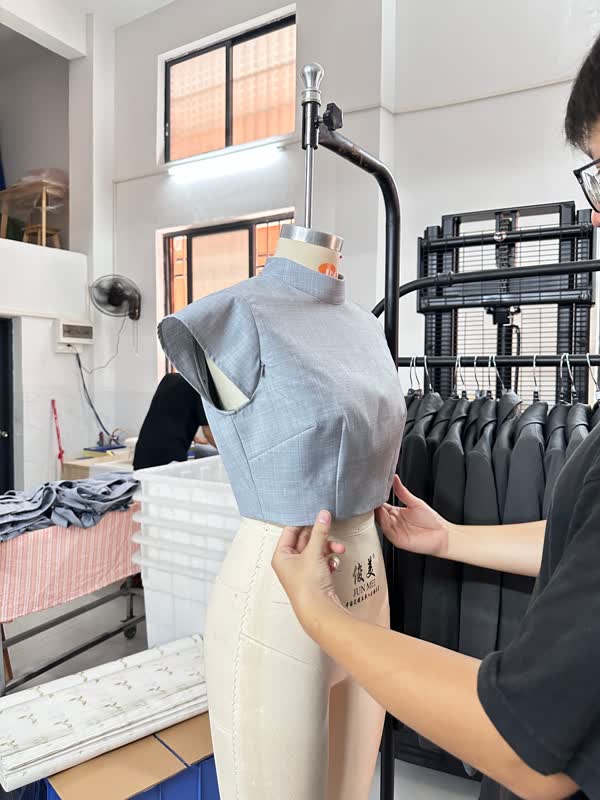
A private label clothing manufacturer should put your first fit on a calico toile, not on your final cloth. The toile is a cotton mockup that answers one question: does this pattern sit on a body. It costs us about $55 and two days, and when it is wrong it is wrong in a way you can see across the room.
What does a toile actually prove? Balance, length, neckline depth, armhole position, and where the waist sits. What it cannot prove is drape, because 150 gsm calico is stiff and your viscose is not. Treat the two as separate rounds and you stop paying for one with the other.
Why a calico toile comes before the fabric mockup
Our Process 2 runs two mockup rounds, and the first one is calico whenever the pattern is new. Round two is cut in your shell fabric once the pattern has stopped moving.
The arithmetic is blunt. A calico round is roughly $55 in cloth and labour at our line rate. A mockup in silk satin runs $180 to $240 before anyone has agreed the pattern is right.
Cutting the first fit in your own cloth means paying for mistakes in the most expensive material in the order. We have done it, and the invoice is not the part that hurts. The three lost days are.
What a cotton toile proves about balance and length
Balance is the first thing a toile settles. Hang it on a form and look at the side seam: if it swings forward at the hem, the front is short or the bust is too shallow.
We mark five lines on every toile: centre front, centre back, waist, hip, and a horizontal through the bust point. Those five give us a shared language for the fit comments that follow.
Length is where a toile saves the most money. A hem that sits 2 cm high reads fine on a pattern card and reads cheap on a body.
What a calico toile hides: drape, weight and stretch
Calico does not drape. A cowl cut in calico folds into a shape that satin will never repeat, and a bias skirt in calico hangs like a cone.
Weight changes what you see at the shoulder. 150 gsm calico reads heavier than a 110 gsm viscose, so a neckline can look stable on the toile and collapse on the garment.
Stretch is the third blind spot. Calico has none, so a shell with 3% elastane reads tight everywhere and pushes you into over-correcting the block.
How long a calico round takes at 30 pieces
Round one takes 7 to 10 days: pattern, cutting, sewing, and one fitting session with photos. Round two in your fabric takes 4 to 5 days if the pattern only needs small changes.
If round one moves the block, round two becomes a new round one. That is how a two-round sample plan turns into three weeks, and it is the most common reason a first order slips.
We put both dates on the quotation so you can see which round you are paying for.
When to skip the toile and cut in your own cloth
Skip it when you already have an approved block from a previous style in the same fabric family. Skip it on a straight-cut shift with no fitting risk and no waist seam.
Do not skip it on a bias cut, a cowl, a strapless bodice, or anything with a princess seam. Those four are where a 1 cm error becomes a remake.
If you are unsure, ask which lines the toile would test. A factory that cannot answer that is not going to read the toile either.
Reading a toile on a form and on a body
A form gives you symmetry and a clean silhouette. A body gives you movement, and movement is where the problems live.
Sit down in the toile. A waistline that digs when seated is sitting about 1 cm too high. Raise both arms: if the whole garment lifts 4 cm, the armhole is too low.
Walk across the room and watch the hem in a mirror. A hem that swings is a grain problem, not a length problem.
Toile cloth: calico, muslin or cotton voile
150 gsm calico is our default for structured pieces: blazers, tailored dresses, anything with a defined waist. It holds a shape and it shows a bad seam.
For viscose and soft satin we cut the toile in 120 gsm cotton voile instead. It costs about $0.40 more per metre and reads closer to the finished weight.
The wrong toile cloth is a quiet source of bad decisions. A stiff toile makes a soft design look unresolved, and the fix gets applied to the pattern instead of the cloth.
Photographing a toile for a client who is not in the room
Most of our clients never stand in front of the toile. We photograph it on a form at four angles, plus one close-up of each of the five marked lines.
We shoot against a plain wall at 1.5 m with the camera level at the waist. A phone photo taken from above makes every garment look short in the body.
Each file carries the round number and the pattern version in its name. That one habit ended the argument about which mockup a client had approved.
What a toile costs against a wrong bulk run
A toile is $55. Recutting an armhole across 30 pieces is 6 hours of unpicking and resewing, roughly $190, plus the cloth you cannot reuse.
In 2021 we skipped the toile on 30 viscose slips because the block was basically the same as an earlier style. The armhole sat 1.5 cm low on every piece.
We recut 30 armholes, lost four days, and shipped late. The toile would have shown it in one fitting.
What to send us before the toile is cut
Send the tech pack, the reference garment if you have one, and one metre of your shell fabric. The cloth matters in round one too, because we pick the toile weight against it.
Tell us the fit model's height and the bra you will sell with. A strapless toile fitted on a different cup size is a wasted round.
Our private label program prices the toile as its own line, so you can see what round one costs before you commit to bulk. The FAQ covers what a mockup includes, and the case studies show the slip run we had to recut.
Go deeper: why mockup rounds queue for 11 days · the 9 fields that get fit fixed in one round · what a sample actually costs
Questions we get about this
Can we skip the calico and go straight to a mockup in my fabric?
You can, and about one client in five asks. We quote it higher, because a fabric round that moves the pattern has to be cut again in the same cloth. On a new pattern the calico round usually costs less in total.
Does the toile count as one of my two mockup rounds?
Yes. Process 2 is two rounds, and a calico toile is round one. If the toile changes the block, round two is cut in your fabric and the two-round count still holds.
Quick Take
$55. What a calico toile costs us in cloth and labour, against $180 to $240 for a satin mockup.
5 lines. Centre front, centre back, waist, hip and bust. The shared language for fit comments.
1.5 cm. How far a skipped toile put the armhole out on 30 viscose slips in 2021.
About UP Fashion
UP Fashion is a Guangzhou garment manufacturer founded in 2016, run by a team with 20+ years of OEM experience in silk, viscose and embroidery. We quote from 30 pieces, show the rate we used, and inspect three times before shipping.





