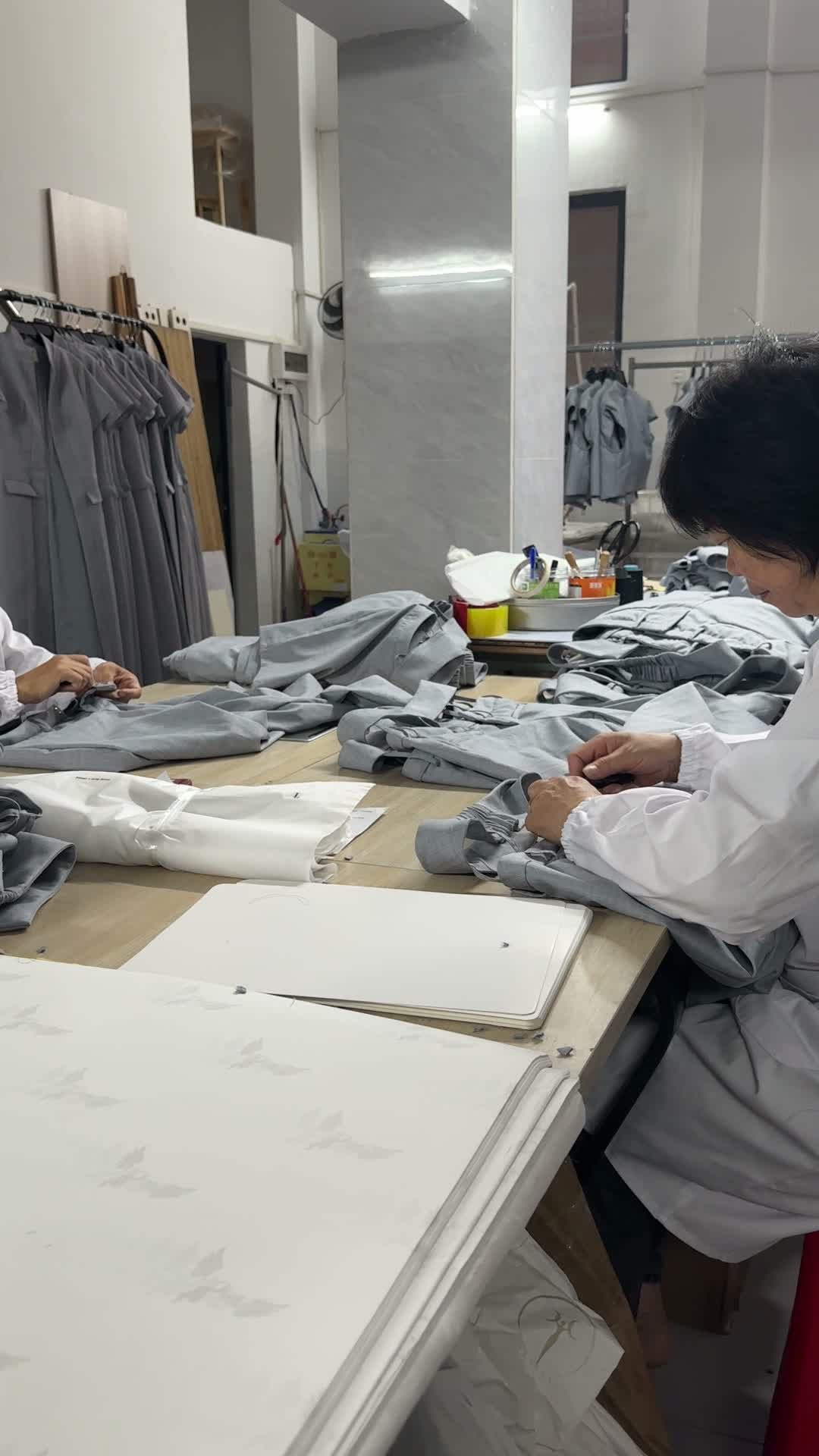
A blazer manufacturer will usually quote you 300 pieces. We run tailoring at 30, and it changes four things: pattern time, canvas handling, the number of fit checks, and how the cloth gets bought. Below is what actually shifts on a small tailoring run, in numbers.
What does a 30-piece blazer order need that a dress order does not? A fitting model with the canvas basted, three checks that only exist on tailoring, and a fabric plan that survives a 300-metre dye minimum. Get those right and 30 jackets is a normal job for a cut and sew manufacturer with a tailoring floor.
What changes on a blazer run below 50 pieces
A blazer runs 25 to 35 pattern pieces against 6 to 10 for a simple dress, and sewing time per garment is three to four times longer. The setup lines are identical at 30 and at 300, though: pattern, grading, two mock-up rounds, a final sample and a marker.
That is the whole story of the price. Below 50 pieces the setup is divided by 30 instead of 300, and the labour saving from a longer run is smaller than most brands expect, because a blazer is mostly skilled hand time rather than machine speed.
Trims follow the same logic. A jacket needs four to six buttons, two shoulder pads, a length of canvas, fusible interlining, a pocketing cloth and a back lining. Buttons and shoulder pads come by the box rather than by the garment, so a 30-piece run leaves you with spares you will use on the reorder. That is a cost, not a waste, as long as the style repeats.
Pattern pieces and canvas: where tailoring eats time
We build a half-canvas front on TR suiting: a floating chest piece, a taped front edge and a hand-set collar. Full canvas is a different trade with far more hand work, and we quote it separately rather than pretending the two are interchangeable.
Interlining is cut and fused piece by piece, and the collar goes on by hand. On a 30-jacket run that is 30 collars, and it is the slowest single operation on the floor. Nobody speeds it up by making more of them.
What we do not take: wool outerwear, knitwear, and hand beading at any volume. Our cloth list is viscose, polyester, linen, cotton-linen, satin, rayon and TR suiting.
Shoulder, armhole and sleeve pitch: the three fit checks
Tailoring has three checks a dress does not. Shoulder width holds plus or minus 0.5 cm. The armhole has to sit without pulling the chest. And the sleeve pitch has to let the sleeve hang without a twist down the front of the arm.
Round one is fitted on the model with the canvas basted and no lining, because a lining hides a shoulder fault. Round two is the finished jacket on the same model, checked with the arm raised, the arm forward, and the jacket buttoned.
We got this wrong in 2021. We quoted a 30-piece jacket order and did not test sleeve pitch until the finished sample, and eight of the 30 jackets needed their sleeves re-set. That added six days and a lot of unpicking. Pitch is now checked on mock-up one, on the model, on every tailoring run.
TR suiting and lining: fabric numbers for a small tailoring run
TR suiting for tailoring runs 240 to 280 g/m². A single-breasted two-button jacket takes 1.8 to 2.1 metres, and the lining takes 0.9 to 1.1 metres in cupro or viscose. On 30 jackets that is roughly 60 to 65 metres of suiting and 30 metres of lining.
That puts you inside the stock range. Dyed-to-order suiting starts at 300 metres per colour, five times what 30 jackets need, so a first tailoring run belongs on stock cloth and a shade card rather than a custom colour.
Ask for the marker before you approve the sample. A 3 cm change in jacket length moves the fabric requirement by about 6 metres across 30 pieces, which is the difference between one roll and two.
What a 30-piece blazer order costs against 300
A half-canvas TR suiting blazer at 30 pieces runs roughly $78 to $105 per piece FOB, with two mock-up rounds and the final sample included. The same jacket at 300 pieces lands around $58 to $78, and the gap is setup rather than sewing.
Two things move the number more than quantity does. Lining choice, where cupro against a good viscose is $2 to $3 per jacket, and the fabric price step, where 60 metres and 300 metres are not the same rate per metre.
If you are ordering a set, cut the jacket and the trouser on one marker. Thirty jackets and thirty trousers booked as two separate markers means two lays, two fabric bookings and two cutting days for one outfit.
How to brief a small tailoring run
Send the reference, the target retail price, the size run, and the fabric direction if you have one. Tell us whether it is a jacket on its own or a set, because that decides the marker.
Then ask two questions before you pay the deposit: how many pattern pieces the style takes, and how many fit checks the jacket gets. The first tells you what you are paying setup for. The second tells you whether the shoulder will fit a real customer or only the sample.
Our cut and sew service page sets out what a tailoring order includes and what you supply. The FAQ page answers the tailoring questions we get most, and the case studies page lists delivered orders with their quantities and fit outcomes attached. Our production process page maps the two mock-up rounds and the three inspections. The Fashion Pains Solver we are bringing online is being built to flag a pitch or shoulder fault before a jacket is cut.
Go deeper: why blazers cost more than dresses at the same MOQ · can you mix jacket and trouser sizes? · what "perfect fit" means: 5 numbers a factory should publish
Questions we get about this
Can a factory make 30 blazers without a 300-piece minimum?
Yes, if the floor is set up for tailoring rather than for volume. The constraint is not the sewing, it is the setup: pattern, grade, two mock-up rounds and a marker cost the same at 30 as at 300. We run it at 30 with the premium printed as its own line, and the number works best from 50 pieces upward.
How much TR suiting do I need for 30 jackets?
Plan on 1.8 to 2.1 metres per jacket, so about 60 to 65 metres for 30 pieces, plus 30 metres of lining. Buy 68 to 70 metres to allow for a faulty roll or a cutting error, and keep the balance labelled with its dye lot in case you reorder.
Quick Take
The setup is the price. A half-canvas TR blazer runs about $78 to $105 at 30 pieces against $58 to $78 at 300. Same sewing, divided differently.
Test sleeve pitch on mock-up one. Eight of 30 jackets needed sleeves re-set in 2021 because we checked pitch too late. It is a ten-minute check on the model.
Build a first tailoring run on stock cloth. Thirty jackets need about 65 metres. Dyed-to-order starts at 300, so a shade card beats a custom colour on run one.
About UP Fashion
UP Fashion is a Guangzhou garment manufacturer founded in 2016, run by a team with 20+ years of OEM experience in silk, wool and embroidery. We run small MOQ production from 30 pieces per style, including half-canvas tailoring in TR suiting, and we decline wool outerwear, knitwear and hand beading so brands can rule us out early. Every order is quoted line by line and inspected three times.





