Perfect fit is the phrase every brand uses and almost nobody defines. We are a high end clothing manufacturer in Guangzhou, and we publish five numbers that turn it into something you can check: base size, fit model measurements, tolerance, mock-up rounds and grade rules.
What should you ask a factory to prove fit? Those five things, in writing: which base size the pattern is drafted on, who the fit model is and what she measures, the tolerance you accept at each critical point, how many mock-up rounds are included, and how the grade rule moves between sizes. A factory that cannot answer them is selling you a sample, not a production standard.
Here is how we set ours, including the year we got it wrong.
Base size and fit model: the two numbers behind every pattern
We draft every women's pattern on a base size 8, which is EU 38 and IT 42. The base size is the size the pattern is drawn at, and every other size is derived from it by the grade rule. Draft on a size 4 and grade up to a 16, and the larger sizes carry the accumulated error of six steps. When your range is wide, we move the base to the middle of the run instead of the small end.
The fit model is the second number. Ours measures 86 cm bust, 68 cm waist, 94 cm hip and 168 cm tall, and it is the same person on every sample we fit. We log her measurements, and they do not drift between seasons.
If your customer is 5 cm taller or 8 cm larger through the hip, do not accept our block. Send her measurements and we draft a block on your numbers. That costs about three extra days on the first pattern and nothing after that.
Measurement tolerance: the number that decides a pass or a remake
Tolerance is where a fit standard becomes measurable. Ours is plus or minus 0.5 cm at bust, waist, hip, shoulder and garment length. Non-critical points such as pocket placement hold plus or minus 1 cm, and left and right sides match within 3 mm.
Write the tolerance into the order, not into the conversation. We measure every garment against the approved size chart and record the numbers on a sheet that ships with the goods. On a 30-piece run that is 30 rows of measurements, and it is the fastest way to settle an argument six weeks later.
One thing we will not do is quote a tolerance we cannot hold. On a slippery satin or a fine rayon, plus or minus 0.5 cm at the hem is honest. Promising 2 mm on the same cloth is marketing.
Mock-up rounds and fit approval on a small production run
Two mock-up rounds are included in every order, at any quantity. Round one is fit only: bust, waist, hip, shoulder, armhole, and rise where the style has one. Round two is fit and finish together, including lining, hem and closures.
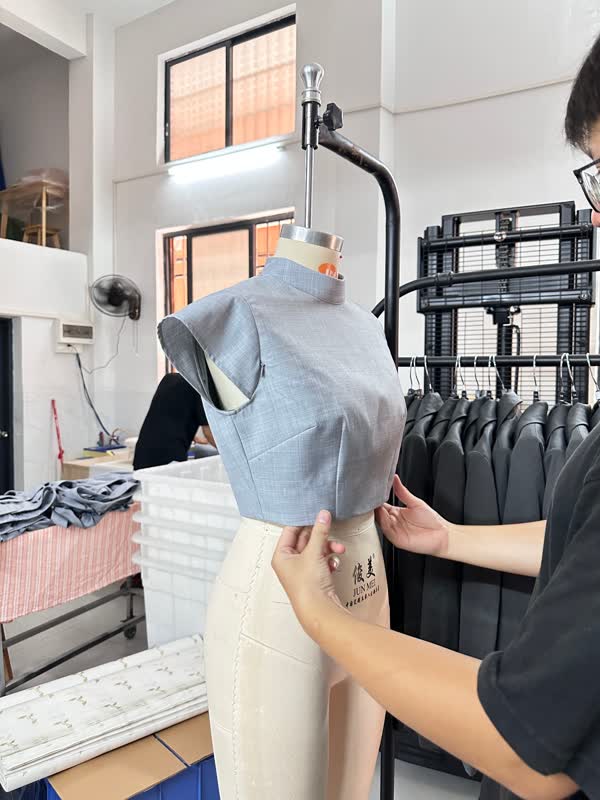
Round one is fitted on the model and then on a dress form, because a form catches the asymmetry a live body hides. Round two goes back on the model before the sample is sealed. A third round is possible and charged separately, and we say that on the quote rather than in week four.
Grade rules: why a size 8 sample says nothing about size 16
A standard grade on a woven dress moves the bust 5 cm, the waist 4.5 cm and the hip 5 cm per size step. Those steps hold until the hip reaches roughly 110 cm, and past that the step has to widen or the garment pulls across the seat.
Stretch fabric is the worst case. A rule set written for woven cloth graded onto jersey gives you a size 8 that fits and a size 16 that clings. We grade jersey on its own rule set, and we fit the two extreme sizes on the model before the bulk marker is made.
We learned this the expensive way. In 2022 we graded a viscose dress to a size 16 with a standard woven rule and the armhole gaped 2 cm on the model. We redrafted the block and re-cut 14 garments at our own cost. Since then the extreme sizes are cut in the base fabric and fitted before bulk, on every style.
What happens when a fit standard fails on our floor
It fails sometimes. The rule is simple: the run stops at the stage where the fault is found, and the schedule moves.
A fit fault caught at round one costs a pattern change. The same fault caught at final sample costs a re-make. Caught after bulk cutting, it costs fabric. That is why we fit the extremes early, and why a third mock-up round is cheaper than a second bulk run.
Ask any factory what they did the last time a fit standard failed. The answer tells you whether the standard is real.
How to put a fit standard in writing before you pay a deposit
Attach one page to the tech pack: base size, fit model measurements, the tolerance table, the number of mock-up rounds, and the grade steps. Ask the factory to confirm each line before the deposit leaves your account.
Then keep the approved size chart with the order. The chart, not the sample, is what the floor measures against, and it is what an inspector should be handed on arrival.
Our high end production page lists the standards we hold on every order, including 30-piece runs. The FAQ page answers the fit questions we get most often, and the case studies page shows delivered orders with their numbers attached. Our production process page maps the two mock-up rounds and the three inspections. The Fashion Pains Solver we are bringing online is being built to flag a fit standard that is missing before a pattern is cut.
Go deeper: mock-up rounds: why yours keep coming back wrong · why your size 8 fits and your size 14 doesn't · what "high quality" means on a quote: 7 specs to ask for
Questions we get about this
What base size should a new brand draft its first pattern on?
The middle of the range you actually plan to sell, not the smallest. If you will sell 8 to 16, draft on a 12 so the grade steps stay short in both directions. Drafting on the smallest size and grading up is the most common reason a larger size fits badly on a first collection.
How do I check that a factory's fit standard is real?
Ask for a filled-in measurement record from a previous order, plus the base size and grade steps in writing. A factory holding a standard can send both the same day. One that cannot will answer with adjectives about quality and craftsmanship instead.
Quick Take
Five numbers, one page. Base size, fit model measurements, tolerance, mock-up rounds, grade steps. Ask for them before the deposit, not after the first sample.
Tolerance is where the standard lives. Plus or minus 0.5 cm at critical points and 3 mm of symmetry. A spec you can measure is a spec a factory has to meet.
Test the extremes, not the middle. A size 8 sample proves nothing about a 16. We re-cut 14 garments in 2022 learning that.
About UP Fashion
UP Fashion is a Guangzhou garment manufacturer founded in 2016, run by a team with 20+ years of OEM experience in silk, wool and embroidery. We run small MOQ production from 30 pieces per style, draft on a stated base size, fit two mock-up rounds on the same model, and inspect every order three times with each garment measured and fitted on a dress form before it ships.





