Talk to our team.
Choose the person who best fits your project. Both reply within 4 hours.
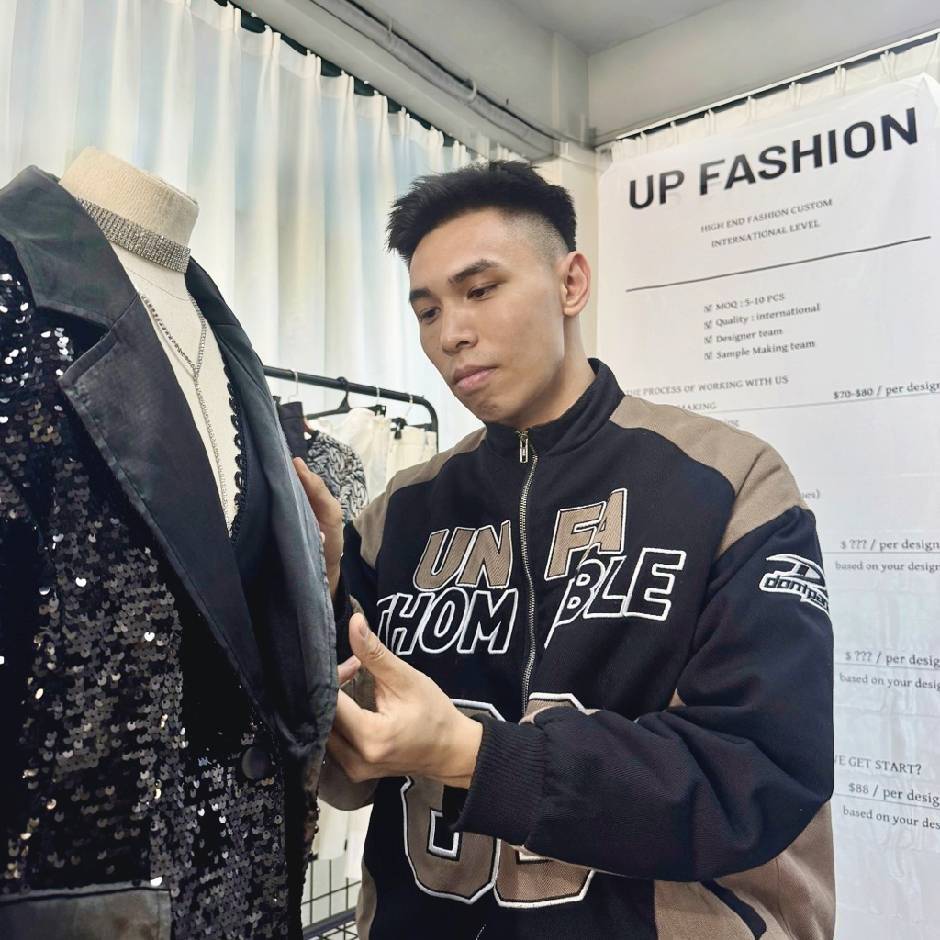
Deng
Project Manager & Sales
Available now

Kiki
Designer & Merchandiser
Available now
It is the standard every UP Fashion garment must pass — the reason independent brands retailing at $250-1,000 trust a Guangzhou factory at MOQ 30. Four tests. No exemptions — even a T-shirt.
Walk, sit, squat, bend, reach — every mock-up is worn moving, not judged on a stand alone.
2–3 rounds per style, in similar fabric. A plain T-shirt gets the same discipline as a blazer.
A documented size-up / size-down boundary per style, so one size works across body types.
Waistline, hip line, neckline, sleeve caps — inspected for distortion on every garment.
A mannequin cannot walk, sit, squat or reach. Your customer can — and will. So every mock-up is worn through a fixed set of movements: a full lap of walking, sitting down and standing up, squatting, bending forward, raising both arms overhead. Comfort and silhouette are checked through each movement.
If the crotch binds when she sits, if the underarm pulls when she lifts an arm, if the back rides up on a bend — the style goes back to the pattern table, not to production. That kind of binding is the single most common reason a beautiful garment stops being worn.
Perfect shape shows before anyone moves. The garment should make the body look longer and leaner — visually slimming, smoothing where it should, closely fitted where it counts — without tightness anywhere. We check the side profile and the back view on the stand and on a person: the waist seam sits at the waist, the hip glides instead of catching, the shoulder line stays put.
When customers say a piece “looks expensive”, this is usually what they are actually seeing — the line.
Two customers can both wear size M and have different bodies: one fuller at the bust, one longer in the torso. So for every style we define a size threshold — a measurement boundary for the key girths: bust, waist, hip. Above the threshold, we advise sizing up. Below it, sizing down.
The threshold is documented per style, because a boxy blazer and a bias-cut dress do not share the same boundary. This is how one size can fit different body types with confidence — and it removes size-related returns at the root.
Worn, the garment should feel even and look flat: no pulling to one side, no torque in the body, no wrinkle that will not press out. Distortion shows first in four places — the waistline, the hip line, the neckline and the sleeve caps — so those are the four places we inspect first, on the stand and in motion.
A neckline that gapes or a sleeve cap that dives is not a finishing problem. It is a pattern problem, and it costs another mock-up round. That is the price of the standard.
Through mock-up rounds — typically two to three, cut in similar fabric, fitted, corrected, refitted. Every style passes the same four tests: a plain T-shirt and a fully tailored blazer go through the same motion set, the same threshold definition, the same smoothness check. That is what perfect fit and shape means on our floor — and here is how the sewing quality is checked to match.
What does 'perfect fit and shape' mean?
It is our fitting standard: the garment stays comfortable and flattering in motion — walking, sitting, squatting, bending — with no binding at the crotch or underarm, a visually slimming line, a documented size threshold per style, and no distortion at the waistline, hip line, neckline or sleeve caps.
Why does the same size fit differently on different people?
Because the same nominal size sits on different body shapes. We define a size threshold per style — a measurement boundary for bust, waist and hip — so customers above it size up and below it size down. Most size-related returns are removed before they happen.
How do you test fit on a moving body?
Every mock-up is worn through a fixed movement set: walking, sitting and standing, squatting, bending forward, raising both arms. Comfort and shape are checked through each movement. Any binding or riding-up sends the style back to the pattern table, not to production.
Does this apply to simple styles like T-shirts?
Yes. A T-shirt or simple trousers go through the same motion tests, threshold definition and smoothness checks as a tailored blazer — usually within 2-3 mock-up rounds. The standard does not scale down with simplicity.
Send styles, quantity and your target price per piece — or just a sketch. Quotes within 24 hours, no obligation.
Request a QuoteYour message goes straight to Deng, the founder. A written reply within 24 hours — with a plan and real numbers, not a sales pitch.
Choose the person who best fits your project. Both reply within 4 hours.