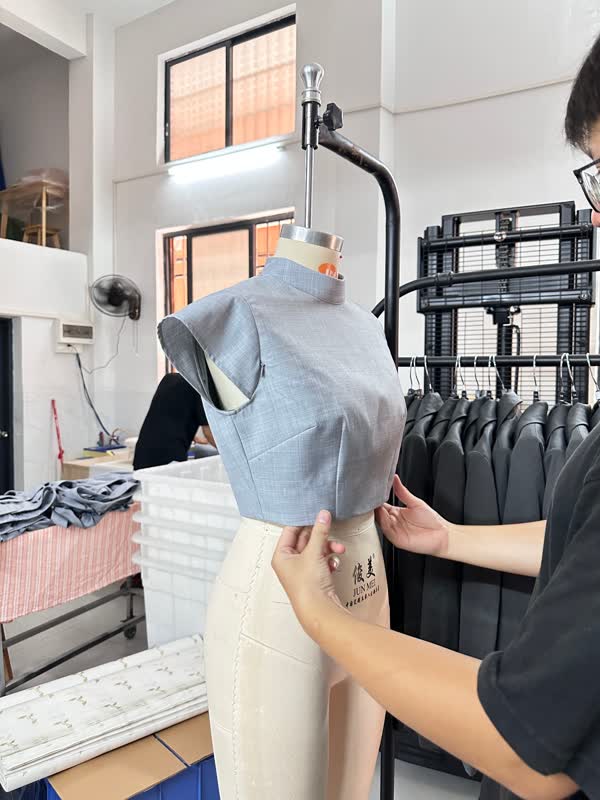
Selling suit sets used to mean one jacket size and one trouser size per customer, sold as a matched pair. It is also the assumption that quietly kills reorders, because real bodies do not come in matched pairs: a customer takes a jacket in FR 40 and a trouser in 42, or a short jacket with a regular trouser, and if you cannot sell her the two halves she walks. So the answer to the question we hear most from small brands is yes, you can mix jacket and trouser sizes in one order, and any suit manufacturer that grades the set as one pattern is making your stock problem worse.
We have run mixed-size suit sets at MOQ 30 since our first tailored capsule, and the method is simpler than most brands expect: the jacket and the trouser are built and graded as two separate blocks, then cut from the same cloth order so they cannot shade apart. Here is how it works, what it costs, and the fit traps to plan for.
Why a suit set is two pattern blocks, not one
A matched-size set is usually drafted as one block scaled together, which is fast and wrong. The jacket and the trouser answer to different bodies, the jacket follows the shoulder and the bust, the trouser follows the hip, the rise and the leg, and scaling both from one base drifts at the size extremes, exactly where your tailoring customers live.
We draft the two garments separately from the same fitting block, so a FR 40 jacket pairs with a FR 42 trouser and both sit correctly on the same body. The grading is independent: the jacket can run 36 to 44 while the trouser runs 36 to 46 with a longer inseam option.
How mixed sizes change the order sheet at MOQ 30
Mixing sizes is a ratio decision, not a chaos decision. Most of our suit-set clients start from a split they already know from sell-through: sixty percent of customers buy the set, and the rest buy separates, so the run carries more trousers than jackets.
A typical first order is 30 jackets across five sizes plus 34 trousers across the same range, 64 garments in total, one cloth order, one marker plan, two blocks. The extra trousers cost close to the matched-set price because both pieces share the fabric buy and the cutting session.
What we need from you is the split in writing before the marker plan is made: how many of each size of the jacket, how many of each size of the trouser, and whether the trouser needs a longer inseam at the top of the range. After the marker is cut, changing the split means re-cutting cloth, which is the expensive kind of change.
The fit traps when jacket and trouser do not agree
Two traps send mixed-size sets back for rework. The first is proportion: a jacket graded by bust and a trouser graded by hip can stop agreeing at the waist, and the mismatch shows as pulling at the side seam or a waistband that sits differently across sizes. We correct both against the same fitting block, the fix that finally stopped one client's five-round sampling loop.
The second is the length story. A trouser that is correct at FR 36 can sit two inches short at 46 if the inseam is graded on a straight scale, and a jacket sleeve does the same thing. We check body length, sleeve and inseam on the smallest and largest sizes before bulk, the same discipline our fit grading guide describes for any size-inclusive run.
Grading jacket and trouser to your market's sizes
Tell us the market and we grade to its standard: FR 34 to 46, IT 38 to 48, US 0 to 14 and UK 6 to 18 map to different base measurements, and the two blocks adapt to whichever one your stockists order. If your sales show the trouser outsells the jacket two to one at the larger sizes, the trouser block can carry a longer inseam without the jacket changing at all.
We keep both sealed blocks on file in your name, so a reorder quotes in 48 hours and the split can change between seasons, one season sixty percent sets, the next sixty percent separates, without paying for new development.
What mixing sizes costs, and what it saves
The honest numbers first. At MOQ 30, a half-canvas wool blazer lands around USD 95 to 135 ex-works and a matching trouser around USD 45 to 65, and mixing sizes within those runs adds no per-piece premium when both come from the same cloth order. Adding a second trouser length, short, regular, long, is a one-time grading cost of roughly USD 250 to 400, paid once and stored with the blocks.
The saving shows up in two places. One marker plan for the whole capsule usually saves 8 to 12 percent on fabric, because jacket and trouser pieces nest in the same lay. And you stop manufacturing stock you cannot sell: if your data says the size 40 jacket sits unsold while the size 42 trouser is short, you reorder the two halves at different ratios instead of buying more matched pairs.
Selling sets and separates without leaving orphans
Plan the packaging with the same honesty. We can pack every set as a pair on one hanger for boutique delivery, or pack each garment separately with its own label so you can sell the set and the separates as two SKUs from the same run. Most clients choose the second, because it lets a stockist pair a jacket with a different trouser already in the store.
The only true orphan risk is cloth, not fit: if you reorder one side alone months later, the new cloth has to match the first run. We hold a length of the original fabric or reorder against the sealed shade standard, which is how a reordered trouser stays indistinguishable from the jacket that shipped earlier.
If the set is still a sketch rather than a spec, our first designer agent A1 is in training and coming online soon: give it your brand positioning and the silhouettes, and it returns design drawings so you can judge jacket-and-trouser proportions before spending a mock-up round on the floor. The agent shortlists; the sealed sample still decides what is sewable.
Mixed-size tailored runs we have shipped, from two-piece wool capsules to separates-first programs, are on our case studies page, and the blazer-to-trouser cost relationship is explained in our blazer pricing guide. The full sequence, separate blocks, sealed mock-up, three inspections per garment, export packing, is on our production process page, the fit and sizing questions buyers ask before a first tailored order are on our FAQ page, and why 30 pieces is enough to start a suit-set program is on our low MOQ landing page.
Go deeper: why blazers cost more than dresses at the same MOQ · fit grading: why your size 8 fits and your size 14 doesn't · cost per garment: the lines your quote won't show · Case studies: tailored runs
Questions we get about this
Do jacket and trouser sizes really need to be graded separately?
Yes. The jacket follows the shoulder and bust, the trouser follows the hip, rise and leg, so scaling one base across both drifts at the size extremes. We draft and grade them as two separate blocks from the same fitting block, which is what lets a FR 40 jacket sit correctly with a FR 42 trouser on the same body.
Does mixing sizes in a suit set cost extra at MOQ 30?
No per-piece premium when both pieces come from the same cloth order and the sizes stay inside one grade set. A second trouser length is a one-time grading cost of roughly USD 250 to 400, paid once and reused on every reorder. The real saving is not manufacturing pairs you cannot sell.
Quick Take
Two blocks, not one. The jacket and the trouser are graded separately from the same fitting block, so a FR 40 jacket and a FR 42 trouser can sit correctly on one body.
Mixing sizes is a ratio, not a mess. Order the split in writing before the marker plan, a run of 30 jackets and 34 trousers costs close to a matched set on one cloth order.
Plan for orphans before they happen. Pack sets and separates as two SKUs, hold original fabric for later reorders, and let sell-through set next season's ratio.
About UP Fashion
UP Fashion is a Guangzhou garment manufacturer founded in 2016, run by a team with 20+ years of OEM experience in silk, wool and embroidery. We produce 30 to 150 pieces per style on our own floor, inspect every piece three times, and treat the jacket and trouser as two blocks so suit sets sell the way bodies are built. This guide is how we explain mixed sizing to brands.





