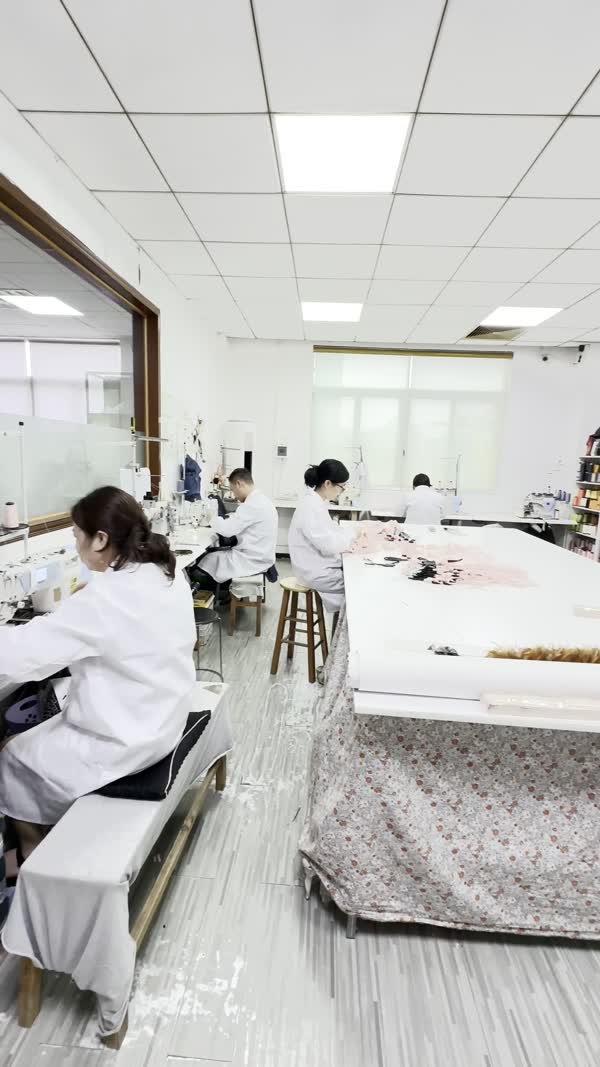
A small batch clothing manufacturer spends nearly the same cutting hours on 30 pieces as on 300, and the cut ticket is the document that shows why. Thirty dresses in three sizes and two colours become four lays, and each lay is spread, marked, cut and bundled by hand.
So why does cutting cost so much on a short run? Because the labour is per lay, not per piece. Four lays at 30 pieces take close to the hours of ten lays at 300, while the fabric lost at the end of each marker is a far bigger share of a smaller order.
What a cut ticket actually contains
Eleven fields, and a workshop that cannot show you all of them is cutting from memory. Style number, colour, fabric lot, size ratio, plies per lay, marker length, metres issued, panels per garment, cutter name, date, and the bundle numbers that follow the pieces to the line.
The metres issued is the field brands should check first. If it does not match the consumption on your quotation, either the marker changed or the fabric is wider than planned, and both change your cost.
Ply limits: why satin takes 40 and chiffon takes 80
Ply is one layer of fabric in a lay. A straight blade cuts a stack, and the taller the stack the more the blade deflects at the bottom, so the limit is set by how much a fabric slips and bends.
Our working limits are 40 plies for satin and crepe, 30 to 40 for viscose, 60 for cotton poplin, and 60 to 80 for chiffon, which is thin enough that the blade error stays small. Push satin past 40 and the bottom panels come out 3 millimetres wider than the top ones.
Marker efficiency: 82 per cent at 30 pieces, 90 at 300
The marker is the nesting plan of every panel on the cloth. A big order can afford a marker that runs 12 metres and nests six sizes together, reaching 88 to 92 per cent efficiency. A 30-piece order nests three sizes and lands at 80 to 84.
That gap is real money. At 82 per cent a 1.55-metre dress needs 1.89 metres of cloth, and at 90 per cent it needs 1.72. On 30 pieces the difference is 5 metres, roughly $45 on a viscose at $9 a metre, and it is already inside the price you were quoted.
Two colours, three sizes: the four-lay arithmetic
Thirty pieces across two colours and three sizes is five per size per colour, which is too few to spread as one lay. We cut colour A in sizes S and M together, colour A in L on its own, then the same two lays for colour B.
Each lay is 5 to 10 plies, and the setup repeats four times: lay the paper, spread, check the grain, cut, notch, bundle. That repetition, not the sewing, is why a 30-piece run has a floor price.
What a lay costs in hours
A 12-metre marker spread 8 plies takes about 20 minutes if the cloth behaves and 40 if it does not. Cutting takes 15 minutes, notching and bundling another 25, and setup before the first ply is 30 to 40.
Four lays is therefore five to six hours of cutting room time for 30 garments. The same 30 garments inside a 300-piece order would take 40 minutes of that time, because one setup is amortised across ten times the pieces.
Cut edge and notching: the 3 millimetres that decide fit
The blade has thickness and it leans, so on a 40-ply lay the bottom panel can come out 2 to 3 millimetres wider than the top. That is enough to make a size 10 waist measure as a size 11 at the side seam.
We cut in two passes on satin and crepe and check the bottom ply against the marker before bundling. It is slow, and it is the difference between a graded run and a run where one size fits oddly.
Shade sorting: keeping one garment inside one roll
Rolls inside a single dye lot can still differ by half a shade at the edges, and a dress cut across two rolls can show a line at the waist seam. Where the marker allows it, we cut each garment from one roll and write the roll number on the bundle ticket.
On a 30-piece order we usually have three or four rolls, which is manageable. At 300 pieces the same discipline needs a shade band chart and a person whose only job is to enforce it.
The marker mistake that cost us three days
In 2021 we cut a marker planned for 44-inch fabric and the mill shipped 43-inch rolls, because the substitution was approved by phone and nobody updated the ticket. Twelve panels came out short at the selvedge and had to be recut from the balance.
Three days lost, and a delivery date we had to renegotiate with the client. The fix was a line on the ticket: fabric width verified at goods-in, signed by the cutter.
What to ask before your first cut
Ask how many lays your order will run in, what the ply limit is for your fabric, and whether you will receive the cut ticket with bundle numbers. Three answers tell you whether the factory planned your order or just accepted it.
Our small batch program sends the cut ticket with every first run, the case studies show a 40-piece order cut in five lays, and the FAQ answers the consumption questions this document creates.
Fashion Pains Solver, the tool we are building to log each cut and its bundle numbers, is still in training. Until it ships, the ticket is paper, signed, and photographed before the spreader moves.
Go deeper: how every panel gets tracked through a run · what one garment really consumes in metres · how many pieces a line sews in a day
Questions we get about this
Can you cut 30 pieces in a single lay to save time?
Only if it is one colour and one size. Mixed sizes in one lay distort the grade, and mixed colours in one lay create shade risk at the bundle.
Who pays for the fabric lost at the end of a marker?
You do, inside the consumption figure on the quote. Ask for the efficiency number and you can check it yourself.
Quick Take
Thirty pieces in two colours and three sizes is four lays. Each one repeats the same setup: paper, spread, grain check, cut, notch, bundle.
82 per cent marker efficiency at 30 pieces against 90 at 300. That gap is about 5 metres of cloth on a 30-piece dress run.
Ask for the cut ticket with bundle numbers. If the factory cannot produce one, nobody can trace a defective panel back to its roll.
About UP Fashion
UP Fashion is a Guangzhou garment manufacturer founded in 2016, run by a team with 20+ years of OEM experience in silk, viscose and embroidery. We quote from 30 pieces, show the rate we used, and inspect three times before shipping.




