A cut and sew manufacturer can cut, sew and press a jacket to your measurements and still hand back something that reads cheap from two metres away. The reason is usually five buttonholes.
Why does a jacket with a correct chest measurement still look inexpensive? Because the eye finds the front edge before it finds the shoulder, and the front edge is only as straight as the buttonholes pulling it there. A 3 mm drift across five holes shows up as a curve long before anyone reaches for a tape measure.
We measure buttonhole position on every jacket before it is pressed. Below is the tolerance we hold, where it goes wrong at 30 pieces, and the run where it went wrong for us.
What buttonhole position tolerance should you ask for on a jacket
On a single-breasted jacket in size M, our five front buttons sit 9.5 to 10 cm apart. The top hole goes 2 cm below the lapel roll and 1.5 cm in from the front edge.
We hold plus or minus 1.5 mm on each hole and 3 mm cumulative across the run of five. The cumulative figure is the one that matters, because every hole can be perfect while the row still bows.
Ask for both numbers in writing. A factory that quotes only the per-hole tolerance has never measured a row.
Where the 3 mm comes from: marker, chalk and needle
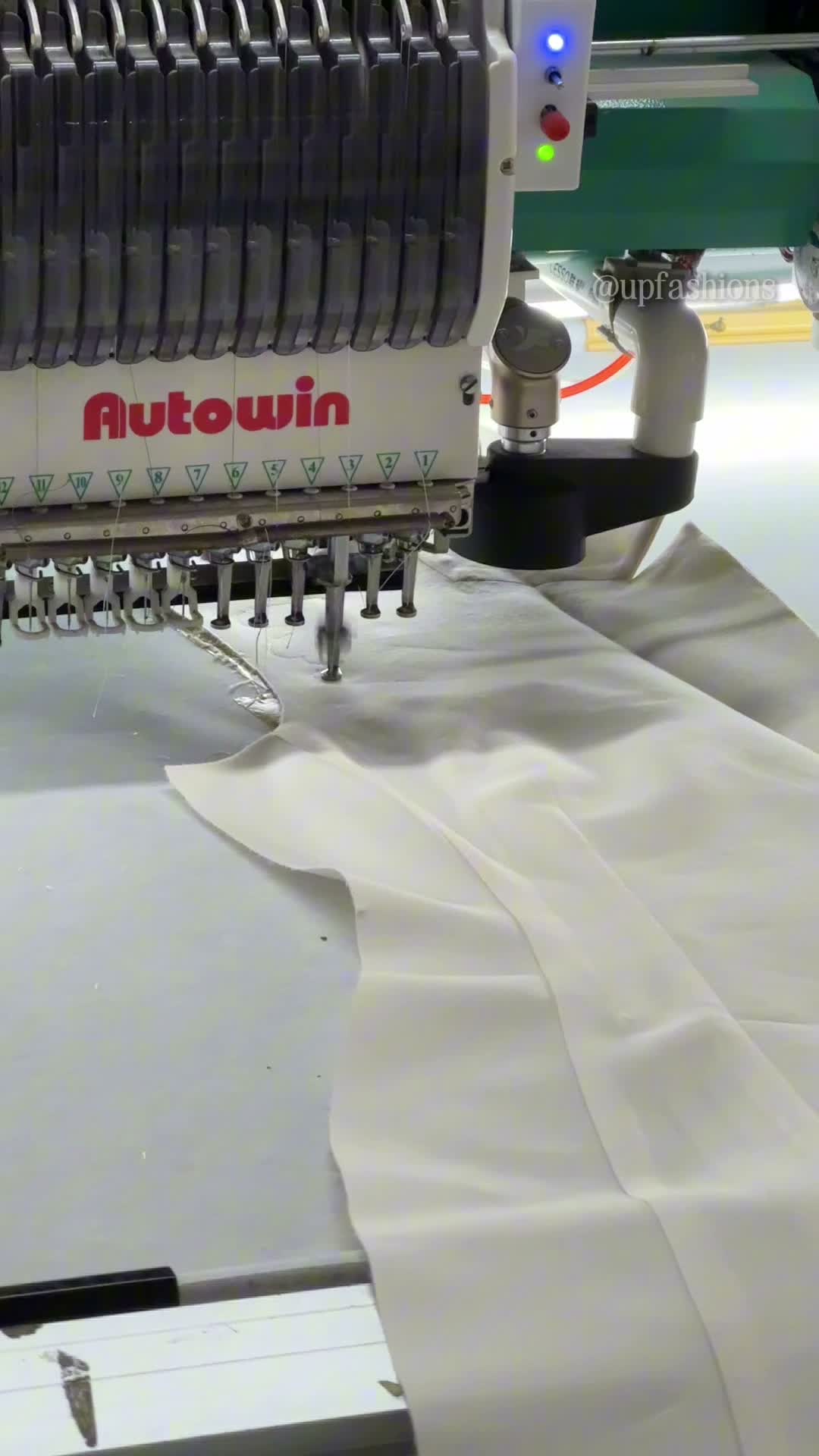
A buttonhole is not cut with the panel. It is cut after the front is assembled, on a machine running a template.
The template is per size. Five sizes means five templates at $18 to $25 each, and that line is the first thing dropped when a run is small.
Without a template for sizes 10 and 12, the operator marks by chalk and eye. Chalk on a dark wool blend is 1 to 2 mm wide, and the eye averages the rest.
We cut a template for every size we run, including the two sizes we make eight pieces of. It is $50 that decides whether a jacket looks like $400 or $1,200.
Cut length, gimp thread and the 4 mm eye
A hole 1 mm short will not pass the button without a fight. A hole 2 mm long shows the bar tack through the opening.
Cut length is button diameter plus button thickness plus 2 mm. For a 20 mm horn button that is 3 mm thick, that comes to 25 mm.
Stitch density runs 12 to 14 per cm. Below 11 the bead frays after ten wears, and above 16 the hole puckers on lightweight viscose.
A gimp thread inside the bead is not decoration. It keeps the hole from collapsing after the fiftieth fastening, and it costs about $0.03 per hole.
The eye should clear the button by 0.3 mm. On a shanked button that clearance is hidden under the shank. On a flat button it is the whole difference between a hole that closes and one that gapes open on a hanger.
Welt or bound: which buttonhole suits a $400 jacket
A machine-made welt hole is what almost every jacket at this price carries. The bead is stitched, cut and whipped in one pass, and it takes about 25 seconds.
A bound hole is made by hand with a strip of lining, takes 4 to 6 minutes, and sits flat against a lightweight fabric where a machine bead would ripple. It costs $1.80 to $2.40 per hole at 30 pieces.
We use bound holes on unlined summer jackets in cotton-linen and viscose, and welt holes everywhere else. Mixing the two on one garment is a mistake we made once and will not repeat.
Attaching buttons at 30 pieces: the shank that fails first
A jacket front is two layers plus canvas plus lining, so the button needs a 2 to 3 mm shank or the fabric bunches when it is fastened.
We sew 8 to 10 passes, wrap the shank, then bar tack the tail on the reverse. A flat four-hole attachment is a shortcut, and it shows as a dent in the front panel.
The pull test is 5 kg held for 10 seconds on three buttons per run. No shank that passed it has come back to us.
The 2021 blazer run where the top button sat 4 mm high
In 2021 we ran 28 blazers from a block a client had used at another factory. The template we pulled was cut for our own house block, and the top hole landed 4 mm high.
Four millimetres is invisible on a table and obvious on a body. Eleven jackets had a front edge that rolled away at the chest.
We unpicked nine holes, patched the facing, re-cut and re-sewed. That was about $180 and three days on a run whose margin was $1,400.
The lesson was not about the template. It was that nobody laid the template on the block before the first hole was cut.
What we check before a jacket leaves the table
Four checks, all by hand, about ninety seconds per garment.
- Front edge straightness against a 60 cm steel rule, held at the seam line and not at the edge.
- Hole-to-button alignment with the jacket closed on a form, because a jacket on a hanger lies and a jacket on a body does not.
- Cut cleanliness at 10x, looking for a frayed bead or a cut gimp thread.
- Thread tail buried in the facing, not knotted on the surface where it rubs.
A buttonhole is 25 mm of a garment that took four hours to make. It is also the part a customer touches every time they put it on.
Our cut and sew program runs from 30 pieces per style, the case studies show a jacket run through three inspections, and the FAQ covers trim and hardware minimums.
Go deeper: zippers, buttons and hardware that survive a run · how the cut ticket sets a run up · the sealed sample that settles arguments
Questions we get about this
Can you match the buttonhole spacing on a jacket I already sell?
Yes, send the jacket. We measure the row, build the template from your garment, and confirm the numbers before the first hole is cut.
Do hand-sewn buttonholes make sense at 30 pieces?
They add roughly $6 to $9 per jacket and 20 minutes each. On a wool blend the difference is visible; on a cotton-linen summer jacket it usually is not.
Quick Take
1.5 mm per hole, 3 mm across the row. Ask for both. Only the cumulative number catches a bowed front edge.
Templates cost $18 to $25 a size. Skip them for two sizes and the operator marks by chalk and eye.
Shank, not flat. A 2 to 3 mm shank and a 5 kg pull test on three buttons per run.
About UP Fashion
UP Fashion is a Guangzhou garment manufacturer founded in 2016, run by a team with 20+ years of OEM experience in silk, viscose and embroidery. We quote from 30 pieces, show the rate we used, and inspect three times before shipping.





