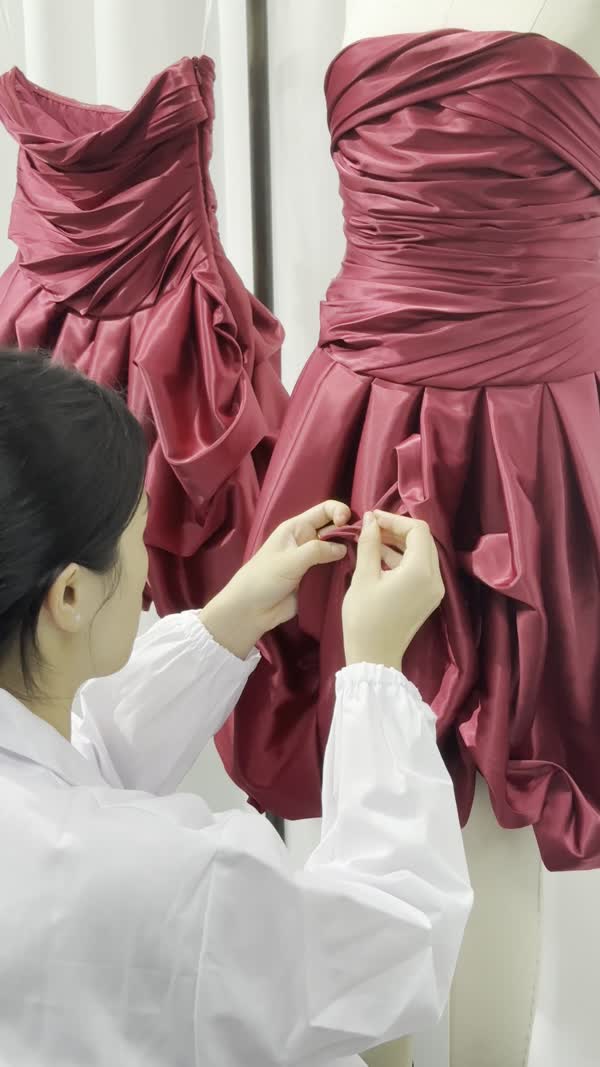
A private label clothing manufacturer usually runs one sample room, and that room has a fixed number of machines and a fixed number of hands. Your mock-up waits because the queue is not first come, first served.
Why does my sample take nine days when the factory promised five? Because your sample went in behind a style that was already cutting, and in every factory I have worked in a stopped bulk line outranks a new sample.
We now publish queue depth on the sample quote. Below is what decides your position, and the year our own queue cost a client a season.
What decides the sample room queue at a garment factory
Our room works to four tiers, and we tell clients which one they are in.
- Bulk-linked samples: size sets, PP samples, anything attached to a line that is waiting. A stalled line costs us $400 to $700 a day in idle hands and floor space.
- New styles with a booked bulk slot and a paid sample fee.
- New styles, sample only, no bulk slot yet.
- Spec samples for a client who has not paid a fee.
That is not a moral ranking. It is what a room with six machines has to do to keep a factory running, and a client who understands it can plan around it.
Six machines, forty samples a month: what that means for your date
Our sample room has six industrial machines, one pattern maker, one cutter and one finisher. Realistic output is about 40 samples a month, and that assumes nothing goes wrong.
A simple viscose slip is 3.5 hours of machine time. A lined blazer with a canvas chest is 9 to 11 hours. A style that needs two mock-up rounds is roughly 20 hours of room time before bulk begins.
The arithmetic says six machines over 22 days is over a thousand machine hours. The calendar says otherwise, because size sets, PP samples and rework take the difference, and rework is the part nobody forecasts.
So when we quote five days for a mock-up, we are quoting a slot in a room that is already partly full. Ask what is ahead of you and the date stops being a mystery.
Why your mock-up is late even when it is next in line
Four things push a sample past its date, and only one of them is the sewing.
- Fabric arrived after the pattern was cut, which happens on roughly a third of first-time orders.
- A trim was specified but not ordered, usually a button or a zip with a 10 day lead time.
- The pattern needed a correction from the previous fitting, which resets the machine booking entirely.
- The comment list arrived in five emails over four days, so the sample was touched five times.
None of these is a factory failing. All of them are calendar events, and all of them can be seen coming.
What a queue position of three actually means in days
Three samples ahead of yours sounds like three days. It rarely is, because each one has a duration of its own.
If the three ahead are simple viscose styles, you are waiting about two days. If one of them is a lined blazer in its second round, you are waiting six, because a second round means unpicking, re-cutting and re-sewing.
So ask for the queue in hours of room time, not in samples. We quote it that way, and the number is usually between 12 and 40 hours for a first-time client in season.
March to June and September to November are the tight months. A sample booked in late July moves in half the time, and that is worth knowing before you pick a launch date.
Four ways to move up the queue without paying more
Clients who get samples back fastest do four things, and none of them involves a bigger deposit.
Send fabric before the tech pack is final. Fabric on our shelf is the single biggest accelerator, because it removes the longest dependency from the critical path.
Book the slot when you pay the sample fee. The date starts at payment, not at tech pack approval. Two weeks of drafting in your own time is two weeks of queue you did not use.
Answer within 24 hours. A sample held for approval for a week is a table, a form and a set of hands doing nothing.
Send one consolidated comment list. Five emails become five fittings, and each fitting is a re-booking.
The 2023 run where our own queue cost a client a season
In 2023 a client sent three styles for a resort drop. Our room was running a 600-piece bulk line, and her three mock-ups sat eleven days.
She approved the third mock-up on the day the fabric should have been ordered. The drop missed its window and the three styles moved to the following season.
We did not charge for the delay, and it still cost her more than the sampling fee. Since then we put queue depth on the quote, in samples, not in days.
What a sample quote should tell you before you pay
Three dates and one number. Pattern and fabric check, mock-up one, mock-up two, and how many samples are ahead of yours on the day we quote.
A date without a queue position is an estimate. A date with one is a commitment somebody can be held to, and we would rather be held to it.
Our private label program quotes the queue with the date, the case studies show a two-round sampling timeline end to end, and the FAQ covers what happens when a mock-up has to be re-cut.
Go deeper: why mock-ups keep coming back wrong · a 50-piece order, week by week · what a sample actually costs
Questions we get about this
Can I pay extra to jump the queue?
Not past a waiting bulk line. We will move a sample ahead of another new style, and we will say so in writing. Anything else would put a client's production at risk.
How many mock-up rounds should I budget for?
Two is our standard. A third round is usually a fit decision the brand has not made yet, and it costs 7 to 10 days plus about $90.
Quick Take
Queue, not price. A bulk line waiting outranks a new sample in every factory. Ask where you sit.
40 samples a month, six machines. A lined blazer is 9 to 11 hours of room time before it is even photographed.
Fabric on the shelf is speed. Send it before the tech pack is final and you buy back a week.
About UP Fashion
UP Fashion is a Guangzhou garment manufacturer founded in 2016, run by a team with 20+ years of OEM experience in silk, viscose and embroidery. We quote from 30 pieces, show the rate we used, and inspect three times before shipping.





