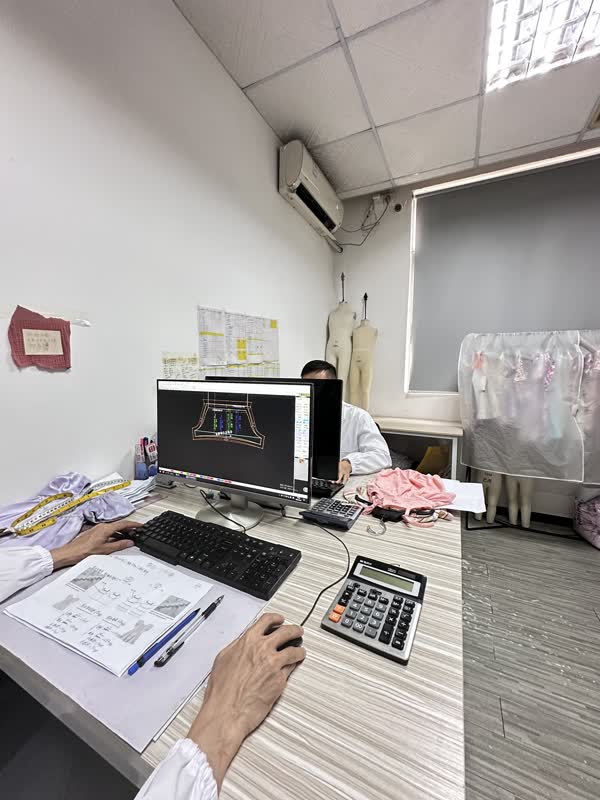
A high end clothing manufacturer will tell you what we tell every brand: 3D software is a screening tool, not a sample. At 30 pieces a digital preview can kill two bad ideas before anyone cuts cloth. It cannot approve one fit.
So can you skip the mock-up and cut bulk from a 3D file? Not with us, and not at this quantity. A render approves proportion, colour blocking and where a seam lands. A fitting approves how cloth behaves on a body that sits, breathes and lifts an arm.
Here is what the software earns on a 30-piece run, what it costs, and the four cases where we would take a file over a physical sample.
What 3D sampling for a 30-piece order can approve
Three things, reliably. Proportion: whether a 62 cm dress length reads short on a 168 cm body. Placement: where a waist seam, a pocket or a print repeat lands. Balance: whether the front and back panels look like they belong to the same garment.
That is worth money in the pattern room. A first block for a dress takes 6 to 9 hours, a lined jacket around 14. If a render shows the length is wrong, those hours get spent once instead of twice.
Colour is the other win. Two colourways across one block can be reviewed in an afternoon, instead of two sample rounds at $85 to $140 each.
Where a virtual sample fails: drape, hand-feel and shrinkage
Drape fails first. The software needs weight, bend and stretch entered by hand. If your mill sends 110 GSM and nothing else, the render is a guess wearing a nice texture.
Hand-feel is worse. A 110 GSM and a 145 GSM viscose look identical on screen. They do not hang the same over a hip, and buyers touch before they buy.
Shrinkage is the quiet one. Bulk fabric can move 3% to 5% after the first wash. A file assumes zero, so a rendered hem length is a number nobody has tested.
The real cost of a digital sample vs two mock-up rounds
A CLO3D individual licence runs about $50 a month. A freelance 3D designer charges roughly $150 to $300 a style. A factory with a modelling room will quote it as a line item, and we prefer that to hiding it.
Two mock-up rounds cost $170 to $280 a style here, plus about 9 days of queue per round. On a single style, 3D is not cheaper. It is cheaper across a range.
Six styles is where the math flips. Six renders at $200 is $1,200 and about a week. Six physical rounds is $1,020 to $1,680 and six weeks of sample room time.
Why a mesh cannot grade a size 14 hip
Grading is arithmetic until a body disagrees with it. A 4 cm hip increment works on paper from size 8 to 12. At 14 and 16 it starts pulling across the seat, and only a fitting shows that.
We fit on one model and grade from her measurements. If your range stops at L, one body is enough. Past L we want a second body in the room, and no render replaces that session.
How we run 3D and physical sampling side by side
We model first when a style has a print, a panel split or a colourway decision to settle. The render goes out with the tech pack questions, before a pattern is cut.
Then we cut calico. The toile answers what the file cannot: where the armhole bites, how the neckline sits, whether the fabric is the right weight for the shape.
Round two is the real fitting. Two mock-up rounds is our standard and the second one is where fit gets decided. A render can shorten round one. It has never removed round two.
Four cases where we would skip the mock-up
A colourway change on an approved block. A print placement check on a style already running. A repeat style with the same pattern and the same fabric. A trim or hardware swap that does not touch a seam line.
In each case the pattern has already passed a body. You are checking a surface, and a surface is what 3D is good at.
What we would not accept: a new block, a new fabric, a bias cut, or anything with a defined waist or a tailored shoulder.
How to approve a fit without flying to Guangzhou
Ask for the flat measurements before you look at a single photo. Bust, waist, hip, and the two or three numbers your tech pack names, against spec.
Then a video session with three angles and a tape on the garment. We send a nine-field fit comment sheet and we ask for numbers, not the words "a bit tight".
Photos alone are not approval. If a style has a waist seam, someone has to move in it on camera or in person.
Where we got this wrong in 2024
We modelled a satin slip and the render looked correct. The mock-up pulled 2 cm across the bust because the satin had about 4% crosswise stretch that the file had entered as zero.
A brand also approved a 30-piece run from a render and rejected it on delivery. We remade 12 pieces at our own cost, about $310, and that was the cheaper outcome for both of us.
Since then we do not accept render approval on any style with stretch in the fabric. That is a rule now, not a preference.
Send a reference garment, not a render
If you own a garment that fits the way you want, send it. We will measure it against your spec and tell you whether 3D earns its fee on this style, or whether the money is better spent on a second mock-up.
Then send the tech pack, or what you have of it. We quote from 30 pieces, we show the rate we used, and we tell you which numbers are still guesses.
Our high end production programme runs the same three processes as a 3,000-piece order: quotation, two mock-up rounds, then bulk with three inspections. The FAQ covers sample fees and mock-up rounds, and the case studies include a debut range sampled in a single round.
Go deeper: why mock-up rounds keep coming back wrong · fit sample, PP sample, top sample · what a mock-up in cotton actually tells you
Questions we get about this
Can I approve a 30-piece order from a 3D render alone?
Only when the pattern has already passed a fitting on a body and you are changing a colour, a print placement or a trim. A new block, a new fabric or a bias cut needs cloth. Any style with stretch in the fabric gets cut and sewn before bulk here, whatever the render says.
Does 3D sampling save money at 30 pieces?
On one style, no. A licence or a freelance render costs about what one mock-up costs, and you still need the mock-up. On six styles the saving is real: roughly $1,200 of renders against $1,020 to $1,680 of physical rounds, plus five weeks of sample room queue that you get back.
Quick Take
6 to 9 hours. Pattern room time on a first dress block. A render is how you avoid paying for it twice.
$170 to $280. Two mock-up rounds per style. 3D does not remove them at 30 pieces.
4 cases. Colourway, print placement, repeat style, trim swap. Everything else gets cut in cloth.
About UP Fashion
UP Fashion is a Guangzhou garment manufacturer founded in 2016, run by a team with 20+ years of OEM experience in silk, viscose and embroidery. We quote from 30 pieces, show the rate we used, and inspect three times before shipping.





