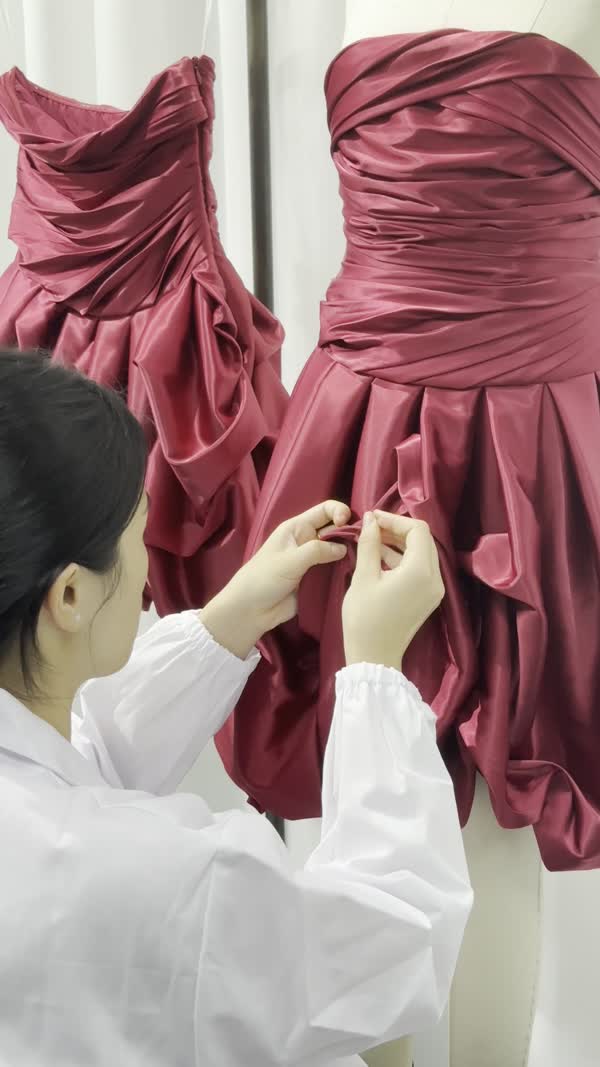
A high end clothing manufacturer will name three samples before bulk, and most first-time buyers approve the first one and assume the other two are paperwork. They are not.
The fit sample decides the pattern. The PP sample decides the fabric, the trims and the construction. The top of production sample decides whether the line can repeat what you approved. Skipping the third is the most common reason a bulk run arrives 4 mm off the sample you signed.
Here is what each stage costs, how many days each takes, and the year our own sample room got it wrong.
What a fit sample decides, and what it cannot
A fit sample is about the body: shoulder, armhole, bust point, waist position, hem length. In a mid-weight viscose ours takes 5 to 7 days and costs $85 to $140, with a second round at $70.
It cannot tell you how the bulk fabric will behave. Fit is geometry. Fabric is a separate test with its own failure modes, and mixing the two is how brands end up re-cutting.
A fit sample also tells you whether the grade will hold. We cut it in the middle size, then check the shoulder and the waist on the smallest and largest size on paper before the pattern is released.
We fit every mock-up on a mannequin and on a live fit model, because a mannequin never slouches and a model always does.
The PP sample: where fabric and trims get locked
PP means pre-production. This is the sample made in your actual bulk fabric with your actual labels, zip and thread, sewn by the same operator who will run the bulk.
It takes 7 to 10 days and costs $120 to $180. At 30 pieces that is $4 to $6 a garment, which makes it the cheapest insurance in the whole order.
Ask for the PP sample in the bulk fabric and the bulk trim, not in whatever substitute the sample room had on the shelf. A substitute zip hides a 3 mm difference in tape width, and that difference is the one your machinist fights at 200 pieces.
On the PP sample we measure every point of measure against the approved fit sample and write the numbers into a sheet. If the armhole has drifted 6 mm, we see it here rather than in 30 finished garments.
Top of production sample: the one buyers skip
A top of production sample is pulled off the line, not built in the sample room. It is the first garment sewn by the operator who will sew the rest, on the machine that will sew the rest, at the speed the line actually runs.
It costs nothing extra and takes 2 days. It catches what a sample room hides: a different press, a new operator, a fusible that behaves differently at eight in the morning.
On a 30-piece run the top of production sample is garment number one. If it is wrong, you have 29 left to fix it in.
Ask for it to travel with the measurement sheet attached. A sample without numbers is an opinion, and an opinion will not settle a dispute in week six.
What the three sample stages cost on a 30 piece run
- Fit sample: 5 to 7 days, $85 to $140. Second round, $70.
- PP sample: 7 to 10 days, $120 to $180.
- Top of production: 2 days, no charge.
Total $205 to $320, which is $7 to $11 a garment at 30 pieces. Compare that with a re-cut: 30 dresses costs $600 to $900 in fabric and labour, plus nine days you did not plan for.
Sample freight sits outside those numbers. Two rounds to Europe by courier is $60 to $90 a parcel, and a sample that lands in four days beats one that lands in ten when a launch date is fixed.
How many mock-up rounds before a pattern is settled
Two rounds settle a pattern, or expose a problem a third round will not fix. In our experience rounds three and four usually mean the tech pack was thin on day one.
A round costs $70 and 5 days here. A brand that runs four rounds has spent $280 and three weeks before bulk, and still owns the same armhole.
The fix is upstream: send the reference garment, the measurement chart and a photo of the fit you want. We would rather spend 90 minutes arguing about a tech pack than 20 days arguing about rounds.
Where our sample room got it wrong
In 2022 we passed a PP sample on a silk-viscose blend without washing it first. The bulk shrank 6 mm at the hem and 30 dresses came up short.
We paid for 30 new hems and a re-press, and the brand paid in a two-week delay on its launch date. The fix was a 20 cm wash test on the PP sample, which now happens on every order before the sample leaves the room.
That test costs us 40 minutes. It would have saved the customer a fortnight.
What to write on a sample approval
Photograph the sample on a mannequin from four sides and put the date in the file name. Approve with a list of points, never with a single yes.
We send a sheet with 9 fields: measurement, tolerance, fabric, trim, construction, label, packing, photo reference, and the name of the person who approved it. A yes with no points attached is not an approval, and it will not settle an argument in month two.
Write the tolerance down as a number. "Shoulder within 5 mm" survives a factory change. "Looks good" does not.
Keep the approved sample. Ours goes into a numbered archive with your style code on the bag, and bulk is measured against it rather than against a photograph on someone's phone.
What to send us before the first sample
Send the tech pack, the size run and the fabric if you already have it. We run two mock-up rounds inside the quote, then one PP sample, then the top of production.
Our high end programme runs those three stages on every style, from 30 pieces. The FAQ explains what a mock-up round includes, and the case studies show a PP sample that should never have passed.
Go deeper: why mock-up rounds keep coming back wrong · why your mock-up lies about the bulk · the archive that settles every argument
Questions we get about this
Do I need all three samples for a 30-piece order?
You need the fit sample and the PP sample. The top of production sample costs nothing and takes two days, so there is no reason to skip it. What you can skip is a third mock-up round: if two rounds have not settled the pattern, the problem is usually the tech pack rather than the sample room.
Can I approve a PP sample from photos?
For colour and trims, yes. For fit, no. A phone camera at 40 cm flattens 6 mm of armhole into nothing. Either send the sample to a local fit model, or ask the factory to measure the 9 points and send the numbers alongside the photos. Numbers travel better than pictures.
Quick Take
$205 to $320. Fit sample, PP sample and top of production at 30 pieces. That is $7 to $11 a garment.
6 mm. How far a hem moved on 30 dresses when we passed a PP sample without a wash test.
2 days, no charge. Top of production sample. It is the first garment off the line, and the cheapest check you will ever run.
About UP Fashion
UP Fashion is a Guangzhou garment manufacturer founded in 2016, run by a team with 20+ years of OEM experience in silk, viscose and embroidery. We quote from 30 pieces, show the rate we used, and inspect three times before shipping.





