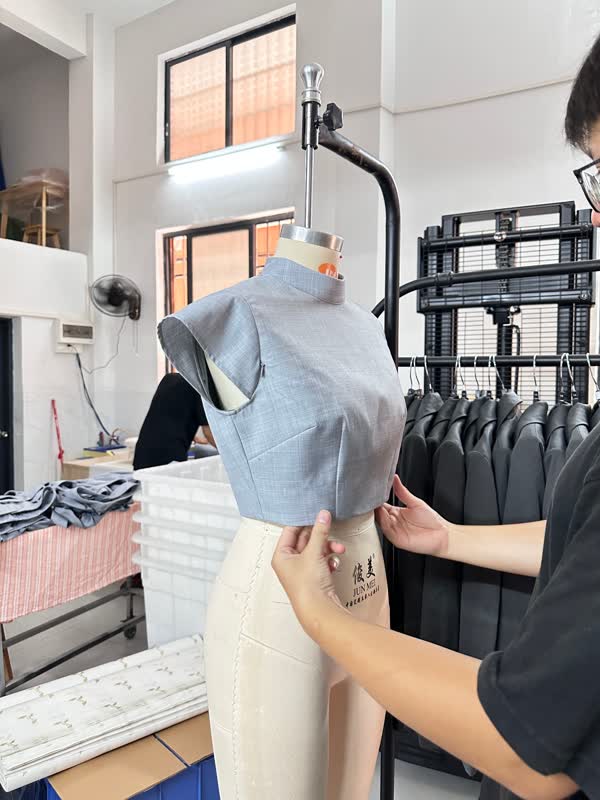
A sample is not approved until a body has worn it, and at 30 pieces that body is usually a mannequin. As a small batch clothing manufacturer we keep six of them and still book a fit model for anything with a sleeve. A mannequin cannot raise an arm, sit down or turn its shoulder.
So who should try on your sample? Someone whose bust, waist, hip and shoulder match your base size within 1 cm, standing, sitting and reaching overhead. Not you, not the pattern maker, and not the mannequin that has been standing in the same pose since 2019.
What a mannequin cannot show you on a 30-piece run
Our six mannequins run 84, 88, 92, 96, 100 and 104 cm bust. They hold a garment up and show proportion. They do not show movement.
Armhole gape is the classic miss. A mannequin's arm is fixed in a slight A-pose, so the armhole reads clean. Put the same dress on a person and raise one arm 90 degrees, and 2.5 cm of gap opens under the arm.
Sleeve pitch is the second. The sleeve has to hang without twisting forward, and that only shows on a body standing naturally. Our blazer runs check pitch on mock-up one for exactly this reason.
The third is the back neck. A mannequin has no shoulder blade movement, so a back neckline that stands away only appears when someone reaches forward.
Five numbers a fitting session should produce
We measure five things and write them on the sample's own sheet. Shoulder slope, armhole depth, bust apex position, back neck drop and hem level from the floor.
Shoulder slope is the one brands skip. Two centimetres of drop across a 12 cm shoulder is normal, and a pattern cut for a flat shoulder will hang off a real one by that much at the sleeve head.
Hem level gets measured standing and seated. A 40 cm hem sitting 3 cm higher on a chair is a dress that photographs badly on a stool and gets returned as short.
How to run the session in 90 minutes
Fifteen minutes on the stand, sixty on the body, fifteen for notes and photographs. Bring one sample per size you intend to sell, not one sample and good intentions.
Bring the tech pack as well, open at the measurement page. Half of every fitting argument is a number someone remembers differently, and the sheet ends it in ten seconds.
Photograph four angles at 3000K with tape marks on the wall, and one short video of the arm raise and the sit. A still cannot show a twist.
Running a fitting when you are 8,000 km away
Most of our brands never stand in the sample room. The sample ships to a fit model in London, New York or Dubai, and the session happens there.
That round trip adds 7 to 10 days per fitting. Two rounds is normal, which is why we ask for the fit model's eight measurements before the first mock-up is cut rather than after.
The sourcing agent we have in training is being taught to catch exactly this: a quote that goes out with no fit model measurements attached. It is not online yet, and until it is, a person checks the sheet.
The measurements we need: bust, underbust, waist, high hip, hip, shoulder width, back length and height. With those we can grade your block to that body before the first sample exists.
What a fit model costs
Locally, $45 to $70 for 90 minutes with a day or two of notice. In London or New York, $120 to $200 an hour, usually with a two-hour minimum.
Set that against a rework. Nine dresses re-cut at $7.50 a piece is $67.50, plus five days, plus a conversation with a stockist you would rather not have.
The 2020 run we approved on a stand
Thirty viscose dresses, approved on the 88 cm mannequin, shipped to a stockist in Amsterdam. Nine came back with an armhole that gaped when tried on.
The pattern was not wrong. The armhole was cut 8 mm too deep for a body that moves, and the mannequin could not tell us.
We took the nine back, re-cut the armhole and reset the binding at $7.50 a piece, and paid the return freight. Every order with a sleeve now gets a fit model session before bulk, and we photograph the arm raise as proof.
If you are about to approve a first sample, our small batch programme explains what a fitting includes, the case studies show fit rounds on 30-piece runs, and the FAQ covers how remote fittings work.
Go deeper: the six mannequins in our sample room · five numbers a factory should publish · what two mock-up rounds actually fix
Questions we get about this
Can I use myself as the fit model?
Only if your measurements match your base size within 1 cm. Otherwise you will approve a garment that fits one body, and your size chart will be wrong for every stockist.
Do I need a fitting for a loose dress?
For a straight cut with no sleeve, a mannequin and a measurement check is usually enough. Add a body the moment there is a sleeve, a waist seam or a fitted back.
Quick Take
A mannequin cannot move. Armhole gape and sleeve pitch only appear on a body that raises an arm.
Get eight measurements first. Before the first mock-up, not after the second rejection.
Budget $45 to $200. One session costs less than re-cutting nine dresses.
About UP Fashion
UP Fashion is a Guangzhou garment manufacturer founded in 2016, run by a team with 20+ years of OEM experience in silk, viscose and embroidery. We quote from 30 pieces, show the rate we used, and inspect three times before shipping.





