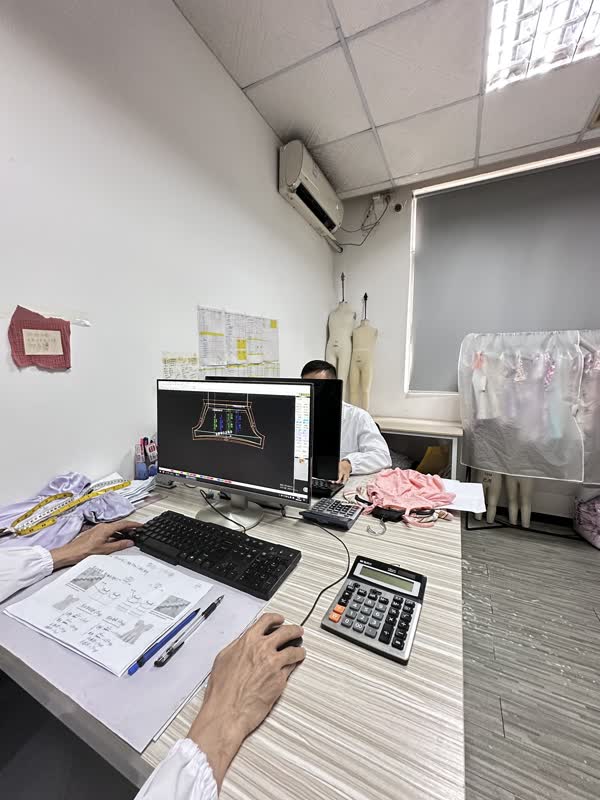
A small batch clothing manufacturer lives or dies on the sleeve cap, because it is the one part of a woven top a customer feels every time she lifts an arm. Our cap height runs 13 to 15 cm on a size 8 dress, and 1 cm of it decides whether the sleeve pulls.
Why does a sleeve ride up when you raise your arm? Either the cap is too high for the armhole, or the armhole is too deep for the cap. Both faults look identical on a hanger and feel completely different on a body.
Here is what the cap number does, what ease we allow, and the 30 sleeves we re-cut because of 12 mm.
What sleeve cap height actually does
The cap is the curved top of the sleeve. Its height is the vertical distance from the underarm line to the highest point.
A high cap gives a clean, narrow shoulder line and a sleeve that hangs straight. It also restricts the arm, because there is no spare cloth to rotate.
A low cap gives freedom and a softer shoulder. On a woven dress it also gives a diagonal fold from the underarm to the bust that never presses out.
We see the two extremes on the same rack every month: a satin top with a 16 cm cap that photographs beautifully and cannot be worn to dinner, and a linen dress with an 11 cm cap that feels wonderful and looks like a sack on the hanger.
Cap ease: 2.5 cm against 4 cm
Cap ease is the difference between the cap curve length and the armhole curve length. It has to be positive, or the sleeve will not sit.
We set 2.5 cm of ease on a viscose or a crepe, and 3.5 to 4 cm on a TR suiting or a lined blazer. Below 2 cm the cap has to be forced in and the seam puckers at the notch.
Above 4.5 cm on a light cloth you get a pleated cap that reads as a defect. On a blazer that same 4.5 cm is a deliberate, expensive look.
Why the underarm point wrinkles
The underarm point is where four seams meet and where the arm rotates most. If the armhole is cut 5 mm too deep, the sleeve hangs below the joint and folds when the arm comes down.
We check the underarm point on the body, not the block, with the arm at 45 degrees. That is the position where a bad armhole shows first.
On a 30-piece run the fix is a pattern change before cutting. After cutting it is a new sleeve, which is 0.85 metres of cloth per garment.
Sleeve cap cost at 30 pieces
A set-in sleeve adds $3.20 to $5.60 a piece in labour over a sleeveless version, depending on whether the cap is eased by hand or by machine.
Hand-easing the cap takes about 4 minutes a sleeve. On 30 pieces that is 2 hours, or roughly $14 across the order at our line rate.
The cloth matters more. A sleeve uses 0.85 metres on a short sleeve and 1.15 metres on a long one, so a silk satin long sleeve is $30 of fabric on its own.
The run we re-cut: 30 sleeves, 12 mm short
In 2023 we cut 30 viscose dresses with a set-in sleeve and the cap came out 12 mm lower than the approved sample.
The pattern had been adjusted for a wider shoulder after approval and the sleeve was not re-drafted. The grade was correct; the block was not.
The sleeve pulled across the upper arm on 9 of the 30. We re-cut all 30 sleeves because a mixed batch is worse than a late one.
Now any shoulder change after approval triggers a mandatory sleeve check, and the check is a tape measure on the block, not an opinion.
How to measure a cap before you approve
Measure the armhole curve and the cap curve with a tape standing on edge, not flat. Flat measurement understates both by about 4 mm on a size 8.
Then subtract. The difference is your ease, and it should match the tech pack number within 3 mm.
Finally put the sample on a body and raise the arm to 90 degrees. If the hem of the garment lifts more than 2 cm, the cap is too high or the armhole too deep.
When a dropped shoulder is the cheaper answer
A dropped shoulder removes the cap problem entirely: the seam sits off the shoulder point and the sleeve head is nearly straight.
It costs about $1.80 less a piece in labour and it suits a relaxed viscose or linen-blend dress. It does not suit a tailored look, and it will not hold a shoulder pad.
If your design is a soft summer dress at 30 pieces, the dropped shoulder is usually the right call. We say so even though the set-in sleeve earns us more.
What we ask for in a sleeve spec
Four numbers: cap height, armhole depth, bicep width and sleeve length from the shoulder point.
Add the desired ease and the finish at the cuff. A 2 cm cuff opening difference changes the whole drape of a bishop sleeve.
If the brand has a reference garment, we measure its cap and armhole before drafting. That single measurement saves a mock-up round more often than anything else we do.
Our small batch program re-measures the cap after any shoulder change, even a 5 mm one. The FAQ covers fit approvals, and the case studies include the sleeve re-cut.
Go deeper: the yoke that decides how a shirt sits · fit comments that get fixed in one round · why size 8 fits and size 14 does not
Questions we get about this
How much cap ease should a woven dress sleeve have?
2.5 cm on viscose or crepe, 3.5 to 4 cm on TR suiting or a lined blazer. Below 2 cm the cap has to be forced into the armhole and the seam puckers at the notch. Above 4.5 cm on a light cloth you get a pleated cap that reads as a defect rather than a design choice.
Why does my sleeve pull when I raise my arm?
The cap is too high for the armhole, or the armhole is cut too deep. Both leave no cloth for the arm to rotate. The test is simple: put the sample on a body, raise the arm to 90 degrees, and watch the garment hem. More than 2 cm of lift means the cap height or the armhole depth is wrong, and it has to be fixed in the pattern before cutting.
Quick Take
2.5 cm of ease. What a viscose dress sleeve needs. A blazer takes 4 cm, and the same number reads as a defect on light cloth.
12 mm. How much our cap came out low in 2023 after a shoulder change nobody re-drafted. We re-cut 30 sleeves.
2 cm of lift. The fail line. Raise the arm to 90 degrees; if the hem climbs more than that, the cap is wrong.
About UP Fashion
UP Fashion is a Guangzhou garment manufacturer founded in 2016, run by a team with 20+ years of OEM experience in silk, viscose and embroidery. We quote from 30 pieces, show the rate we used, and inspect three times before shipping.





