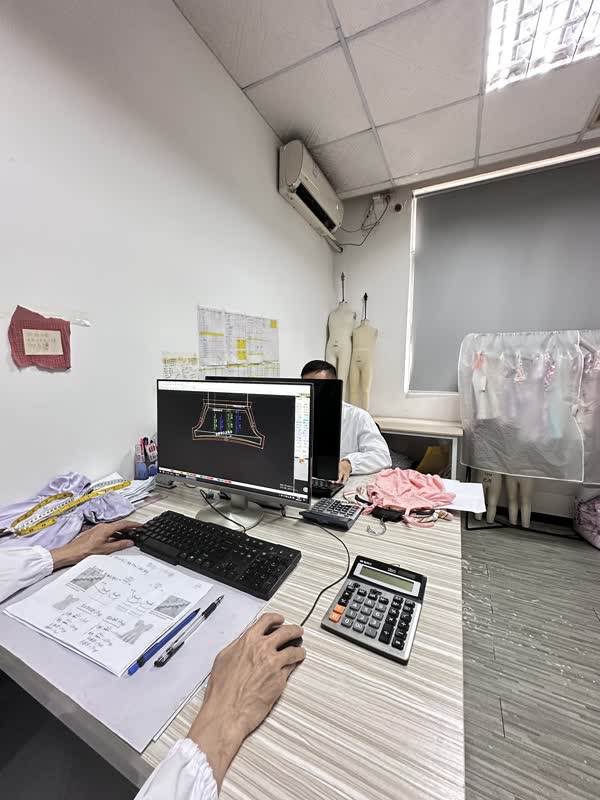
A private label clothing manufacturer holds three copies of your pattern: the paper master, the CAD file and the cutting copy on the table. A reorder only fits the same if all three carry the same version.
Why does my third run fit differently from my first? Because a correction agreed after the first fitting was applied to one copy and not the others, and bulk was cut from the copy that missed it. Nobody made a mistake at the machine. The filing failed.
This is the least dramatic failure in garment production and the most expensive, because it repeats on every reorder until someone opens the pattern bag and reads a date.
Where a pattern version gets lost: paper, CAD and the cutting copy
The paper master lives in the sample room because that is what the pattern maker holds while fitting. The CAD file lives on one machine, often one operator's desktop. The cutting copy sits in a sleeve at the table.
Corrections almost always land on the paper first, because the fitting happens in front of it. The CAD is updated later, or not at all. The cutting copy is printed from the CAD.
Three copies, three chances, and the gap between them is measured in centimetres at the waist.
What a 1 cm waist correction touches
A waist reduction of 1 cm is not one line. On a fitted bodice it changes the front, the back, the waist facing, the lining front and the lining back. Five pieces, and two of them are cut from a different fabric.
A 0.5 cm armhole change touches the armhole facing, the sleeve head, the sleeve, the lining and the back neck facing. Five or six pieces depending on how the block is split.
If the correction is applied to the shell and not the lining, the lining will be 1 cm larger than the shell. The garment still closes. It hangs wrong, and the customer reads that as cheap fabric.
Grading from the wrong base size
Our womenswear grade rules run 5 cm at the bust, 4 at the waist and 5 at the hip between sizes, from a base of M.
If the base block is version 1 and the size run is graded from version 2, every size is correct and the base is not. Size 14 lands about 1 cm off at the waist, which is exactly the size that gets returned.
Grading is arithmetic. It cannot detect that its input was the wrong file.
The five fields on our pattern change log
Every change gets one line: style code, version number, date, what changed and on which piece, and who approved it.
The line is written on the pattern bag in marker and in the header of the CAD file. A version without a log is a rumour, and rumours do not survive a staff change.
We keep the log with the sealed sample, so the approved garment and the file that made it are in the same place.
Never overwrite a file
Versions get a suffix: _v1, _v2, _v3. The cutting copy is exported read-only, and the pattern maker's working file is never the file the cutter receives.
Overwriting is the single most common cause of a reorder that fits differently, because the old version disappears without a trace and the new one looks authoritative.
A file with no version in the name has no history, and a pattern without history cannot be audited.
Pattern custody: who holds the master, in what format
Ask for the master in DXF, AAMA or ASTM format, or the native file from Gerber or Lectra. A PDF is a picture of a pattern. You cannot grade from it.
The paper master is 120 gsm card in a hanging bag with the style code on the outside. Ours are stored flat in a humidity-controlled room, because card that absorbs moisture grows and the pattern grows with it.
Ask what happens if you leave. Who keeps the block, what is handed over, and whether the graded set goes with it.
Why the third run is the one that breaks
Run one is made from the pattern that was corrected during sampling, so it is right by construction. Run two follows within a season and the same people remember it.
Run three comes after a gap, often after a holiday or a staff change. The memory is gone and only the file remains, which is why the file has to be enough on its own.
The reorder we cut from an overwritten file
In 2022 a client reordered 36 pieces of a crepe de chine dress. The pattern maker had saved the corrected DXF over the original filename, which was fine until the cutting copy was printed from a backup folder.
Twelve pieces came out 1 cm loose at the waist. We took them in at the side seam, which pulled the pocket bags out of line, and re-cut four from stock fabric. The fix cost about $290 and four days.
The garment was correct on the form. The version was not, and no one had asked which one we were cutting.
What to send with a reorder
Four things: the approved sample, the version number you expect, the change log, and one line on what must not change.
That last line is the useful one. "Do not change the waist, everything else may move 3 mm" tells a pattern maker more than a full spec sheet read cold.
Our private label program logs a version on every style, the case studies show a fit correction carried through a reorder, and the FAQ covers pattern ownership after a project ends.
Go deeper: who owns the pattern when you leave · the sealed sample that settles arguments · why a reorder costs 18 per cent less
Questions we get about this
Can you just send me the DXF now?
Yes, on request, and it is yours if you paid for the pattern development. Ask before the project starts, not after.
Do I need a version number if I only have one style?
One style still gets corrected. The first correction is exactly when a version number starts to matter.
Quick Take
Three copies, one version. Paper, CAD and cutting copy drift apart at the first fitting correction.
1 cm at the waist touches five pieces. Correct the shell and forget the lining and the garment hangs wrong.
Never overwrite. Suffix every file, log five fields, and export the cutting copy read-only.
About UP Fashion
UP Fashion is a Guangzhou garment manufacturer founded in 2016, run by a team with 20+ years of OEM experience in silk, viscose and embroidery. We quote from 30 pieces, show the rate we used, and inspect three times before shipping.





