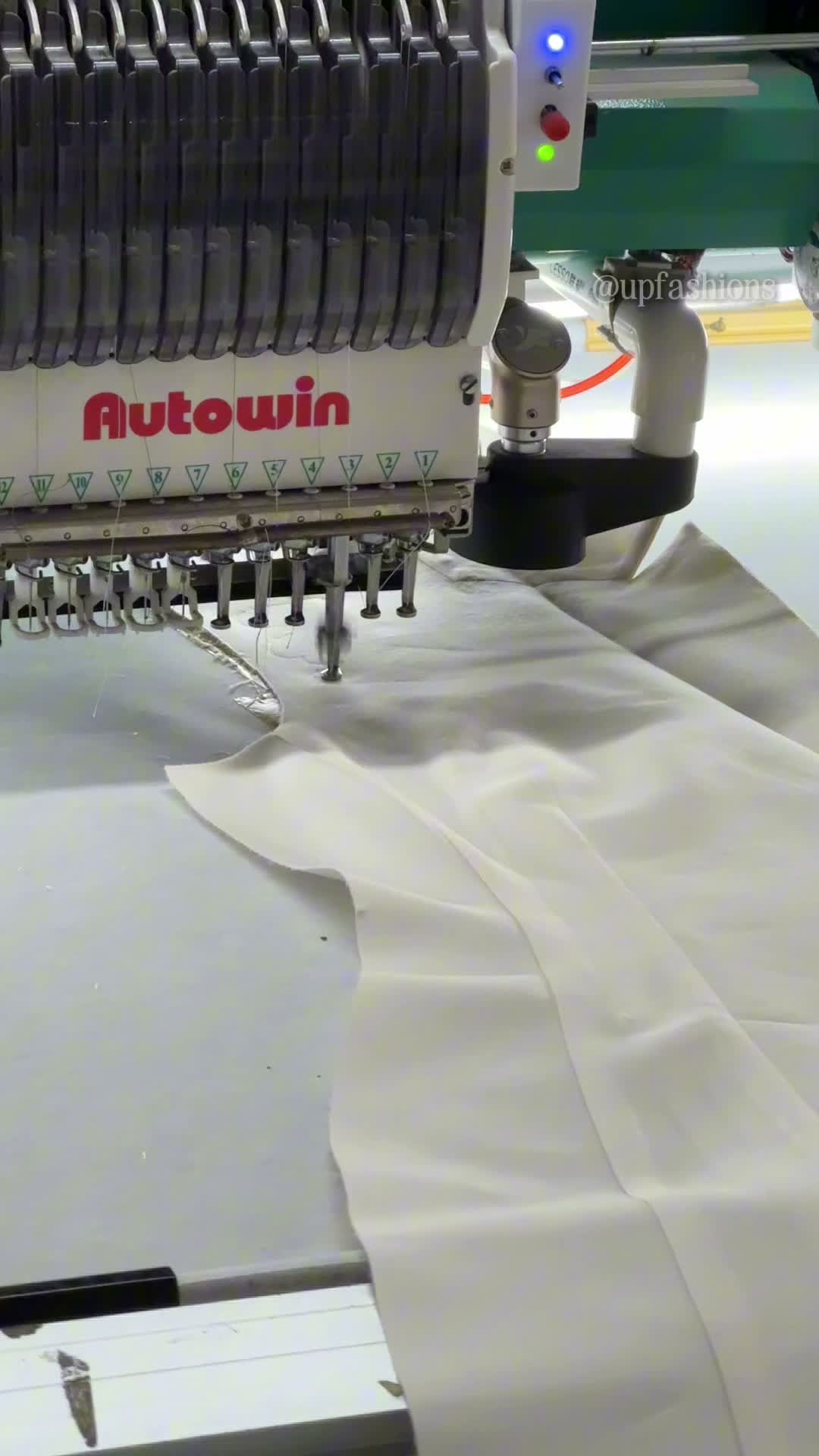
Embroidery on a 30-piece run lands around $12.60 a piece for a 7,800-stitch chest motif, and $180 of the first order is a file you pay for once. As a private label clothing manufacturer we keep that setup on its own quote line, because it is the line brands misread. The per-piece number looks like a stitching cost. Most of it is the spread of a fixed file over thirty garments instead of three hundred.
Why did your trim supplier quote $4 and your factory quote $12? The supplier quoted stitches and thread. The factory quoted stitches, thread, hooping time, backing, topping and the digitising file.
At 30 pieces that file divides by 30. At 300 it divides by 300, and nothing else about the motif changes.
Embroidery cost at 30 pieces vs 300: the arithmetic
Our stitch rate sits at $0.55 to $0.65 per 1,000 stitches for a six-colour chest motif. At 7,800 stitches that is $4.68 a garment.
Hooping is the number nobody quotes. Four minutes a piece at $0.28 a minute is $1.12, and on a soft viscose it can run to six minutes because the panel has to be stabilised before the frame closes.
Backing and topping add $0.35. Two layers of cut-away behind the motif, plus a water-soluble topping on top so the satin edge does not sink into the cloth.
Add it up and the sewing side is $6.15 a piece, or $184.50 across 30 pieces. Then the file: $180 once. Then thread, which we come back to.
The order totals $378.90, or $12.63 a piece. At 300 pieces the same motif is $6.80, and the difference is entirely the $180.
Why the first order feels expensive and the second does not
A reorder should not repeat the digitising fee if the artwork and the fabric have not changed. Ask for that in writing before you pay the first invoice.
If you switch fabric, the file usually has to be re-sewn and sometimes re-digitised. Pull is different on 110 gsm viscose than on a stable polyester, and a file tuned for one will pucker on the other.
What the $180 digitising file actually buys
Two hours at the machine, a vector path built from your artwork, and one test sew on your actual fabric. The test sew is the part worth paying for.
We sew the motif on an offcut of the bulk cloth, wash it once at 40°C, and photograph it next to the artwork. If the satin column is 0.3 mm narrow after washing, the file gets adjusted before the run, not after.
Cheap digitising exists and it shows up as registration drift. A file traced from a photo has no true circle and no consistent underlay, so the outline wanders by 2 to 3 mm across a 90 mm motif.
Artwork we need before we quote
Send vector, or a 300 dpi image at final size, plus the Pantone reference for each colour. A JPEG of a logo off your website is 72 dpi and about 400 px wide, which is not enough to place a stitch path.
Tell us the placement and the size in millimetres. Chest left at 90 mm and centre front at 140 mm are different files, different stitch counts and different prices.
Thread, backing and topping on a viscose panel
Six colours means six cones, and cones come in 5,000 m minimums at about $2.40 each. That is $14.40 of thread for a run that uses a fraction of it, and the rest sits in our store until your reorder.
Colour matching is where small runs lose time. We match to a Pantone TCX under 3000K light, then confirm on the actual cloth, because the same thread reads a shade warmer on ivory viscose than on white polyester.
Topping is not optional on a soft drape fabric. Without it the satin edge pulls the weave up and you get a halo of loose fibres around every letter.
How to approve embroidery on a small run
Approve a sewn sample, never a digital mock-up. The mock-up shows your artwork; the sewn sample shows what 7,800 stitches do to your fabric.
Check four things. Registration at the tightest curve, the density at the widest fill, the thread shade against the cloth, and the back of the motif, which should be clean enough to wear against skin.
Then wash it once at the temperature on your care label and look again. If the motif shrinks and the panel does not, you will see it as a pucker along one edge.
The 2019 motif we digitised from a photo
A brand sent a 600 px JPEG of a monogram and asked for 40 pieces at 110 mm. We digitised it in an afternoon and skipped the test sew to save a day.
Eleven pieces drifted 3 mm at the shoulder curve, and the viscose looped around the satin edge because we ran no topping. The client saw it in the photographs before the carton was sealed.
We re-ran 11 at $9.50 each, paid $60 to re-digitise properly, and lost six days. The file now costs $180 and includes the test sew, which is the cheapest insurance on the quote.
If you are pricing a decorated first run, our private label programme lists what a setup fee covers, the case studies show decorated runs at 30 pieces, and the FAQ answers what we will and will not embroider.
Go deeper: print minimums at 30 pieces · trims that survive a small run · care labels that match the decoration
Questions we get about this
Can I reuse the digitising file on my next order?
Yes, if the artwork, the size and the fabric stay the same. Change the fabric and we re-sew the file, usually at no charge. Change the size and it is a new file.
Is a 30-piece embroidery run worth it at all?
For a chest logo, yes. It costs about $12.60 a piece once. For a full-back motif at 25,000 stitches the setup and the sewing time push it past $30, and we would quote a woven label instead.
Quick Take
The file is the cost. $180 once, spread over 30 pieces, is $6 a garment before a stitch is sewn.
Hooping is real time. Four to six minutes a piece, and soft viscose is always the six.
Approve a sewn sample. Then wash it once at your care-label temperature and look at the edge.
About UP Fashion
UP Fashion is a Guangzhou garment manufacturer founded in 2016, run by a team with 20+ years of OEM experience in silk, viscose and embroidery. We quote from 30 pieces, show the rate we used, and inspect three times before shipping.





