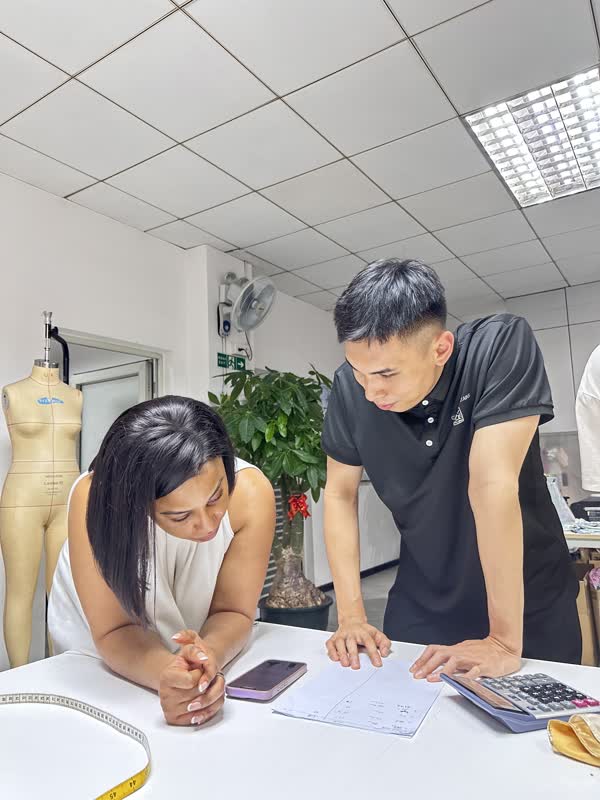
A garment sold in the US needs three things on a label before it can legally be offered: fibre content, country of origin and care instructions. As a private label clothing manufacturer we print what you approve, and we have watched a brand lose a stockist over a label that was one word wrong.
What has to be on a US apparel label? Fibre percentages in descending order, the country where the garment was made, the company marketing it, and care instructions that match how it should actually be washed. Children's products carry more, and we do not make them.
Fibre content: the percentage that gets checked
The FTC requires fibres listed by generic name, in order of weight, with percentages. Viscose and rayon are both accepted names for the same fibre in the US. Pick one and use it on the label, the invoice and the tech pack, because a mismatch invites a question.
The tolerance is 3 per cent on the stated fibre, and it does not cover a blend you guessed at. Write 100 per cent viscose on an 85/15 and the label is wrong even if the garment feels right in the hand.
This is where we failed once. A 2022 order of 40 dresses shipped labelled 100 per cent viscose on a 92/8 blend, because the mill changed composition on a reorder and nobody reopened the label file. The stockist caught it at receiving. Relabelling and rework cost $1.20 a piece and eleven days.
Care instructions that survive a customer wash
The Care Labeling Rule requires instructions that are accurate for the life of the garment, or a warning that it cannot be cleaned. Dry clean only is legal. Putting it on a washable viscose dress to be safe is a decision that costs you sales.
Our default for a 110 gsm viscose: machine wash cold on a gentle cycle, do not bleach, line dry, cool iron on the reverse. We wash one piece before the label file is confirmed, because a care instruction is a promise and a return is how the customer collects on it.
Symbols are optional in the US if the words are there. If you use them, use the ASTM set and keep the words as well. A symbol nobody recognises protects nobody, and a stockist will not argue with plain English.
Country of origin and who is responsible
Made in China has to be visible and legible, on the neck label or a side seam label, and it has to match the commercial invoice and the packing list. A garment labelled one country and invoiced as another is a customs problem, not a labelling problem.
The label also needs the identity of the company marketing the product, which is you. Your brand name plus a city and postcode is enough in most cases. We will not print our factory name as the marketer, because that would make us the seller and you the middleman.
Where the label actually goes
Neck labels sit at the centre back, 1 cm below the neck seam, sewn into the seam allowance rather than on top of it. On a 110 gsm viscose the label weight matters: a 40 mm woven label on a light dress pulls the neckline out by 2 mm over a week on a rail.
Care and content labels go into a left side seam, 12 to 15 cm below the armhole, so a customer can read them without turning the garment inside out. On a lined dress they go between the shell and the lining, which means they must be attached before the lining is closed.
That timing is the part brands miss. A label change after the lining is sewn is not a label change, it is an alteration, and on 30 pieces it costs $4 to $6 a garment.
Flammability and children's rules
Adult apparel textiles fall under 16 CFR 1610, a flammability test that plain viscose, polyester, cotton and their blends pass routinely. It becomes relevant with raised-surface fabrics and loose construction, not with a satin slip dress.
Children's apparel is a different regime under CPSIA, with tracking labels, lead limits and third-party testing at a laboratory. We do not produce it, and when a brand asks we say no rather than learn on their order.
California Prop 65 and PFAS: the two that catch small brands
Prop 65 is a warning requirement, not a ban. In apparel the realistic exposures are lead in metal trims and coatings, and phthalates in plastisol prints. Ask the trim supplier for a test report before the print is approved, not after the cartons are packed.
California's PFAS restriction on textile articles has applied to manufacture and sale since 1 January 2025. If your garment is water or stain repellent, that is the ingredient to check. A plain viscose dress with no finish is not the risk case, and most small brands over-worry here while under-worrying about fibre content.
None of this is legal advice, and we are a factory rather than a compliance department. What we can do is refuse to print a label we think is wrong. We do that a few times a year, and it has cost us orders.
What to send us before we print
Four files. The fibre composition from the mill, in writing. The care wording you want. Your legal entity name and address as it appears on your invoices.
And the artwork, at 300 dpi minimum with a 2 mm bleed. A logo pulled off your website will print at about 90 dpi and look soft on a woven label.
Then approve a printed sample, not a PDF. Colour on a woven label shifts, and a navy that reads black at the neck is a remake of 500 labels and a two-week delay.
On a 30-piece run the cost is small: about $0.18 for a woven main label at a 500-piece order, $0.06 for a printed care label, and $45 to $90 for artwork and setup. The mistake is never the cost. It is printing 500 before anyone reads the composition line.
If the label side of a first run is new to you, our FAQ covers what a factory needs before it quotes, and the private label program page shows what we handle from artwork to carton. The case studies include labels we reprinted at our own cost.
Go deeper: care label wording that survives a wash · what artwork to send a factory first · packing a small order for retail
Questions we get about this
Can the factory supply the labels for me?
We can print them, but the content has to come from you and your mill. Fibre percentages and care wording are the brand's responsibility, and a factory that invents them is guessing with your liability.
Do I need a separate country of origin label?
Not always. Made in China can sit on the main neck label as long as it is legible and permanent. Many brands add it to the care label instead, which is cheaper and equally accepted.
Quick Take
Three lines, no exceptions. Fibre content, country of origin, care instructions.
3 per cent. The fibre tolerance. It does not cover a blend nobody verified.
Print 500 after approval. A label file reopened at reorder is how 40 dresses get relabelled.
About UP Fashion
UP Fashion is a Guangzhou garment manufacturer founded in 2016, run by a team with 20+ years of OEM experience in silk, viscose and embroidery. We quote from 30 pieces, show the rate we used, and inspect three times before shipping.





