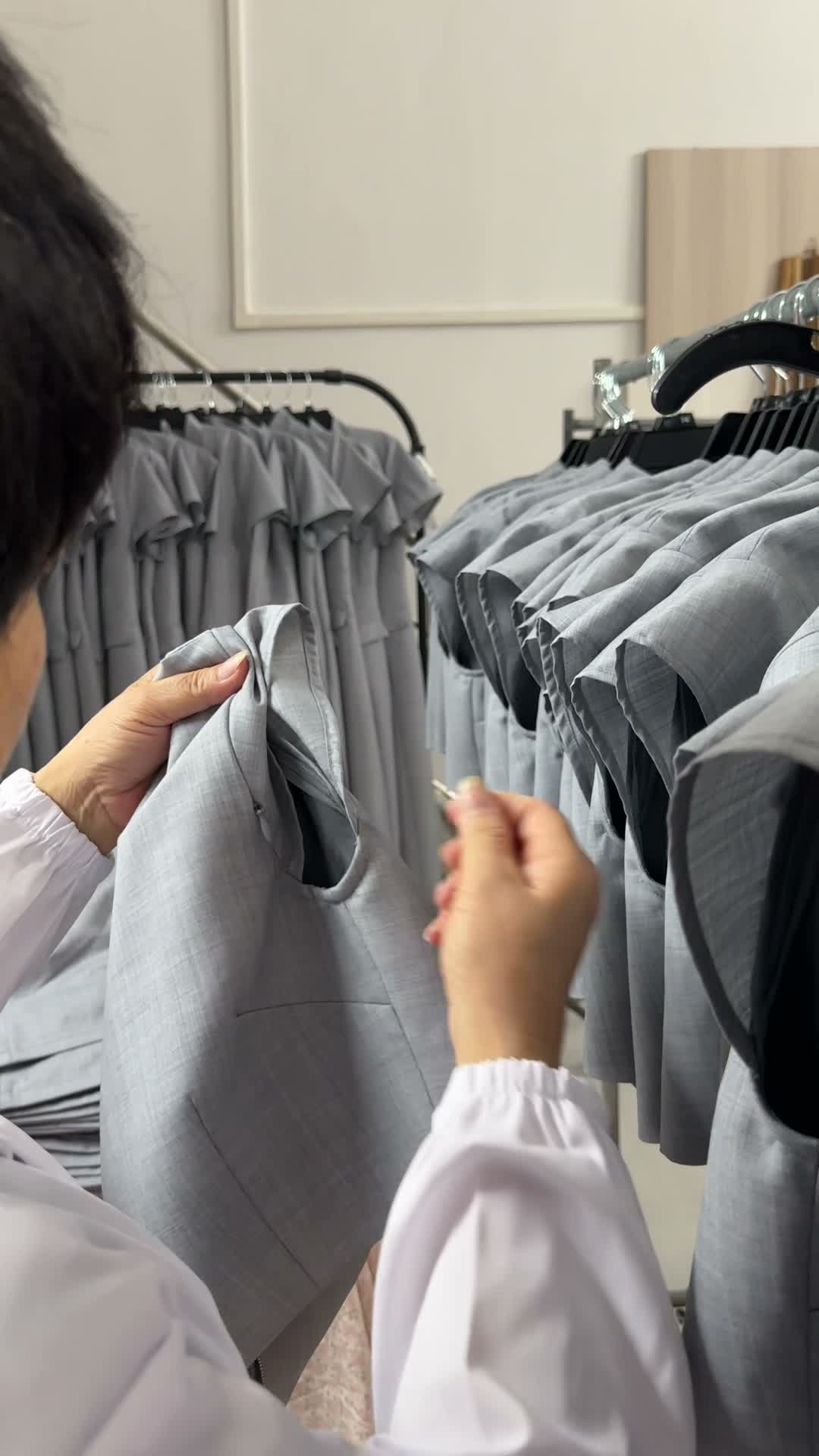
A private label clothing manufacturer applies your hangtag, and the string length is the part that fails an audit.
What does a hangtag cost? $0.07 to $0.14 a garment all in: printed tag, string, pin, and the 25 seconds to attach it. At 30 pieces that is under $5, which is why nobody looks at it until a stockist does.
The pull test is the step brands skip. A tag that comes off in a customer's hand is a return. A string that tangles in a returns sorter is a chargeback you will not win.
How long should a hangtag string be
75 mm is our default. It hangs clear of the garment on a rail, it does not tangle in a polybag, and it does not wrap itself around a button in transit.
Over 120 mm and the tag folds into the garment when it is bagged, which creases the tag and leaves a shadow on the cloth. Under 50 mm and the tag sits against the neck and hides the label you paid for.
If your stockist hangs on a security loop instead of a string, the loop replaces the string and the length rule changes. Ask them before you print 500 tags.
Where the tag attaches
Through the care label at the left side seam, the tag sits flat and does not pull the neckline. Through the neck label, a 30-piece run of light viscose will show a 2 mm stretch at centre back within a week on a rail.
That 2 mm is the difference between a garment that looks new and one that has been tried on. We learned it on a 110 gsm viscose, not on a heavy cloth.
Small parts pull test: what force to ask for
Adult apparel has no federal pull test, which is exactly why brands invent one. Ours is 5 kgf, about 49 newtons, held for 10 seconds on the tag, the button and any cord end.
Children's garments sit in a different regime at 15 lbf, about 67 newtons, plus a small parts cylinder. We do not make children's wear, so we do not quote it.
A tag that holds 5 kgf will not come off in a fitting room. A tag attached with a single knot instead of a loop fails at about 2 kgf, and that is the failure we see most often.
Ask the factory what force it tests at. A number is a system. "We check them" is not.
What a hangtag actually costs at 30 pieces
Printed tag $0.06 to $0.12 depending on stock and finish. String $0.015 to $0.03. Nickel-free safety pin $0.008. Application 22 to 30 seconds, $0.09 at our rate.
On 30 pieces the total is $5 to $7, plus $45 to $90 for a plate or setup charge if the artwork is new. The setup is the real cost, and it is why a 30-piece run should reuse a tag design rather than invent one.
Print the tag with the care label in the same order. Two print runs mean two setup charges and two chances of a colour mismatch between a navy tag and a navy label.
The trim minimum nobody warns you about
Tag printers work in 500 or 1,000. A 30-piece order still buys 500 tags, so the per-piece cost on your invoice looks wrong until you accept that 470 tags go into a drawer.
Keep them. They are good for two years in a dry room, and your reorder will not pay the setup again.
Where our hangtags failed a stockist audit
In 2021 we attached 30 tags with a knotted string because the loop tool was at the other station. The garments passed our own inspection, which only checked that a tag was present.
The stockist's audit pulled six tags off by hand. Not a machine, a person, in about four seconds each.
We re-tagged all 30 in Guangzhou, air-freighted the cartons, and paid $180 in freight on a $4,200 order. The lesson was not about the knot. It was that our inspection sheet had no line for attachment.
Now it has one: pull every tag on the first and last garment of the bundle at 5 kgf and record pass or fail. It takes 40 seconds and it has not failed since.
Nickel, dye and the pin nobody checks
A safety pin touches the garment for weeks. A nickel-plated pin on a white silk blouse can leave a mark, and in a damp container it can leave a rust spot that reads as a stain at the neck.
We use nickel-free and ask the supplier for the report once a year. It costs about $0.002 more a pin, which is $0.06 on 30 pieces.
The string has the same problem in a different form. A cheap dyed string bleeds onto an ivory garment in a humid container, and the mark appears exactly where everyone looks.
Cord ends and drawstrings on the same sheet
A drawstring is a small part even when it is sewn into the garment. On adult styles we cap the cord at 220 mm exposed and lock the ends with a bartack so the cord cannot pull out of the channel.
On a viscose trouser the channel is often 8 mm wide against a 6 mm cord, which leaves 2 mm of play. That play is what makes a cord disappear inside the waistband on the first wear.
Ask for the cord length measured exposed, not total. A factory that quotes total length will hand you a cord that looks right flat and vanishes when the waistband gathers.
What to put in the packing spec
Six lines. Tag position, string length in millimetres, attachment method, pin type, whether the tag sits inside or outside the polybag, and the pull force you will accept.
Inside or outside matters commercially. A tag outside the bag is scanned at receiving; inside, it is scanned after opening, and some warehouses charge for that handling.
Then photograph one packed garment from the front and one from the back, and attach both to the confirmation. It is the cheapest specification you will ever write.
If this is your first private label run, the private label program page shows what we handle from artwork to carton. The FAQ covers trims and packing, and the case studies include the re-tagging week.
Go deeper: what artwork to send a factory first · the trim minimums at 30 pieces · packing a small order for retail
Questions we get about this
Can I supply my own hangtags?
Yes, and it is often cheaper. Ship them to us with the care labels, not after the bulk is sewn, because attaching 30 tags is a 15-minute job and re-opening cartons is not.
Do I need a pull test report?
For adult apparel, only if your stockist asks. Keep the record anyway: the force, the parts tested and the date. It answers the question in one page instead of one week.
Quick Take
75 mm of string. Longer creases the tag, shorter hides the label.
5 kgf for 10 seconds. A knot fails at 2, and a knot is what we used in 2021.
$5 on 30 pieces. The $180 air freight came from skipping a 40-second check.
About UP Fashion
UP Fashion is a Guangzhou garment manufacturer founded in 2016, run by a team with 20+ years of OEM experience in silk, viscose and embroidery. We quote from 30 pieces, show the rate we used, and inspect three times before shipping.





