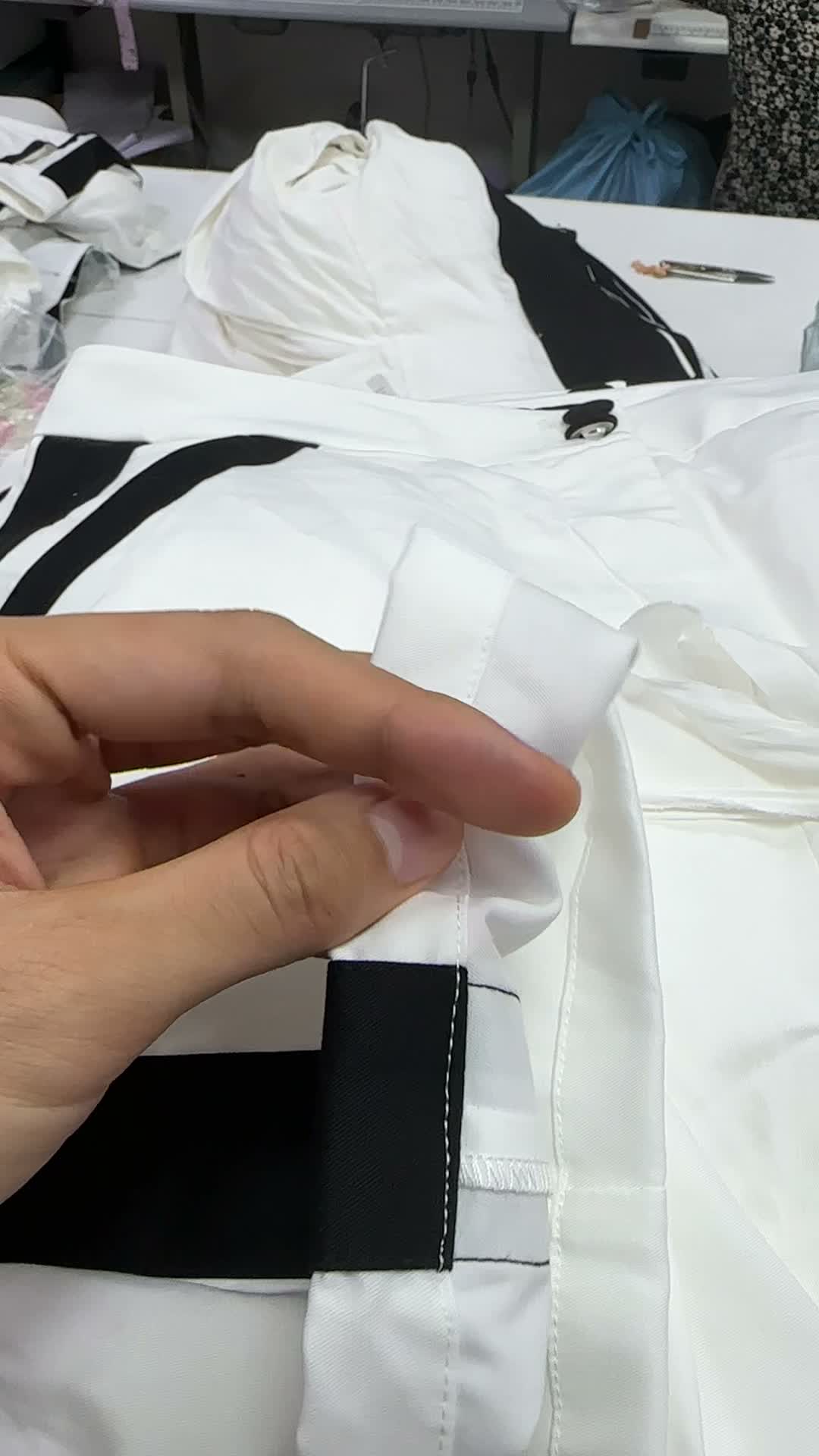
A high end clothing manufacturer spends more time on a collar band than on the front of a shirt. That is not vanity. The band touches skin all day, and it is the one place where two millimetres of error is visible from a metre away.
What makes a band fail? Three things, in this order: the turn of cloth at the top edge, the interlining, and the height against the leaf. All three are settled before the first stitch.
What a collar band is, and why the strip is cut 7 cm
The band is the stand the collar leaf sits on. Finished height is usually 2.8 to 3.2 cm on a dress shirt; 3.5 cm and up reads casual or workwear.
The cut strip is roughly twice the finished height plus seam allowance, so 7 cm for a 3 cm band with a folded top edge and 1 cm seams.
Cut it 6 cm and the band finishes at 2.5 cm. The shirt still closes, but the collar sits low and the leaf covers the top button, which is not the look anyone ordered.
Turn of cloth: the 2 mm that decides the roll
The leaf has to be 2 to 3 mm larger than the band along the top edge, because the band folds over it and the fold eats cloth.
Cut them equal and the seam pulls tight, the leaf stands up instead of rolling, and the collar looks starched even when it is not.
On a $180 shirt this is the difference a buyer notices without being able to name. We measure it with a steel rule on every counter sample, not by eye.
Interlining: fused, sewn-in, or none at all
Most bands are fused with a 0.4 to 0.6 mm interlining at 140°C for 8 to 10 seconds. That holds the stand up and keeps the top edge crisp through washing.
A 0.3 mm fusible is cheaper and bubbles after about five washes, usually along the fold where it shows most.
A sewn-in interlining gives a softer roll and costs more minutes. We use it on linen and cotton-linen, where a fused band reads stiff against a slubby cloth.
Band height against leaf length: the proportion nobody checks
A 3.0 cm band with a 7.5 cm leaf point is the classic dress-shirt proportion. A 3.5 cm band with a 7.0 cm point is a different garment: shorter leaf, taller stand, reads casual.
Neither is wrong. Mixing them without deciding is wrong, and it happens when the band and the leaf are taken from two different patterns.
We put both numbers in the tech pack comment, because a factory will otherwise use whatever block is nearest the bench.
Stitch density and topstitch distance at the band edge
Eight to nine stitches per inch on the band edge holds the fold without puckering poplin. Twelve looks neat on a swatch and ripples along the seam on a finished collar.
Topstitch 1.5 mm from the fold. At 3 mm the stitching drifts into the middle of the band and the edge loses its line; at 1 mm the needle catches the fold and the seam fails first.
Thread matters here too. A poly-core thread at the same ticket number sits heavier than cotton and shows every tension change.
Cost: what a proper band adds at 30 pieces
A separate band and leaf, cut and joined, adds about $0.90 per shirt against $0.55 for a one-piece collar. On 30 pieces that is $10.50 and roughly 45 extra minutes.
That is the whole argument for doing it properly. The band is not where a small run saves money, and it is the first place a buyer looks.
Where a small run does save is in the sample. One counter sample with a correct band tells you more than three mock-ups with a wrong one.
Where our bands have failed
In 2022 we cut 30 poplin shirts with a 3.2 cm band against a 7.4 cm leaf. The top button stood 4 mm proud of the stand and the collar would not sit flat when closed.
We re-cut 30 bands, re-set 30 collars and lost three days. The bill was $180, and the lesson was that 2 mm of turn is a measurement, not an opinion.
Since then the band height and the leaf length go on the counter sample sheet as two numbers with tolerances, and the fit model closes the top button before we approve anything.
What to check on a collar sample before you approve
Close the top button. If the stand gaps at the throat or the leaf lifts, the turn of cloth is wrong.
Turn the collar down and look at the roll from the side. A correct roll curves; a flat fold means the leaf is too small for the band.
Measure the band at the centre front and at both ends. More than 2 mm of variation means it was cut off grain or pressed unevenly.
Wash one sample. A fused band that bubbles at the fold will do it in your customer's hands, not in your studio.
Our high end production standards put band and leaf tolerances on the counter sample sheet. The FAQ covers sample rounds, and the case studies include the run where 30 bands were re-cut.
Go deeper: the front placket and its four layers · why fusible bubbles after a few wears · the counter sample you approve before bulk
Questions we get about this
Can a 30-piece shirt run have a separate collar band?
Yes, and it is the version we recommend. The extra cost is about $0.90 a shirt and 45 minutes across the run. What it buys is a collar that rolls instead of standing up, which is the first thing a stockist looks at.
Should the band be fused on linen?
Usually not. Linen and cotton-linen read better with a sewn-in interlining or a very light fusible, because a stiff band against a slubby cloth looks like two garments joined at the neck.
Quick Take
2 to 3 mm. How much larger the leaf must be than the band, or the collar stands up instead of rolling.
7 cm strip. What a 3 cm finished band is cut at, once seams and the folded top edge are counted.
$180, three days. What 30 re-cut bands cost us in 2022 for 4 mm of proud button.
About UP Fashion
UP Fashion is a Guangzhou garment manufacturer founded in 2016, run by a team with 20+ years of OEM experience in silk, viscose and embroidery. We quote from 30 pieces, show the rate we used, and inspect three times before shipping.





