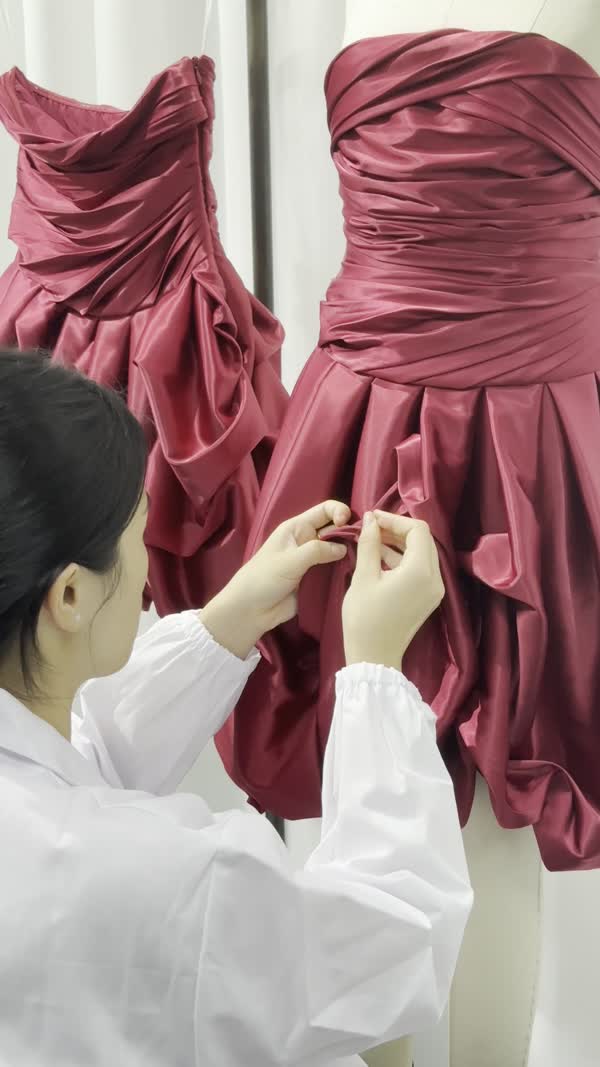
As a private label clothing manufacturer we cut a counter sample before every bulk run, and we cut it on the same line that will sew the order.
What is a counter sample? It is one garment made from your bulk fabric, your production trims and the production pattern, sewn by the operator who will run the style. You sign it, we seal it, and that single garment becomes the standard for the whole order.
Most first-time brands confuse it with the mock-up and skip the approval. That is the mistake we see most often, and it is expensive in a way that only shows up six weeks later.
Counter sample vs mock-up: three things change
The mock-up is a design tool. It is made in the sample room, usually from sample fabric, often by the pattern maker rather than a line operator.
The counter sample is a production document. Three things change at this stage: the cloth comes off the bulk roll, the trims are the ones actually ordered, and the machine and operator are the ones booked for your run.
That third point is the one brands underestimate. A mock-up sewn by a sample-room tailor at 40 pieces a week and a bulk run sewn at 90 pieces a day are not the same garment, even with the same pattern.
Bulk cloth behaves differently from sample cloth
Sample fabric is often the mill's stock length, cut from the middle of a roll that has relaxed for weeks. Bulk cloth arrives compressed, sometimes still warm from the finishing line.
On a 145 gsm viscose crepe we expect 2.5 cm of length loss in the first wash, and 4 to 5 cm on a 110 gsm plain. A mock-up in stock cloth will not show you that.
The counter sample will, because it is the cloth you are actually buying.
Trims arrive late and get substituted
Your zip, your buttons and your label all have lead times. On a 30-piece run the trim order often lands after the mock-up is approved, and sometimes the exact item is out of stock.
The counter sample is where a substitution becomes visible. A 4 mm change in button diameter is nothing on a spec sheet and obvious in the hand.
What a counter sample approval sheet must contain
One page, signed before cutting. Ours carries nine lines: style number, fabric roll and dye lot, trim list with supplier, measurement table for every size in the run, seam allowance, stitch density, thread colour, label placement, and the ship date the sample was made against.
If a factory hands you a counter sample with no paperwork, you are approving a garment you can never prove anything about. Ask for the sheet.
The numbers we write down
Measurement tolerance is plus or minus 6 mm on most woven styles and 4 mm on a fitted bodice. Stitch density is 12 to 14 SPI on a main seam and 10 to 11 on a viscose that puckers.
Colour is checked at Delta E 1.2 against the approved lab dip, and fabric weight at 5 per cent either side of nominal GSM. Those four numbers settle most arguments before they start.
Ten minutes at the counter sample
You do not need a fit model to catch the common faults. Put the garment on a mannequin and look at four places.
Check the side seam first, from armhole to hem, and see whether it swings or twists. Then the centre back, where a 3 mm drift is invisible flat and obvious worn.
Next the armhole, inside and out, for puckering at the sleeve head. Then the hem, measured at four points against the spec.
Finally turn it inside out. Thread ends, a raw edge and a skipped stitch at the underarm are all things the outside will not tell you.
Where our own counter sample failed
In 2022 a brand changed the lining of a 30-piece dress two days before we cut the counter. The message arrived while the sample was on the machine, and nobody carried it to the cutting table.
We sewed the counter in the old lining and the bulk in the new one. Both were correct against their own paperwork, which is exactly why the client did not notice for three weeks.
The lining had a different hand and the dresses hung stiffer. We reworked 12 and replaced the remaining lining at our cost, about $6.80 a piece.
The fix was not a better system. It was one rule: a counter sample is re-cut, not amended, if any material changes after it is sewn.
Counter sample cost and time
We charge $65 to $95 for a counter sample on a dress or blouse, and $120 to $180 on a lined blazer. That covers the garment, the sheet and the photographs.
It takes three working days once the bulk fabric is in the building. If the cloth is still at the mill, the sample waits, and that wait is the reason a 30-piece run takes nine weeks instead of seven.
The cost is refunded against the bulk invoice on orders above 100 pieces. Below that we keep it, because the garment stays in our archive with your pattern.
Who keeps the sealed sample
We keep two. One stays sealed in the archive with your style number and the date, and one goes to the line as the reference at every inspection.
The archive copy is the one that matters in a dispute. If a claim reaches us in month four, the sealed garment is the only honest witness, and it is also why we photograph it from six angles on the day it is approved.
If you want a third for your own records, ask. We ship it with the bulk at no charge.
Before you book a run, read the private label program page for what each stage commits you to, the FAQ for sampling and deposit questions, and the case studies for a run where the counter sample saved the order.
Go deeper: how mock-up rounds work · the sealed sample archive · who tries the sample on
Questions we get about this
Can we skip the counter sample on a reorder?
Yes, if the fabric roll and the trims are the same and the pattern has not been touched. We still sew one piece and photograph it before the line starts.
What if the bulk fabric is a different dye lot?
Then the counter sample is mandatory. A new lot shifts colour and often hand, and a 1.2 Delta E difference is enough to make a reorder read as a different product.
Quick Take
Counter sample, not mock-up. Bulk cloth, bulk trims, the operator who will sew your run.
Nine lines on one page. No sheet, no proof, no claim.
Three days and $65 to $95. Cheaper than reworking 12 dresses.
About UP Fashion
UP Fashion is a Guangzhou garment manufacturer founded in 2016, run by a team with 20+ years of OEM experience in silk, viscose and embroidery. We quote from 30 pieces, show the rate we used, and inspect three times before shipping.





