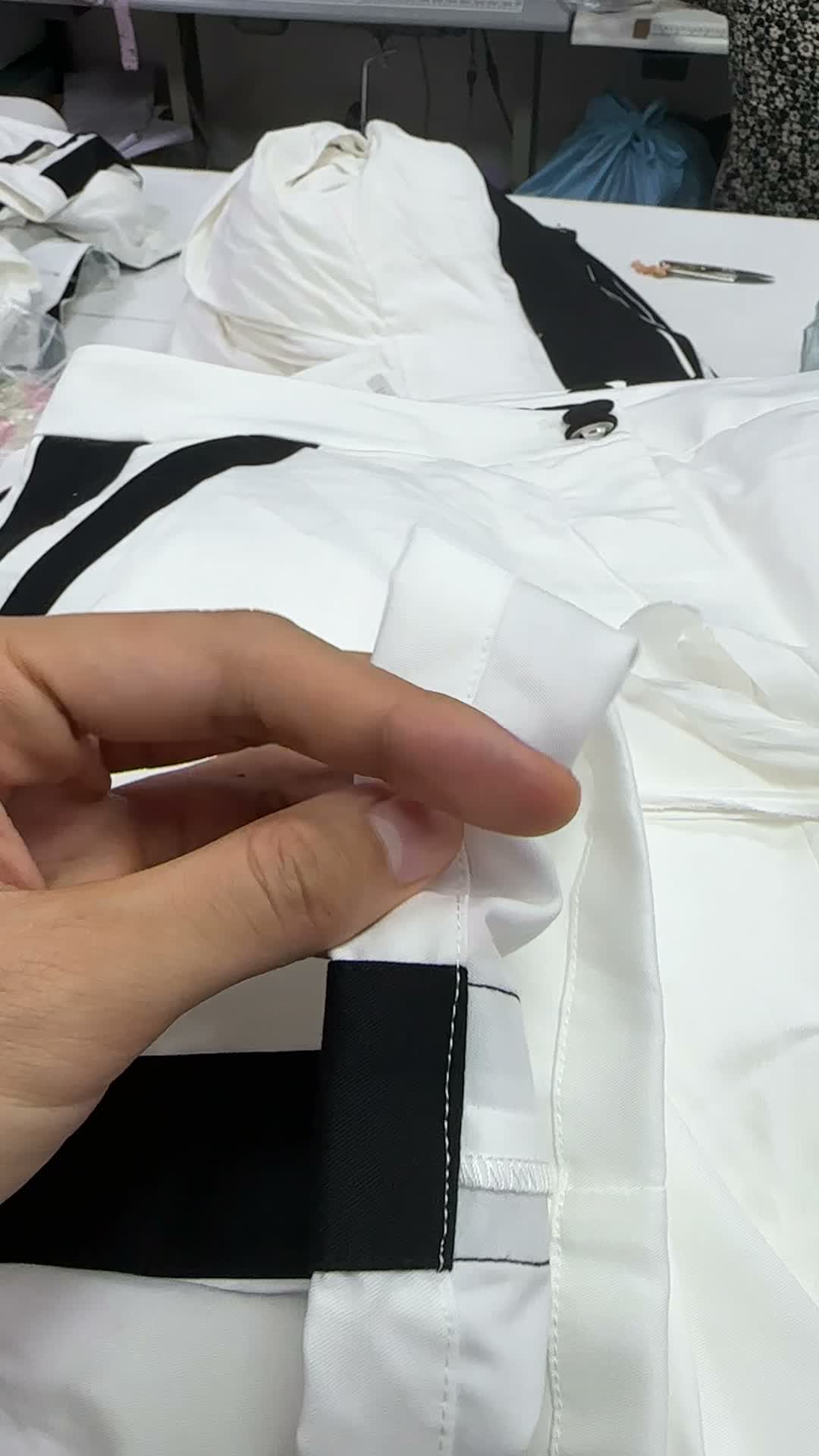
A high end clothing manufacturer spends more on needles in a week than on thread in a month, and almost nobody asks about it. Needle size and point decide whether a seam sits flat or leaves a line of holes down the front of a dress.
The question behind most needle conversations is why the first three centimetres of a seam pucker and the rest of it looks fine. It is rarely the machine. It is a needle meeting cloth it was not chosen for, at the point where that cloth has been folded longest.
Needle size by fabric weight: the four numbers we keep on the table
70/10 for 19 to 22 momme silk and fine viscose. 80/12 for standard viscose, lining and satin. 90/14 for cotton, linen and cotton-linen blends. 100/16 for TR suiting and heavier twill.
The first number is the metric size in hundredths of a millimetre, the second is the old Singer number. A 90/14 needle is 0.9 millimetres across the blade, and that is the hole it makes.
One size too heavy is not a small error. On a fine viscose it puckers the seam before the thread ever breaks, and on satin it leaves a permanent track along the stitch line.
Sharp, ballpoint or cutting point
Woven cloth takes a sharp needle with a round shank and a conical point, which pushes between yarns instead of cutting them. That is our default, because almost everything we sew is woven.
Ballpoint has a rounded tip that slips between loops rather than piercing them, and it belongs on jersey and rib. A sharp on a knit is how a small hole becomes a run after three washes.
Cutting point is for coated cloth and leather-look finishes, where a sharp tip would tear the surface rather than part it. We use it rarely, and never on satin.
Why the first three centimetres pucker
The start of a seam sits on a fold that has been pressed into the roll for weeks. The weave there is compacted, so the needle meets denser cloth than it will ten centimetres later, and the feed dog pulls against a section that will not stretch.
Two fixes work. Start a centimetre inside the seam allowance and backstitch over it, or run a strip of scrap cloth through first as a leader. Both take seconds and both remove the pucker.
If the pucker runs the whole seam instead, it is tension or needle size, not the fold.
Needle plate and feed dog: the other half of the pucker
A correct needle still puckers if the feed dog is set for heavy fabric. Fine cloth needs a fine-tooth dog and a needle plate with a small hole, otherwise the cloth is dragged down into the gap between them.
We keep a second plate and dog set for silk and fine viscose, and swapping them takes about ten minutes. Most factories do not bother, because most runs are not silk.
Eight hours, then change the needle
An industrial needle is good for about eight hours of running, or roughly 4,000 to 6,000 stitches through medium cloth. After that the point dulls, the blade picks up a burr, and the burr cuts filaments instead of parting them.
Needles cost $0.12 to $0.30 each, so a 30-piece run spends maybe $4 on them across three machines. A dull needle spends that much in rework on the first garment it marks.
We change at the start of every shift, and immediately after any needle break, because a broken needle can leave a fragment inside the seam where nobody will find it until a customer does.
Needle holes that never close
On 19 momme silk, a 90/14 leaves a 0.9 millimetre hole and the fibre does not recover. Under a 5000K lamp it reads as a dotted line beside the seam, and pressing does not remove it.
In 2021 we ran 40 silk blouses with the wrong needle in one machine. Nine front panels carried a visible line along the princess seam, we remade them, and the run shipped five days late.
The cost was about $380 in cloth and labour. The cause was a needle nobody had changed, because the machine was sewing "fine".
The four-minute test seam
Before every run we sew 30 centimetres on the actual bulk cloth, in both directions, and look at it under daylight. We check for holes holding light, for pucker at the start, and for the stitch sitting in the cloth rather than on top of it.
That is four minutes against a remake that takes five days. It is the cheapest test in the building.
Why the same needle behaves differently on two machines
Two identical machines set up by two operators will not sew the same seam. Needle height, presser foot pressure and the timing of the take-up lever all change how the stitch is drawn into the cloth.
That is why we test on the machine that will run the bulk, not on the sample machine. The sample machine is set for one garment a day; the line machine is set for forty.
What to put in your tech pack about stitching
Three lines are enough: needle size, stitch density per centimetre, and whether the seam should be visible. Add the thread Tex number if you have one, and we will match the rest.
If you do not know the numbers, send the cloth and a sample you like. We will set the needle from the swatch and photograph the test seam before the run starts.
Our production standards page lists the needle schedule, the case studies include a needle-mark remake, and the FAQ covers who supplies needles on a short run.
Go deeper: how stitch density decides whether a seam holds · why your seam reads a shade off · what a luxury workshop does differently
Questions we get about this
Can I specify the needle in my tech pack?
Yes, and we will follow it. If the cloth disagrees with the number, we will tell you before the run rather than after the remake.
Do you charge for the test seam?
No. It is part of setting up the line, and it is cheaper than the alternative for both of us.
Quick Take
70/10 for silk and fine viscose, 80/12 for satin and lining, 90/14 for cotton, 100/16 for suiting. The metric number is the hole in millimetres.
Eight hours of running, then change. A dull point cuts filaments instead of parting them, and the burr marks cloth on the first garment.
Pucker at the start is the fold, not the machine. Start a centimetre inside the allowance, or lead with scrap cloth.
About UP Fashion
UP Fashion is a Guangzhou garment manufacturer founded in 2016, run by a team with 20+ years of OEM experience in silk, viscose and embroidery. We quote from 30 pieces, show the rate we used, and inspect three times before shipping.





