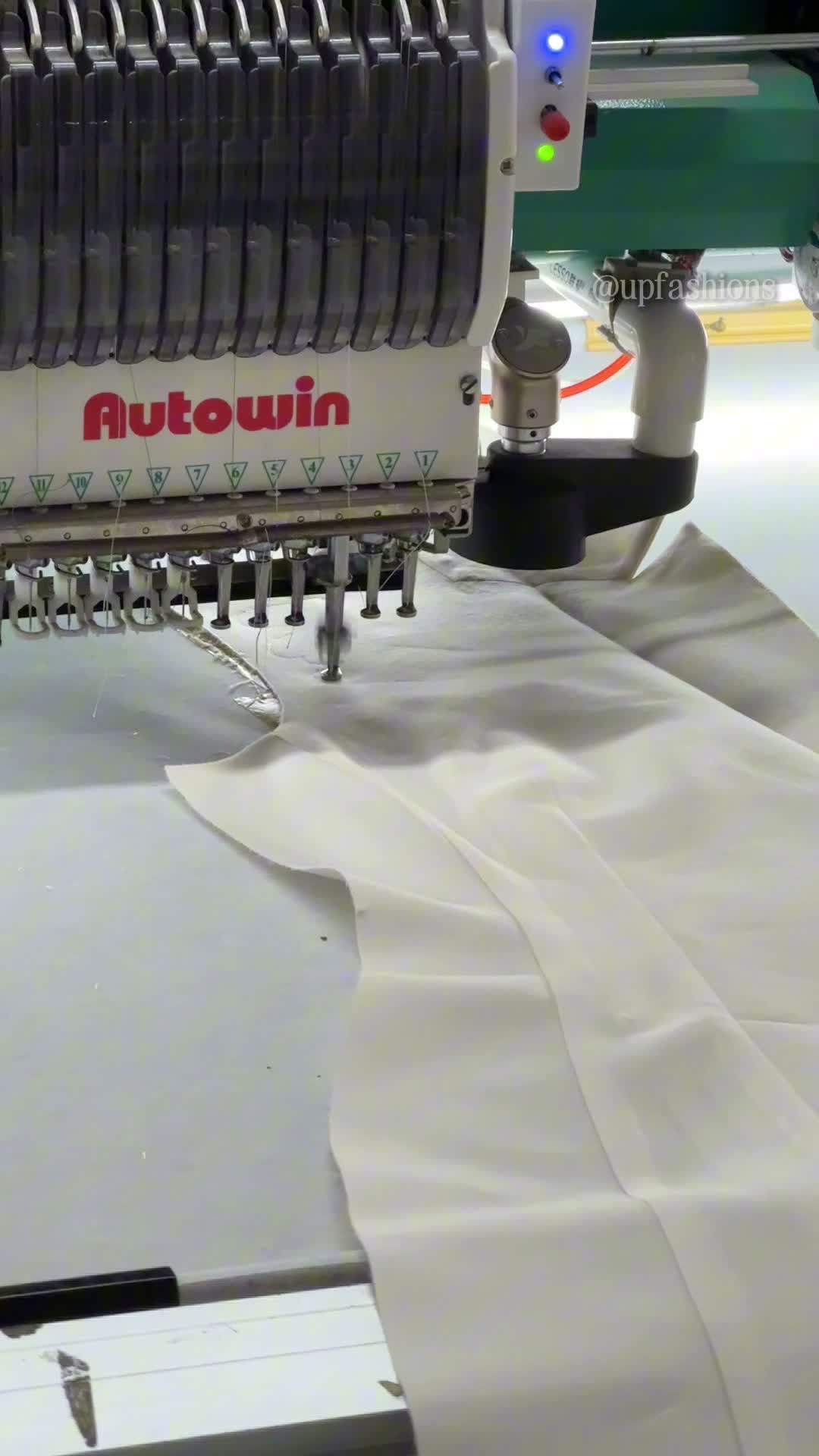
A pintuck is a narrow channel stitched into the cloth and pressed flat, and twelve of them across a bodice remove about 4 cm of width. That is the whole trick: you shape a garment without a single dart. A private label clothing manufacturer will quote pintucks as a construction line, and that line is bigger than most first-time brands expect.
How much do they cost? At 30 pieces we charge $2.40 to $4.10 a garment for twelve rows on a bodice. Each row is 40 cm of stitching plus two press passes, and the row count is what drives the price, not the cloth.
Here is where the width goes, why rows drift on viscose, and the blouse where row seven landed 4 mm off.
How much width twelve pintucks actually remove
A 2 mm pintuck consumes about 4 mm of surface: 2 mm for each side of the fold plus the fold itself. Twelve rows take roughly 4.8 cm off the panel.
We quote 4 cm because the cloth recovers a little after pressing. On a 96 cm bust that is 4 percent of the circumference, which is the difference between a relaxed blouse and a fitted one.
This is why pintucks are usually a design decision and a fit decision at the same time. If the pattern is graded for a 96 cm bust and you add twelve rows, the finished garment measures 92 cm and the fit comment comes back as too tight.
Pintuck width: 1.5 mm, 2 mm and 3 mm
1.5 mm on a cotton lawn at 90 gsm, because a wider channel disappears in a light cloth. 2 mm is our standard on viscose and cotton poplin. 3 mm on a linen blend or a heavier TR, where a fine channel reads as a stitching fault.
The foot decides the width, and the foot is fixed. We keep three sizes on the line, which means a brand that asks for 1.5 mm and 2.5 mm on the same garment is asking for two setups.
Two setups on 30 pieces is fine. Two setups on 300 is a scheduling problem, and we will say so at quotation.
Why pintucks wander on viscose and hold on cotton lawn
Viscose at 120 gsm has a low twist and a slick surface. The feed dogs grip one layer slightly more than the other and the row curves by 1 to 2 mm over a 40 cm run.
Two fixes. Sew over a strip of 20 gsm tissue paper and tear it away after, or use a walking foot with the pressure backed off half a turn.
Cotton lawn at 90 gsm holds a row straight with neither fix, because the surface has enough friction. We still use the tissue paper on anything with a sheen, because a wandering row shows under a light.
Marking twelve rows: by hand or with a jig
By hand, twelve rows at 2.5 cm spacing take 40 minutes a panel, and the last three rows are always the ones that drift because the marker is tired.
We built a 60 cm acrylic jig with twelve slots. It takes 11 minutes a panel and the spacing is fixed at whatever the slots are, so we cut a new jig for a new spacing.
A jig costs about $60 once. On a single 30-piece run it pays for itself in 12 panels, which is 6 garments.
Pressing pintucks before the seam closes
Press each row as it is sewn, then block press the whole panel before any seam goes in. A row pressed after the side seam is closed will pull 2 mm at the seam and the rows will fan.
We press on a needle board with a dry iron at 140 C for viscose and 160 C for cotton, and we let the panel cool flat for 10 minutes.
Cooling flat is not fussiness. Cloth that is moved while warm takes the shape of whatever it is folded over, and on a bodice that shape is usually a crease across the bust.
What twelve pintucks add to a 30-piece order
Labour is $2.40 to $4.10 a garment, so $72 to $123 across 30 pieces. The spread is the row length and whether the rows stop at the waist or run to the hem.
Cloth adds about 0.35 m a garment for the width the pintucks consume, which at $12 a metre is $4.20 a piece. That is the number brands forget, because the panel looks the same size on paper.
Total is roughly $7 to $8.50 a garment on a $95 wholesale blouse. It is real money, and it is also the reason the blouse looks like a $95 blouse.
The blouse where row seven drifted 4 mm
In 2023 we ran 30 viscose blouses with twelve rows. The operator skipped the tissue paper on six front panels because the roll had run out and nobody restocked it.
Rows six to eight pulled to one side on those six panels. Four millimetres at the row, 9 mm at the side seam, and visible in any photo taken straight on.
We re-cut six fronts, used 2.1 metres of cloth, and lost nine days. The tissue paper now sits in the notion bin at the machine, not in the store room.
When a pintuck is the wrong choice
On a bias panel, a pintuck fights the grain. The row wants to run straight and the cloth wants to hang diagonally, and the result is a channel that looks like a pulled seam.
On a knit or anything with more than 5 percent stretch, the rows ripple after the first wash and no press brings them back.
And on a very light silk under 60 gsm, the needle marks show at the fold. If the design needs texture there, we use a tuck that is stitched down instead, which is a different and cheaper line.
What to send us for a pintuck spec
Five numbers: channel width, row count, spacing between rows, thread ticket, and where the rows start and stop. Add the finish at the end of each row, because a row that runs into a seam needs no backtack and one that stops in the open does.
A photo of a reference garment with a ruler across the rows settles the spacing faster than any drawing. We measure the spacing on the photo and confirm it before we cut the jig.
If the rows are meant to shape the bodice, tell us the finished bust measurement you want. We will do the arithmetic backwards and tell you the row count that gets there, which sometimes is nine and not twelve.
Our private label program cuts a jig per spacing so the rows do not drift. The FAQ covers construction pricing, and the case studies include the six re-cut fronts.
Go deeper: why 30 pieces never gather the same · why a bias slip needs 30 percent more cloth · the stitch that stops a neckline rolling
Questions we get about this
How much width do twelve pintucks remove from a bodice?
About 4.8 cm of surface on a 2 mm channel, and we quote 4 cm because the cloth recovers slightly after pressing. On a 96 cm bust that is 4 percent of the circumference. If the pattern is graded for 96 cm and you add twelve rows, the finished garment measures about 92 cm, so the block has to be adjusted before cutting.
Why do my pintucks come out wavy?
Usually the feed dogs are gripping the two layers unevenly, which is common on viscose under 140 gsm. Sew over 20 gsm tissue paper and tear it away, or switch to a walking foot with the pressure backed off. Also press each row as it is sewn. A row pressed after the side seam is closed pulls about 2 mm at the seam and the rows fan.
Quick Take
4.8 cm. What twelve 2 mm rows take off a bodice. We quote 4 cm, and the pattern has to be graded for it.
11 minutes. A panel with our twelve-slot jig. By hand it is 40 minutes, and the last three rows are the ones that drift.
4 mm. How far row seven pulled in 2023 when the tissue paper ran out. Six fronts re-cut, nine days lost.
About UP Fashion
UP Fashion is a Guangzhou garment manufacturer founded in 2016, run by a team with 20+ years of OEM experience in silk, viscose and embroidery. We quote from 30 pieces, show the rate we used, and inspect three times before shipping.





