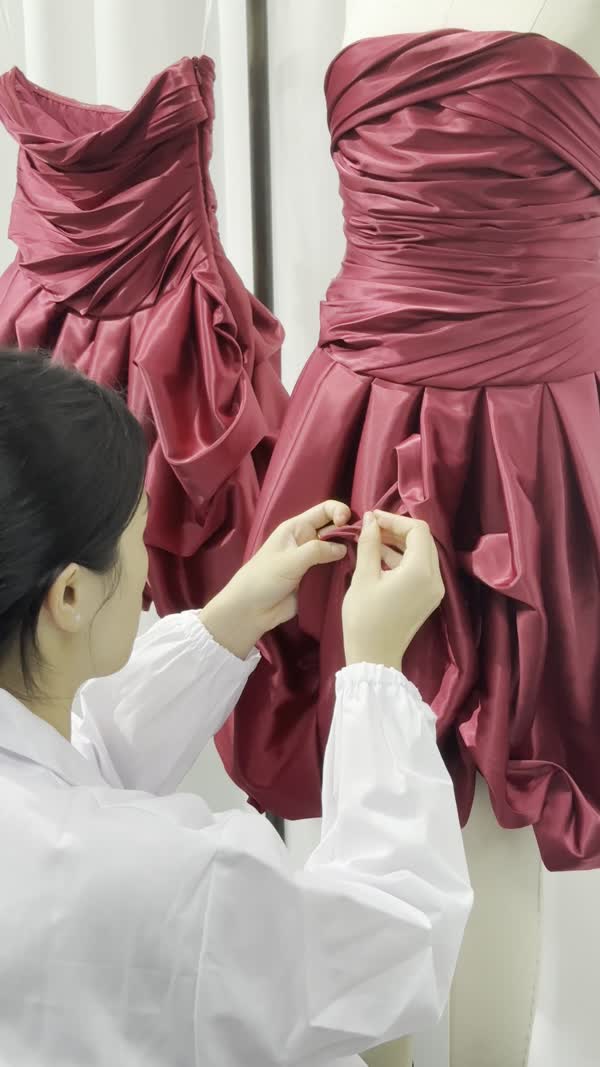
A small batch clothing manufacturer earns its reputation on the inside of a neckline. Understitching is 15 to 20 minutes of work per garment that no customer will ever see, and its absence is visible from a metre away.
What does it actually do? It stitches the seam allowance to the facing so the facing cannot roll to the outside. Without it, the neckline of a viscose dress curls out after two wears and the garment looks tired on the rail.
What understitching is, and the 2 mm that makes it work
Understitching is a row of straight stitch through the facing and both seam allowances, sewn from the inside, about 2 mm from the seam line.
The needle must catch the allowances and miss the garment face. Catch the face and the stitch shows on the outside, which defeats the point of doing it invisibly.
Two millimetres is the working distance. At 4 mm the allowances are too far from the seam to hold the facing down, and the neckline rolls anyway.
Why a facing rolls out: three causes, one fix
First, no understitch. Second, a facing cut too narrow to carry the stitch. Third, a facing cut on the same grain as the body in a cloth that has any memory of its own.
All three end the same way: the facing creeps past the seam and shows a raw edge line at the neck.
Understitching fixes the first two outright. The third needs the facing cut slightly off-grain or on a lighter fusible, and the stitch then holds it in place.
Where it pays: necklines, armholes, pocket openings
Anywhere a facing meets an opening, understitching is the cheapest insurance in the garment. Necklines, armholes, waistbands on skirts, and the top edge of a patch pocket.
On a lined bodice the equivalent is stitching the lining to the seam allowance at the armhole, which stops the lining creeping out at the underarm.
We list each opening on the operations sheet with its own understitch line. If it is not on the sheet, it does not happen, and that is how a run of 30 ends up inconsistent.
Understitch or topstitch: what each costs at 30 pieces
Topstitching is faster, about 3 minutes, and it is visible. On a denim or a utility style that is correct. On a satin or a crepe it draws a line where the eye does not want one.
Understitching takes 4 to 6 minutes per opening and leaves nothing to see. On three openings that is 15 to 18 minutes per garment, roughly $0.45 at our line rate.
Across 30 pieces it is 9 hours of work and about $13.50. A remake of one garment costs more than that.
Facing depth: why 4 cm is the minimum that stays put
A 4 cm facing gives the understitch enough cloth to bite into and enough weight to sit flat. At 2.5 cm the stitch lands near the facing edge and the whole strip flips out.
On a wide scoop neckline we go to 5 cm, because the curve is longer and the facing has more room to lift.
Facing depth is one of the numbers we put on the pattern card. It gets lost when a pattern is re-traced, and a 2 cm facing is the first sign that it was.
Viscose and bias: the fabrics that need it most
Viscose and rayon have little shape memory, so a facing that is not understitched will roll within a day of hanging. We treat it as mandatory on any viscose or cupro neckline.
Bias-cut edges are worse, because the cloth stretches as it hangs and the facing follows it outward.
On stable cotton and on TR suiting a topstitch or a fused facing can be enough. On anything that moves, the 2 mm row is what holds the shape.
20 minutes a garment, 10 hours across 30 pieces
The time is real and it is not where a small run should save. On 30 pieces the understitch line costs about $13.50 in labour and prevents a rework pass that costs $190 or more.
What a small run should question is the number of openings. Three is normal. Six, on a style with a keyhole back and a bound pocket, is a design choice that should show up in the quote.
We show it as its own line so the client can see what the finish costs rather than guessing from the total.
The run where we skipped it
In 2022 we took a shortcut on 30 viscose dresses to hold a ship date. The neckline facing went in without understitching, and we pressed the edge flat instead.
By the time the cartons were packed, 24 of the 30 had a rolled neckline. We opened every carton, unpicked 24 facings, understitched and re-pressed, and shipped four days late.
The rework was 6 hours and $190, on a saving of about $13.50. We have not skipped it since, and the operations sheet now lists it as a mandatory line rather than a note.
How to check understitching on a sample
Hold the garment up to a window. A correct understitch leaves a faint shadow line inside the neckline and nothing on the outside.
Run a finger along the inside of the neck seam. You should feel a flat strip of allowances, not a loose edge you can lift.
Hang the sample overnight and look again in the morning. A facing that is going to roll usually starts within a few hours under its own weight.
Wash one sample before you approve bulk. Viscose moves on the first wash, and a neckline that survived the hanger may not survive the machine.
Our small batch program prices each finish operation separately, so you can see what a clean neckline costs. The FAQ covers what we send with a sample, and the case studies include the dress run we had to rework.
Go deeper: what overlock, binding and French seam cost · why viscose comes back 3 cm shorter · the counter sample you approve before bulk
Questions we get about this
Can understitching replace a facing entirely?
No. It holds a facing down; it does not remove the need for one. On an unlined neckline you still need 4 to 5 cm of facing or a binding, and the understitch is the step that keeps that strip from showing.
Is a fused facing faster and good enough?
Faster, yes, and often good enough on cotton or TR. On viscose, cupro and bias cuts a fused facing still rolls at the edge because the fusible stiffens the strip without anchoring it to the seam. We fuse and understitch on those.
Quick Take
2 mm. The distance from the seam line where understitching holds. At 4 mm it does nothing.
4 cm. Minimum facing depth that gives the stitch something to bite into.
$190 against $13.50. Rework on 24 rolled necklines versus the labour we tried to save in 2022.
About UP Fashion
UP Fashion is a Guangzhou garment manufacturer founded in 2016, run by a team with 20+ years of OEM experience in silk, viscose and embroidery. We quote from 30 pieces, show the rate we used, and inspect three times before shipping.





