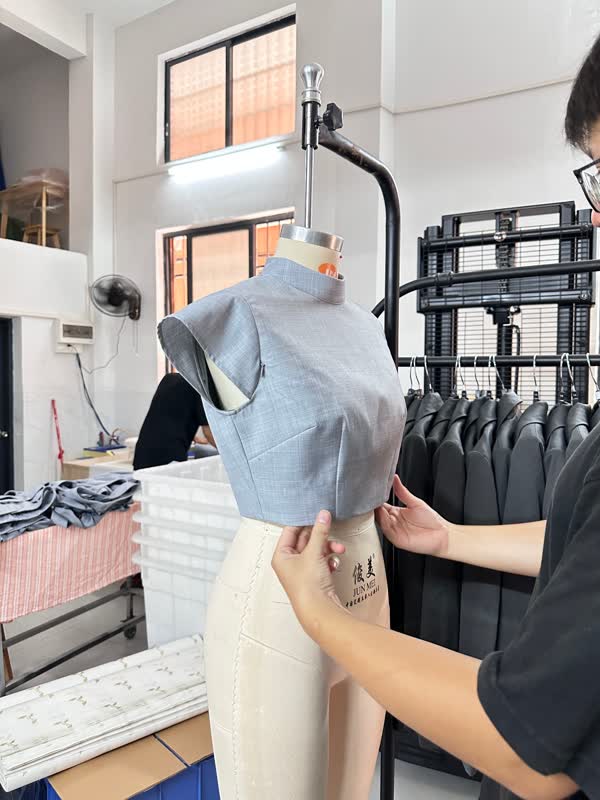
Most brands approve one sample and go straight to bulk. A cut and sew manufacturer that runs 30-piece orders will usually push back and ask for a size set first.
A size set is one finished garment in each size you plan to sell, made in production fabric before the bulk cut. Three pieces, usually, and they decide whether 30 more are worth cutting.
Here is what they catch, what they cost, and why we made them standard on any order with three sizes or more.
What a size set is, and what it is not
It is not a fit sample. A fit sample proves the design. A size set proves the grading.
It is also not the counter sample, which is the piece made from your approved pattern and your actual bulk fabric just before cutting.
The size set sits between them: same pattern, three sizes, production fabric, no shortcuts on construction.
Why 3 sizes, not 5, on a 30-piece run
Three catches almost every grading error: the smallest, the middle and the largest. Errors live at the ends.
On a 30-piece run split across five sizes you have six pieces per size. Making five size-set pieces means 17 percent of the order is sewn before bulk starts.
Three is where the cost stops buying new information.
What a size set catches that a fit sample cannot
It catches a grade rule that breaks a seam. A 1.5 cm grade on the bust is fine at medium and pulls the armhole at large.
It catches trim placement. A pocket that sits correctly on the small size sits too low on the extra large, and nobody sees it until the piece is on a body.
It catches fabric behaviour at the largest size. Viscose cut 30 percent wider drapes differently, and a facing cut for the small size will not hold.
It catches shoulder slope, which most size charts never specify. A 1 cm difference between the small and the large shows as a seam sitting off the bone, and no measurement on paper records it.
The grading errors that only show at the largest size
Armhole depth, crotch curve and the distance from bust point to shoulder. All three are graded by rule, and all three go wrong quietly.
We grade in 5 cm steps on the bust and 4 cm on the waist for a five-size run. If your size chart asks for 6 cm steps, the armhole will not follow.
A size set is the only place that shows up before 30 garments carry the mistake.
What a size set costs at 30 pieces
Three pieces at sample rate, which is $120 to $180 each depending on construction. Call it $450 for a lined dress.
That is 40 percent of a $1,140 order, and it is the line most brands try to delete. We quote it separately so the decision is visible instead of buried.
If your run is 30 pieces in one size, there is no size set and no charge. That is the trade.
Where the size set sits in our 3-stage process
Stage 2 is sample making: two mock-up rounds, then approval. The size set is made after round two, still inside stage 2.
Stage 3 is bulk, with a 30/70 payment split, three inspections and a mannequin try-on of every piece.
Making the size set in stage 2 means a grading fix costs one pattern edit instead of a recut.
Skipping the size set: what it costs when grading breaks
We have recut a 30-piece run once. The large armhole was 1.2 cm too deep on every piece, and the fabric was a $14 a metre satin.
The recut cost $620 in fabric and labour and eleven days. The size set would have cost $390.
That single order is why the size set is now standard on anything with three sizes or more.
Who tries on the size set, and for how long
Our fit model wears each piece for 20 minutes, sitting, walking and raising both arms. We photograph the armhole, the back neck and the hem line.
The buyer approves from photos and a measurement sheet, not from a video call. A video call hides 4 mm.
If nobody on your side can try it on, send three body measurements and we fit it to the closest model on our floor.
We keep the three pieces after the fitting. They become the reference for the bulk inspection, so an inspector can put a finished garment next to the approved one in the same size.
When a size set is not worth the money
On a one-size garment, an accessory, or a style with an elastic waist and no fitted seams.
Also on a repeat order from the same pattern and the same fabric, where the grading is already proven.
Everywhere else, at 30 pieces, it is the cheapest insurance in the order.
What we got wrong before we made size sets standard
We used to grade on the pattern and check measurements on paper. Paper does not show that a large shoulder seam sits 1 cm off the shoulder bone.
Two brands left over it. One came back after we changed the process, which is the only reason we can write this paragraph.
How a first run with a size set looks is in our production cases, and the numbers behind our cut and sew program sit on that page.
If you are planning 30 pieces across three or more sizes, ask your factory what a size set costs. If the answer is nothing, ask what they check instead. Our MOQ and lead time FAQ answers the rest of the first-order questions.
Go deeper: Where grading breaks at size 14 · Extended sizes and 50-piece runs · Fit, PP and top samples
Questions we get about this
Is a size set the same as a fit sample?
No. A fit sample proves the design in one size. A size set proves the grading by making one piece in the smallest, middle and largest size.
How long does a size set take?
Seven to ten days from approved pattern and fabric in house. It runs inside sample making, so it does not add to the bulk calendar.
Quick Take
Three sizes, three pieces. Smallest, middle, largest. Errors live at the ends, not the centre.
$450 against $620. One recut we ran cost more than the size set would have, plus eleven days.
It runs inside stage 2. No extra calendar if the pattern is approved and the fabric is in house.
A1 is coming online. Our assistant is in training on grading questions and will answer them directly for buyers.
About UP Fashion
UP Fashion is a Guangzhou garment manufacturer founded in 2016, run by a team with 20+ years of OEM experience in silk, viscose and tailoring. We quote from 30 pieces, show the rate we used, and inspect three times before shipping.