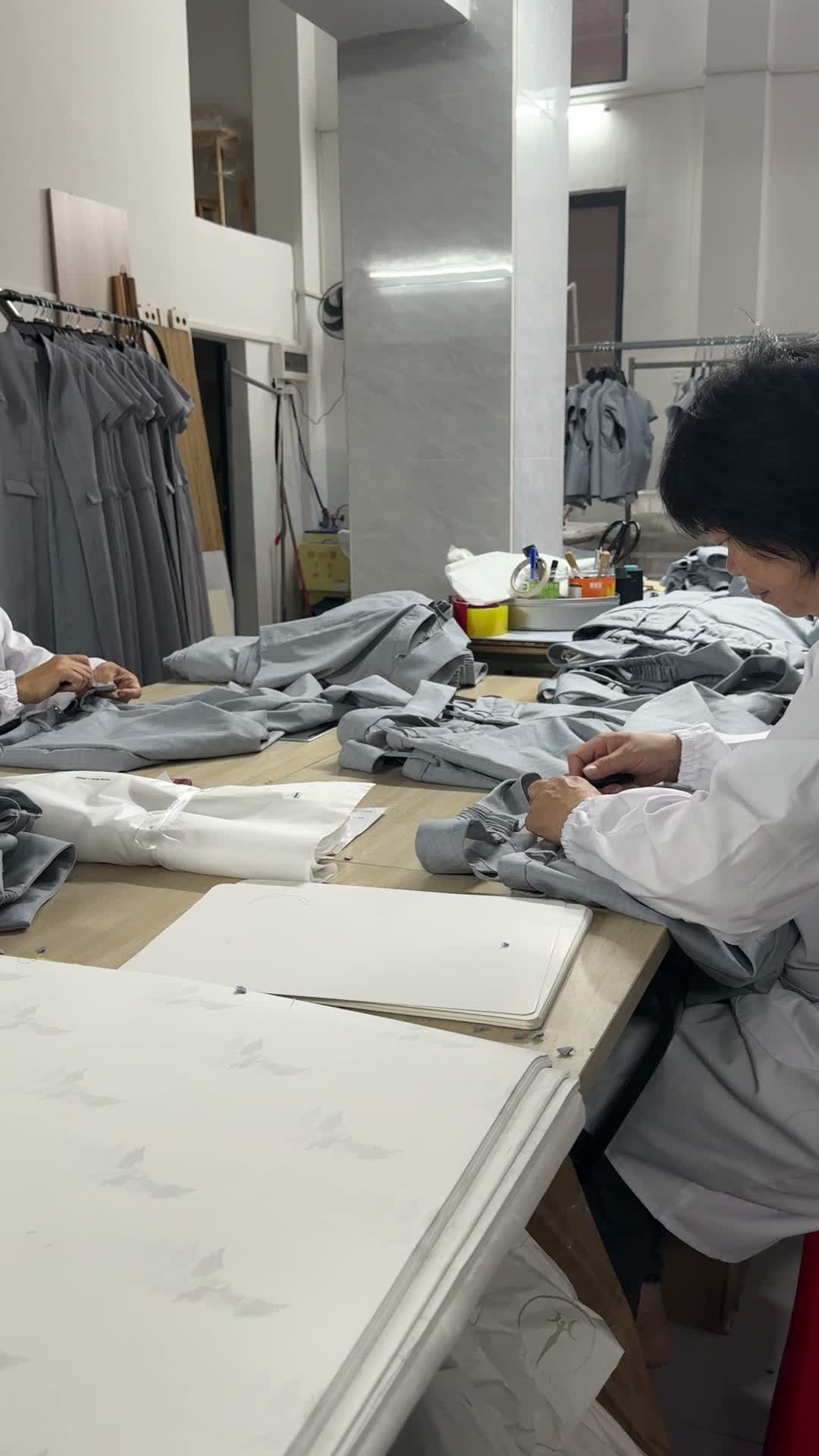
When a client asks why a cut and sew manufacturer charges what it charges, the honest answer is minutes. Every style has a sewing time, and that time is a line on your quote even when it isn't printed. Two factories can quote the same dress eighteen dollars apart and neither one is lying.
So what is SMV, and why does it decide your price? SMV stands for standard minute value. It is the time a trained operator needs to finish one garment at a normal pace, counted in minutes. Multiply it by the factory's minute rate and you have the sewing portion of your quote before you open the file.
Here is how we use it, where it goes wrong, and the question to ask on the next quote you receive.
What a standard minute value actually measures
SMV covers the sewing room only. Joining panels, setting sleeves, inserting zips, hemming, and the small finishing the operator does at the machine. It does not include cutting, pressing, inspection or packing, which sit on separate lines.
On a 30-piece run those extra stages add roughly 20 to 35% on top of the sewing minutes. If a quote shows a sewing number and nothing else, ask what happened to pressing and inspection.
Our own ranges, for reference: a slip dress 20 to 30 minutes, a lined midi dress 40 to 60, trousers 35 to 55, a lined blazer 90 to 150. Structured garments cost what they cost because of minutes, not because of a brand name.
Why the same style carries two SMV numbers
A textbook SMV assumes a steady line. A 30-piece run is not a steady line. The first ten pieces of any style are slower while the operators learn the seams, and the last ten are the fastest.
Line efficiency on a small run usually lands between 60 and 75%. On a long bulk run it reaches 85 to 90%. Take a 45-minute SMV: at 85% efficiency that is 53 actual minutes, and at 65% it is 69. Sixteen minutes, same garment, same operator.
This is why we quote small orders on effective minutes rather than textbook SMV, and we write both numbers down.
How minutes turn into money: the minute rate
Our small-run minute rate sits around RMB 1.1 to 1.5 a minute, roughly 15 to 21 US cents. It covers the operator, the line supervisor, machine time and floor overhead, and nothing else.
Run the numbers on a lined midi dress. Fifty SMV, 65% efficiency, 77 actual minutes, and at RMB 1.3 that is about RMB 100, or $14 of sewing. Fabric, trims and freight are separate lines.
The same dress at 1,000 pieces: 85% efficiency, 59 minutes, and a minute rate near RMB 0.9 because the line never stops learning. That comes to about RMB 53, or $7.40. The unit price falls with quantity because of arithmetic, not because of a volume discount.
How to compare two garment quotes using SMV
Ask two questions: what is the SMV, and what is the minute rate. If a factory says it doesn't use SMV, ask for minutes per garment by operation. Anyone who quotes sewing can produce that.
Then sanity-check it. A lined blazer with a chest canvas cannot be sewn in twenty minutes. If a quote implies that, the price is either missing an operation or the lining is fused and minimal. Both are fine, but you should know which one you bought.
A quote that lists sewing as one lump sum, with no minutes and no operations, tells you nothing about where the cost sits. That is the one to push back on.
Where SMV does not help you
SMV tells you the sewing cost and little else. It will not tell you whether the fabric is right, whether the grade holds at size 14, or whether the same team will still be there for your reorder.
It is also not a number you can compare across countries without the minute rate. A 60-minute garment in Guangzhou and a 60-minute garment in Portugal are the same time and very different money.
Use it for one job: checking that a quote was built from operations rather than from a guess.
The run where our SMV was wrong
In 2022 we quoted a lined jumpsuit with an invisible zip running through the waist seam at 55 minutes. The first pieces took 78. Thirty pieces at 23 extra minutes and RMB 1.3 is about RMB 900 that we absorbed rather than re-quote.
We now cut and time a first-piece sample before quoting anything with a hidden closure, a bias cut or a lined bodice. It costs us half a day and saves the argument.
Minutes are one of several lines behind a price. Our cut and sew service page sets out what the sewing price includes. The case studies page shows real runs with their timelines, the FAQ page answers costing questions, and the production process page maps the steps from tech pack to carton.
Go deeper: how many pieces a line actually sews per day · how long a quote holds when fabric prices move · why most sewing lines ask for 300 pieces
Questions we get about this
Can I ask for the SMV on a quote?
Yes, and we will give it to you. If a factory will not, ask for minutes per operation instead. Any sewing room knows both numbers.
Does a higher SMV mean a worse factory?
No. A higher SMV usually means more operations, not slower hands. Compare the operation list before you compare the total.
Quick Take
Ask for the SMV and the minute rate. Those two numbers rebuild the sewing line on any quote.
Small runs lose 15 to 25 points of efficiency. That is why the same style costs more at 30 than at 300.
Sanity-check the minutes. A lined blazer cannot be sewn in twenty, whatever the price says.
About UP Fashion
UP Fashion is a Guangzhou garment manufacturer founded in 2016, run by a team with 20+ years of OEM experience in silk, viscose and embroidery. We quote from 30 pieces, show the rate we used, and inspect three times before shipping.





