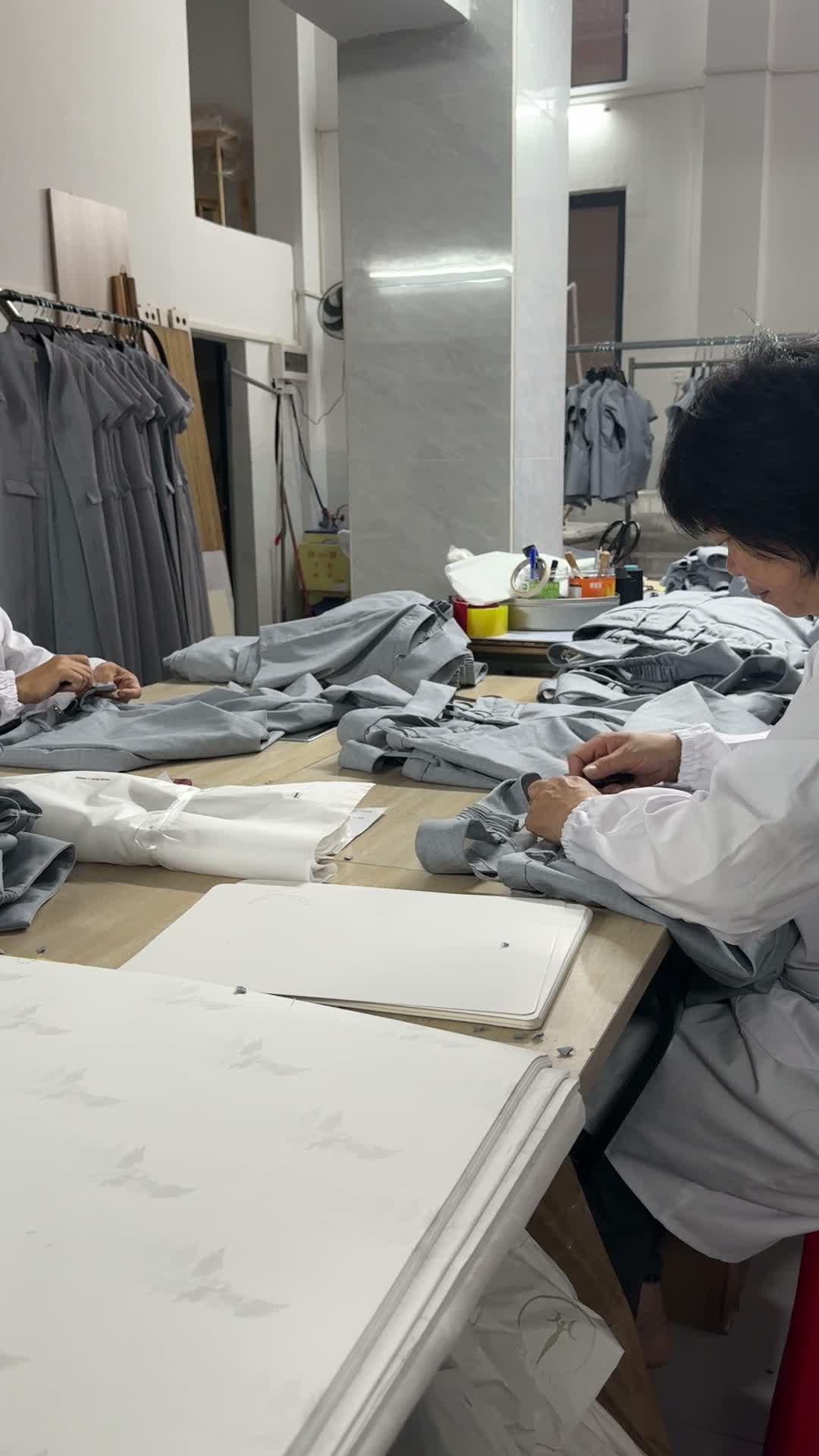
A cut and sew manufacturer puts a bartack wherever a seam is going to be pulled apart, and it is the first thing to fail when it is missing. Four millimetres of dense zigzag holds a pocket corner that a hundred wears would otherwise open.
Why does a garment come back with a split pocket mouth and an intact seam? Because the bartack was skipped, or sewn with 18 stitches instead of 34. It is the cheapest operation in the order and the most common claim we see.
What a bartack does that a backstitch cannot
A backstitch locks a seam end. A bartack spreads the load across 4 mm of cloth so no single stitch takes the pull.
That difference matters at a pocket corner, where the stress arrives at an angle. A backstitch there tears the corner; a bartack holds it.
The machine is a dedicated bartacker, and the operation takes 6 to 8 seconds. It is not a step anyone should be improvising with a zigzag foot.
Where a bartack belongs on a 30-piece run
Pocket corners, both ends of a fly opening, belt loops top and bottom, strap joins, the top of a back vent, and the ends of a zip opening on a lined dress.
On a tailored jacket we add bartacks at the top of each side vent and at the welt pocket ends. That is 14 bartacks on one blazer, or about 90 seconds of machine time.
We list each one on the operations sheet by position. If it is not on the sheet it does not get sewn, and that is exactly how a run of 30 ends up inconsistent.
Stitch count: 28 against 42, and what fails first
A correct bartack on dress-weight cloth runs 28 to 42 stitches in 4 mm. Below 24 the density is too low and the stitches pull out as a group.
Above 45 the needle punches the same hole repeatedly and cuts the yarn. The bartack looks perfect and the cloth fails beside it.
We set 32 as standard on satin and 36 on TR suiting, and the setting goes on the sample card so a reorder runs the same number.
Thread choice on satin and TR suiting
A bartack needs a thread that is slightly weaker than the cloth. If the thread wins, the fabric tears around the tack instead of the tack breaking.
We use a 60/2 polyester on satin and a 40/2 on TR suiting. On a fine viscose, a 80/2 keeps the tack from puckering the panel.
Matching the thread to the seam thread is the usual mistake. A bartack carries more density per millimetre, so the same ticket number behaves differently.
The pull test we run before packing
We hang 12 kg from a bartacked strap for 30 seconds, and 8 kg from a belt loop. Both are above anything a customer will do, which is the point.
On pocket corners we pull the mouth open by hand and look for the first stitch to move. If one moves at 6 kg, the tack is under-stitched.
We test the first piece and the last piece of every run, not the middle. The first and last are where the operator's attention is thinnest.
Why a bartack fails on the second wash
The first wash softens the cloth and hides a weak tack. The second wash is when a 20-stitch bartack lets go, usually at a pocket corner.
We wash one finished piece from every run at 30 degrees before packing. It costs a garment and catches the failure before your customer does.
A tack that survives the second wash usually survives the garment's life. That is a cheap test against a return from a stockist.
What a missing bartack costs at the claim stage
A bartack costs about $0.02. Repairing a split pocket corner on a finished garment costs $3.40 in labour, and it cannot be done invisibly on a lined piece.
A claim from a stockist is worse than the repair. One brand we work with pulled 40 pieces from a rail over four split pocket mouths.
That was $0.80 of skipped bartacks against a $2,600 order and a season's delay.
The 2022 run where we skipped two bartacks
In 2022 we ran 30 TR suiting blazers and left the vent tops off the operations sheet. Nobody noticed, because a vent top bartack is small and the vents pressed flat.
Nine of the 30 split at the vent within the first month of wear. All nine came back through the brand, not through us, which is the expensive route.
We repaired them free, added the position to the standard sheet, and now check vent tacks at the second inspection.
Reading a bartack on a finished sample
Hold the piece to the light. A good bartack is a solid block of thread with no light through the centre.
Run a fingernail across it. It should feel like a raised bar, not a soft patch. A soft tack means the density is low.
Pull the pocket mouth gently. If you can see the cloth gather between stitches, the tack is too loose to carry load.
Our cut and sew service lists every bartack position on the operations sheet and checks them at the second inspection. The FAQ covers what we inspect, and the case studies include the blazer run we repaired.
Go deeper: stitch density and seam strength · trimming and final press · what happens when bulk arrives with defects
Questions we get about this
Can a bartack be replaced by a double backstitch?
On a low-stress seam, yes. At a pocket corner, a fly end or a belt loop, no. A backstitch concentrates the load on two stitch holes, so the cloth tears there instead of the thread breaking. Those positions get a bartack.
Do you charge bartacks as a separate line?
On a 30-piece run we list machine operations that take more than 30 seconds per garment. A full set of bartacks is under two minutes, so it sits inside the sewing rate rather than on its own line. If a style needs 20 or more, we show it.
Quick Take
32 to 36 stitches. The density range we run in 4 mm. Below 24 the tack pulls out as a block.
12 kg for 30 seconds. The pull test on a bartacked strap before packing.
$0.80 against $2,600. Bartacks skipped on 30 blazers in 2022, against the order they put at risk.
About UP Fashion
UP Fashion is a Guangzhou garment manufacturer founded in 2016, run by a team with 20+ years of OEM experience in silk, viscose and embroidery. We quote from 30 pieces, show the rate we used, and inspect three times before shipping.





