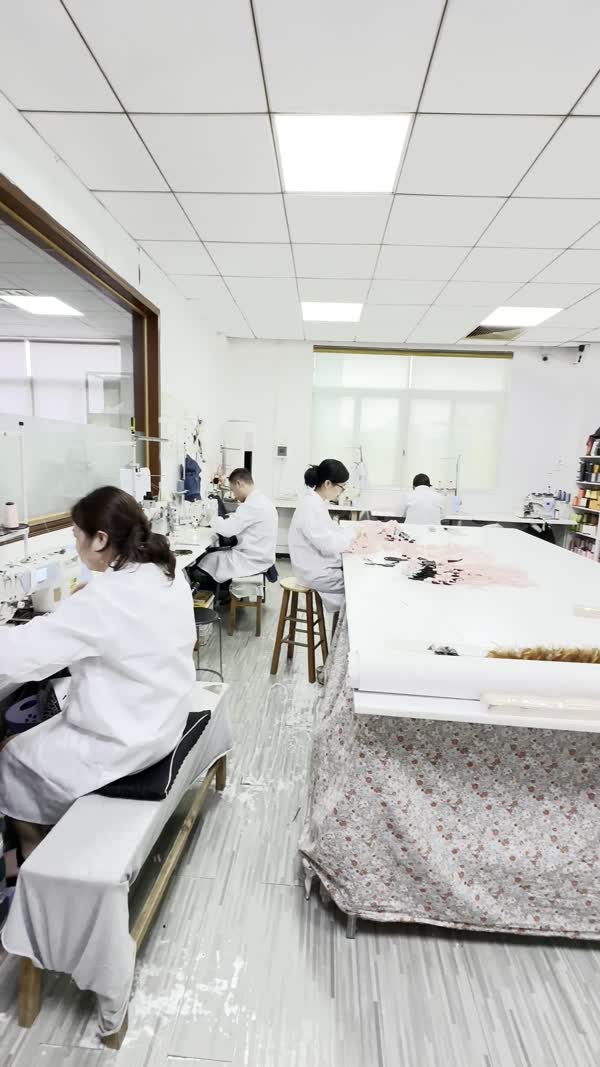
As a private label clothing manufacturer we put the cancellation clause in the quote, not the contract, because that is the page a new brand actually reads.
What happens if you cancel a 30-piece order? Before the fabric is booked you get the deposit back minus an admin fee of $0 to $150. After dyeing you lose the fabric; after cutting you lose the fabric and the cutting time. After sewing starts you pay for the pieces already made.
None of that is unusual. What surprises brands is how early the expensive line falls, and how little a 30 per cent deposit actually covers.
The four points where cancelling gets expensive
Take a 30-piece dress run at $42 a piece ex-works, $1,260 in total, with a 30 per cent deposit of $378.
Before fabric booking: refund $378 minus an admin fee, usually $80, so $298 back. Nothing is lost except the days.
After dyeing: the fabric is bought. Sixty-two metres at $3.20 is $198, trims are $34, and the deposit no longer covers what has been spent. We refund what is left and invoice nothing further, but the brand has lost the fabric value.
After cutting: add three hours of cutting at $36 and a marker that cannot be reused. Panels are numbered and bundled, and they have no resale value.
After sewing starts: we count finished pieces and charge them at the unit price. Twelve of 30 sewn is $504, and the remaining cloth is yours to collect or write off.
What a 30 per cent deposit actually covers
Thirty per cent of $1,260 is $378. Fabric and trims come to $232, cutting to $36, and the rest reserves line time. The deposit is mostly materials, which is why it cannot behave like a refund in the later stages.
Pattern making and the two mock-ups are paid separately, at the sample stage. That is deliberate. A brand that cancels after sampling has already paid for the work it used, and we have already been paid for the work we did.
It also means a cancellation is rarely a fight about the deposit. It is a fight about whether the fabric was really bought, which is why we keep the mill invoice with the order file.
Why cut fabric cannot be un-cut
Thirty dresses is four lays and roughly 240 panels. Each panel is numbered, bundled by size and matched to a cut ticket. Once the knife is through, the cloth is a set of shapes that fit one style in one size run.
We have never found a buyer for a cancelled cut. Twice we have finished the garments and shipped them at cost, because that was cheaper for the brand than writing off the cloth.
The other option is to hold the panels and cut the balance later, if the brand expects to revive the style. We do that for 90 days. After that the cloth goes into our scrap, and we say so in writing rather than quietly.
What to do instead of cancelling
Most cancellations we see are not cancellations. A stockist pulls out, a launch moves, and the brand's first instinct is to stop everything.
Four alternatives are usually cheaper. Cut the quantity down to the fabric already bought, which on a 30-piece run can mean 24. Push the ship date by 30 to 60 days and keep the slot. Change the size mix inside the same lay, which costs a marker and 90 minutes.
The last one is to ship as planned and hold the stock with us at no charge for 90 days. Ask for those options before you ask for a refund. A factory that only offers one answer has not thought about it.
Written notice, not a message
Our clause asks for five working days written notice. The line stops the day we receive it, and anything cut or sewn before that date is billable.
That sentence prevents most arguments, because the date is in the email and the cut ticket carries the same date. It also stops the worst version of this, where a brand assumes a phone call stopped the work.
What we do with the finished pieces
We do not sell them, and we do not put them in a sample sale. Your design stays yours whether the order completed or not. That clause matters more than the refund, and almost nobody asks for it.
We will hold finished pieces for 90 days at no charge. After that we ask for a decision in writing: ship, destroy, or transfer to another order.
Where a cancellation went badly
In 2021 a brand cancelled 30 pieces four days after cutting, because their stockist pulled out. We invoiced fabric and cutting at $286 and refunded $92 of the $378 deposit.
They were angry for about a month. We sent the cut ticket, the lay photograph and the mill invoice, and the conversation changed. They ordered 60 pieces the following season.
The lesson was not about the money. It was that we had never shown them where the money goes, so the refund looked arbitrary. A one-page stage table in the quote would have saved that month.
How to structure the clause before you sign
Ask for four things: a stage-based schedule like the one above, a written notice period, a rule for finished pieces, and a line that says the pattern stays with the brand.
If a factory will not put those four in writing, the unit price is not the problem you should be solving.
If you are starting a first run, the private label program page sets out the three stages and what each one commits you to, our FAQ covers deposit and payment questions, and the case studies include the 2021 cancellation.
Go deeper: the nine clauses before a deposit · what a deposit is for · what one change after approval costs
Questions we get about this
Is the deposit ever refundable in full?
In two cases: if we cancel, or if we miss the ship date by more than 14 days for reasons inside our control. Both are written into the clause.
Can I move the deposit to another style?
Inside the first five days, yes. After the fabric is booked only the value of the cloth can move, and only if the new style uses the same fabric.
Quick Take
Before fabric, $298 back. After dyeing, the cloth is yours and the money is not.
$378 deposit, $268 of materials. A deposit is not a cancellation fund.
Five working days, in writing. A message stops nothing on a cutting table.
About UP Fashion
UP Fashion is a Guangzhou garment manufacturer founded in 2016, run by a team with 20+ years of OEM experience in silk, viscose and embroidery. We quote from 30 pieces, show the rate we used, and inspect three times before shipping.




