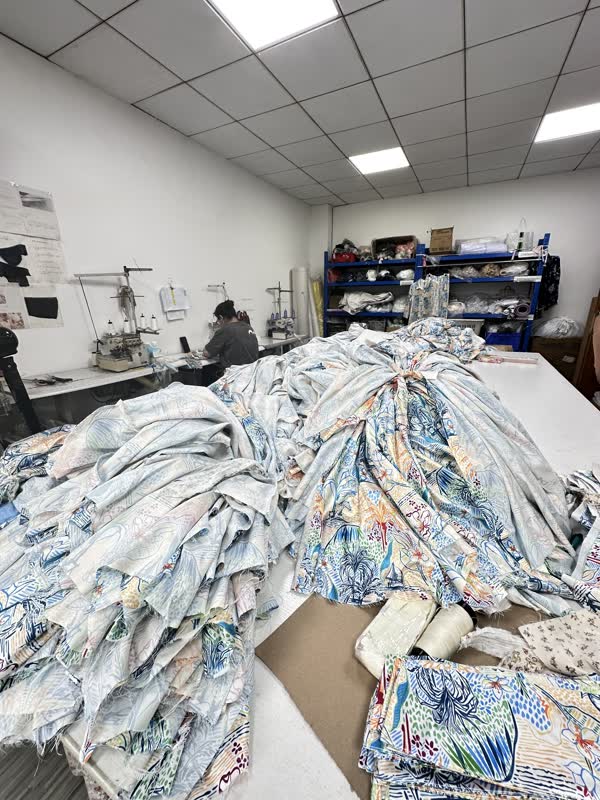
Made to order sounds like the cautious, slower option. Run the cash numbers and it's often the reason a three-person label is still trading in year three.
Stock means paying for everything up front, fabric, 6 to 10 weeks of production, storage, and then being paid back slowly as it sells. Pre-order means being paid before or while you make it. If the style is new, or the market is new, 30 pieces beats 500 even at a worse unit price. That's the argument, and the rest of this is the arithmetic behind it.
What inventory actually eats
Three things, and only the first one is on the invoice.
Cash goes out early. Fabric takes 2 to 4 weeks if the factory is sourcing it, the final sample takes 28 to 42 days, and bulk production takes 6 to 10 weeks. Call it up to 14 weeks from the day you commit to the day goods are in hand. Every dollar is spent months before the first sale.
Cash comes back slowly, and never completely. Our clients retail between $500 and $2,000. Five hundred pieces at $500 is $250,000 of retail that has to clear at full price before the style earns a cent. At $2,000 it's a million. Whatever doesn't clear gets marked down, and that markdown comes straight out of next season's budget.
Then the cost nobody calculates: while that money sits on a shelf, it isn't buying fabric for the next drop. The brands we work with are 1 to 50 people. One wrong 500-piece buy can be the whole year.
The 30-piece version of the same season
A small batch clothing manufacturer charges more per unit, the garment production cost per piece really is worse at 30. That part you already know. What you're buying with the premium is the right to be wrong cheaply.
Make 30 in the hero colour and 30 in the second. Sell them. If size 14 is the one that keeps coming back with a fit complaint, you now know before you've committed 500 units to it. If two rolls from the same dye lot don't match, you've found it on one roll instead of forty.
There's a quality argument too. We inspect each piece three times, at AQL 1.0 to 2.0, measuring every size, with a video record of the batch. That's a fixed amount of work per garment. At 30 pieces it's affordable and it's thorough. At 500, a factory under pressure to hold the unit price is under real pressure to inspect less, and that's where a lot of volume savings quietly come from.
Our first-sample pass rate is 98%. That isn't a quality boast. It means sampling usually doesn't swallow an extra six weeks, which is the thing that makes a pre-order calendar workable at all.
When 500 is the right call
- You've already sold this style once and you're refilling a size curve you trust.
- You tested a colour at 30 and it sold out in three weeks. Reorder at 100 to 150, that's the band where our pricing makes the most sense.
- The fabric forces it. 200 metres yielded 180 pieces on one of our runs. If the mill's minimum is 200 metres, you're buying that much whether you make 30 or 180.
- You have a fixed delivery date and no runway to run pre-order properly. Pre-order only works once sampling is done: two to three mock-ups in 14 to 21 days, then the final sample in 28 to 42 days.
What pre-order demands from you
It isn't free money, though. Pre-order only works if you've done the boring part early.
Sampling has to be finished before you open the window: two to three mock-ups in 14 to 21 days, then the final sample in the correct fabric in 28 to 42 days. Only then can you photograph the real garment and take orders against it. Rush that and you're selling a picture of something that doesn't exist yet, which is how small labels end up paying for air freight they never budgeted.
You also have to be straight with customers about the wait. Bulk production is 6 to 10 weeks, plus 2 to 4 weeks if we're sourcing the fabric. Put those numbers on the product page. The shoppers who mind were never going to buy a small-batch piece anyway, and the ones who stay will wait, because they're buying something made for them rather than pulled off a shelf.
And you have to commit to a size split before we cut. That's the one number you can't correct afterwards, so use whatever sales data you already have, even if it came from a weekend market stall.
How we'd split a first buy
If you're a studio of 1 to 10 people launching into a new market, this is the plan we keep repeating. Thirty to 50 pieces in the hero colour, 30 in the second, and hold the third colour for a reorder. Put the reorder date in the calendar before you launch, not after you've sold out.
Below 50 pieces there's a per-piece premium, and we show it as its own line instead of averaging it away. You should be able to see what the flexibility costs and decide for yourself whether it's worth it.
Watch one more number while you're at it: how long your cash is tied up. Fabric 2 to 4 weeks, sampling 28 to 42 days, production 6 to 10 weeks. If the money has to sit there for 14 weeks before the first sale, the unit price is not your problem.
Ask yourself what $250,000 of unsold coats buys you. Then ask what 30 would have told you for a fraction of that.
Go deeper: MOQ Explained: when 500 pieces beats 30, and when it doesn't
Questions we get about this
Is 30 pieces really smarter than 500 for a new brand?
For a first run into an unproven market, usually yes. Thirty to 50 pieces per style per colour keeps your cash out of storage and lets you catch a grading or colour fault before it multiplies. Five hundred pieces at the $500 end of our clients' retail band is $250,000 of stock that must clear at full price. Once you have a size curve you trust, move up to 100 to 150.
How long does a made to order run take from deposit to delivery?
Two to three mock-ups in 14 to 21 days, a final sample in the correct fabric in 28 to 42 days, then bulk production in 6 to 10 weeks. If we source the fabric, add 2 to 4 weeks. So plan on up to 14 weeks from commitment to goods in hand and set your launch date from there.
What does holding 500 pieces of stock actually cost me?
The production invoice is the visible part. The rest is the gap between paying for everything up front and being paid back over a season, plus storage, plus the markdown on whatever doesn't sell. At our clients' retail band of $250 to $1,000, 500 unsold units is $250,000 to $1,000,000 of retail parked in a warehouse.





