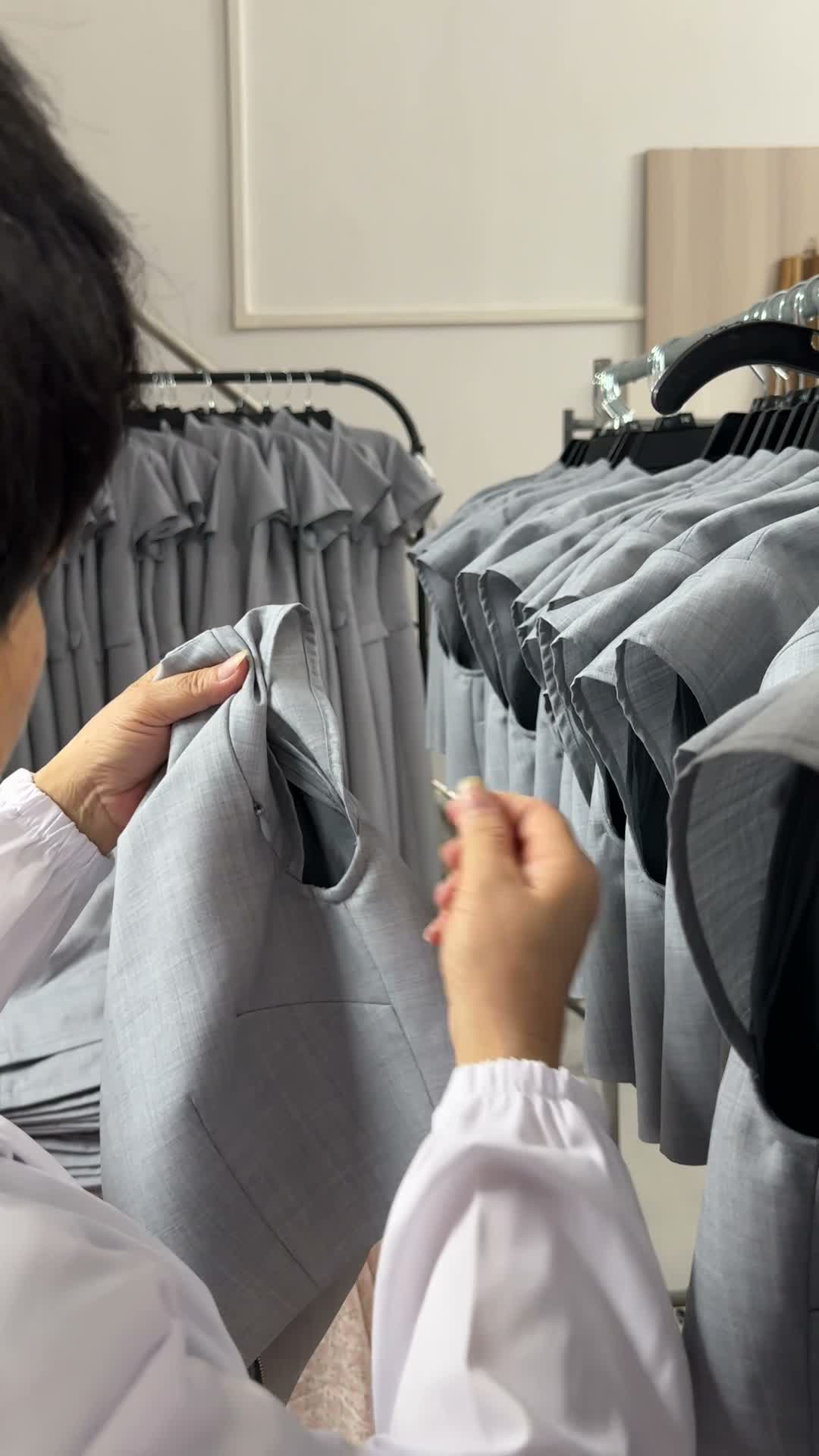
Does washing add cost to a 30-piece order? Yes, and most quotes never show it as a line. As a small batch clothing manufacturer we price washing by weight, and weight is exactly where a short run gets expensive.
Our all-in cost for a soft wash on a viscose dress is about $1.80 a garment at 30 pieces. The same wash at 300 is $0.55. Nothing about the soap changed.
Here is the arithmetic, the two numbers you have to fix before cutting, and the 30 dresses we washed too late.
Why a 30-piece garment wash costs three times more per piece
Washing is billed by weight, with a 25 kilo minimum. Thirty viscose dresses weigh about 10.5 kilos, so you pay for 25.
At $1.10 a kilo that is $27.50, or $0.92 a garment, before the drum has finished turning.
Drying is a lot charge, not a per-piece one: $9 for the room, which is $0.30 each at 30 pieces and $0.03 at 300.
Silicone softener is a second lot charge of $9. Re-pressing after drying is $0.28 a garment at any quantity.
Add it up and you land at $1.80 against $0.55. The drum is not the problem. The lot charges are, and they do not care how many pieces you brought.
Soft wash, enzyme wash and silicone wash: what each one does
A soft wash is water, mild detergent and about 20 minutes of gentle drum time. It strips the mill's stiffness and stops viscose feeling like paper.
An enzyme wash eats surface fuzz. On cotton-linen it softens the hand and pulls the colour down about half a shade, so approve it on a washed bulk swatch, never on a flat lab dip.
A silicone wash adds slip. It is the cheapest way to make a $6 metre satin read like a $600 dress, at $0.30 a garment on a 30-piece run.
None of the three rescues a bad cloth. We washed one stiff polyester three times in 2020 and it stayed stiff, so we stopped promising otherwise.
Shrinkage and colour loss: two numbers to fix before the cutter starts
Viscose moves 3 to 5 per cent in a soft wash. Linen and cotton-linen blends move 4 to 6 per cent.
If you cut to the finished measurement, the garment arrives short and there is nothing to let out at the hem.
We cut 4 per cent bigger, which on a two metre dress is 8 centimetres of cloth, roughly $0.48 at $6 a metre.
Reactive dyes shift between half a shade and a shade and a half after washing. That is why we wash a piece from your actual bulk cutting, not a sample made a month earlier.
Garment dyeing versus piece dyeing: what changes at 30 pieces
Piece dyeing means the mill dyes the roll and you buy it by the metre. Garment dyeing means we sew the dress first and dye the finished garment.
Garment dyeing is the only way to reach a colour at 30 pieces without buying 300 metres of cloth, which is why small brands ask for it.
It costs $2.60 to $3.40 a garment in the drum, and it shrinks 6 to 8 per cent, so the pattern has to be cut for the dyed size, not the greige size.
Repeatability is the catch. Two drums of the same recipe can differ by a shade and a half, which is fine for a soft wash and not fine for a navy that has to match next season.
We dye a garment-dyed style in one drum. Thirty pieces is a ceiling, not a target, and we say so before you design a 12-colour range around it.
What a garment wash adds to your lead time
Five to seven days, and the days are not all machine time. Two days in the wash queue, one day in the drum, 48 hours drying, one day pressing.
Guangzhou humidity sets the drying number. In June a 48 hour dry can stretch to 72. In November it is closer to 24.
Book the wash slot when you book the cut. A wash house with a two week queue will not move for 30 pieces.
In August 2026 we booked a 40-piece satin run late, lost four days at the dryer, and paid $180 to move the air freight date. The garments were fine. The calendar was not.
How to put washing on a quote in one line
Ask for it as its own line: wash type, rate per kilo, lot charges, and whether pressing is included.
A quote that says "washed" with no rate cannot be compared with the next factory's quote, and the gap usually shows up after you have paid the deposit.
Ask which stage the wash happens in, before trimming, after trimming, or after packing. The answer changes the finished size of your garment.
Ours happens before trimming and before the care label goes in. Always, after the year below.
The 30 dresses we washed too late
In 2019 we ran 30 linen-blend dresses, washed them after trimming, and packed the same week.
The cloth relaxed 4 per cent. Nine dresses finished 8 to 12 millimetres short at the hem, and the customer measured before we did.
We replaced all nine at our cost, about $340, and moved washing ahead of trimming on every order since.
Wash early, measure after, then trim. It sounds obvious written down. It cost us a client's first season to learn.
Our small batch program quotes wash as its own line, the FAQ covers who pays when a wash changes the fit, and the case studies include the run where a second wash fixed a hand-feel complaint.
Go deeper: why cloth relaxes overnight · the three tests before you cut · why your mock-up fabric lies
Questions we get about this
Can I skip washing to save $1.80 a piece?
On polyester, usually yes. On viscose or a linen blend, no. The garment will shrink in your customer's machine instead of ours, and that is a refund, not a saving.
Does a wash change the colour enough to need new approval?
Half a shade is normal on reactive dyes. More than that means the dye lot or the bath temperature was wrong, and we stop and re-dye rather than ship it.
Quick Take
Washing is billed by weight. A 25 kilo minimum means 30 pieces pay for 25 kilos.
$1.80 at 30, $0.55 at 300. Lot charges, not soap, create the gap.
Wash before trimming. Viscose moves 3 to 5 per cent, and it moves late.
About UP Fashion
UP Fashion is a Guangzhou garment manufacturer founded in 2016, run by a team with 20+ years of OEM experience in silk, viscose and embroidery. We quote from 30 pieces, show the rate we used, and inspect three times before shipping.




