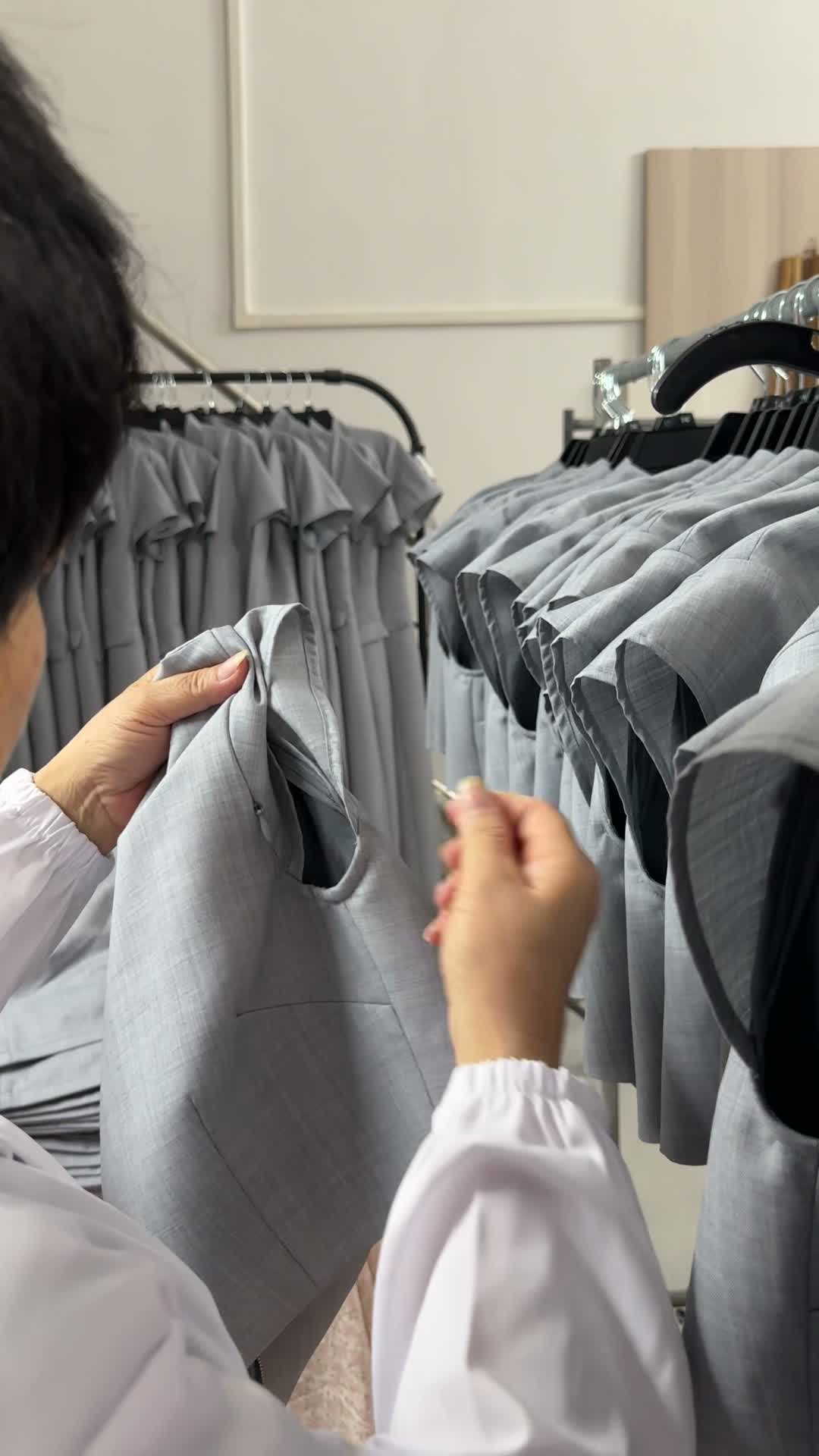
Six millimetres is what separates an approved sample from a bulk garment, and a high end clothing manufacturer measures for it before the marker is drawn. Fabric arrives holding whatever moisture it picked up in transit. A roll cut the day it lands will not measure the same 48 hours later, so every roll here is conditioned before it goes near a table.
The question we hear most is simpler than that: why does bulk measure differently from the sample I signed off? Because the sample was usually cut from cloth that had already settled in a warm room, and bulk is often cut from cloth that came off a truck that morning.
Fabric regain: why a roll cut on arrival measures short
Regain is the moisture a fibre holds at a given humidity, counted as a percentage of its dry weight. Viscose sits near 13 per cent, linen 12, cotton 8.5, polyester under 1. A 30-metre roll of viscose therefore carries close to 4 kilograms of water that nobody invoiced you for.
Move that roll into a heated room at 30 per cent humidity and the water leaves. The yarn contracts, the panel gets shorter, and the loss shows up at the hem, which is the first place a buyer measures.
It runs the other way too. Cut in a humid Guangzhou August and ship to a dry Milan winter, and the garment arrives a size smaller than the one you approved.
The conditioning room: 20°C, 65 per cent humidity, 24 to 48 hours
We relax every roll in a room held at 20 degrees Celsius and 65 per cent relative humidity, give or take four. Woven cotton and polyester need 24 hours. Viscose, linen and their blends get 48, and we turn the rolls once.
That room holds about 400 metres and costs rent nobody can bill to a client. It also adds one to two days to every lead time, which is exactly why a factory chasing a fast quote skips it.
Ask any supplier how long they condition fabric and listen for a number of hours. A vague answer means the roll went from the delivery bay to the cutting table in the same afternoon.
Viscose, linen and polyester shrink on three different curves
Viscose is the one that surprises first-time brands. Without compaction at the mill it can lose 4 to 6 per cent of length on the first home wash, and no amount of resting fixes a fabric that was never pre-shrunk.
Linen moves 3 to 5 per cent, usually across the first two washes, then settles. Polyester moves under 1 per cent, and TR suiting sits near 1.5. We ask the mill for the compaction figure in writing before we quote a viscose style, and we decline the order if they cannot give one.
Container sweat: the fabric that arrives wet
Sea freight from Guangzhou to Rotterdam runs 28 to 35 days, and a steel container crossing climates condenses water on the inside of the roof. Rolls packed in poly bags arrive with damp patches on the outer layer and a smell that only shows up after pressing.
We open every carton on arrival and air the rolls for a day before inspection. Twice in the last three years we rejected 60-metre lengths at the outer edge and asked the mill to replace them, which they did.
The 50-centimetre wash test we run before quoting
We cut a 50 by 50 centimetre square from the roll, measure it, wash it at 40 degrees, dry it flat and measure again. The percentage goes into the quotation, and the square stays in a bag with the lot number on it.
That square has settled more arguments than any email. When a client says the bulk shrank, we can show what the cloth did before we ever cut a pattern.
Why the sample room and the cutting room must match
Our sample room and our cutting room share the same air handling, because a pattern cut at 22 degrees and sewn at 31 degrees gives two different garments. In July the difference between an air-conditioned office and an open workshop floor is nine degrees and 30 per cent humidity.
Small workshops rarely control this, and it is one reason two factories can sew the same pattern to visibly different lengths.
What goes into the tolerance table
Our table for a woven dress reads plus or minus 6 millimetres on body length, 5 on chest and waist, 4 on hem, and 5 on sleeve. Every number is measured on a garment that has rested flat for 24 hours after conditioning.
Without a table, a 6-millimetre difference becomes an argument about who is holding the tape. With one, it becomes a pass or a rework, decided in a minute.
Two runs where we cut too early
In 2022 we cut a 40-piece viscose order the same afternoon the fabric arrived, because a stockist date was tight. Nine dresses measured 8 millimetres short at the hem against the approved sample, and we recut them over three days at our cost.
In 2019 a linen blend went through the sample room in February with the heater running and the humidity at 32 per cent. The panels came out a centimetre narrow after the first wash, and the client found it before we did.
Both mistakes came from the same habit: trusting the calendar more than the cloth.
What this adds to your lead time and your price
One to two days, and roughly $0.20 to $0.40 per garment in handling that we absorb rather than bill. On a 30-piece run that is under $12 in total, against a hem rework that starts at $180.
Our production standards are built around conditioned cloth, the case studies show a hem dispute that a tolerance table settled, and the FAQ covers who pays when bulk measures off the sample.
Go deeper: the three lab tests we run before cutting · why sample fabric lies about bulk · why panels twist after washing
Questions we get about this
Can you cut the same week the fabric arrives?
We can, and we will tell you the risk in writing. On viscose or linen we would rather hold two days than recut nine hems.
Does pre-shrunk fabric still need conditioning?
Yes. Compaction at the mill removes most of the wash shrinkage, not the moisture a roll picks up in a container.
Quick Take
Viscose holds about 13 per cent of its weight in water. Cut it dry and the panel shortens by roughly 1 per cent, which is 6 millimetres on a 60-centimetre length.
24 hours for cotton and polyester, 48 for viscose and linen. At 20°C and 65 per cent humidity, before the marker is drawn.
Put the tolerance in the table, not in the email. 6 millimetres on body length turns an argument into a pass.
About UP Fashion
UP Fashion is a Guangzhou garment manufacturer founded in 2016, run by a team with 20+ years of OEM experience in silk, viscose and embroidery. We quote from 30 pieces, show the rate we used, and inspect three times before shipping.




