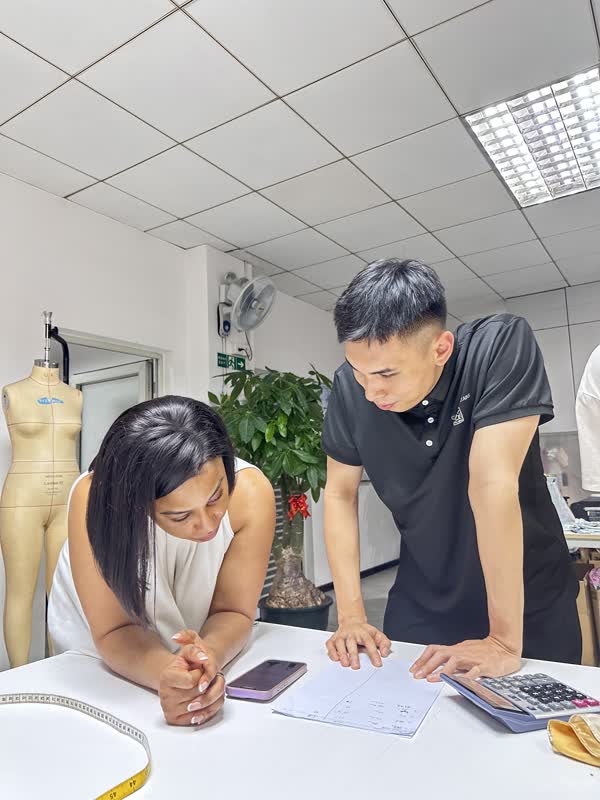
A production quote lands 20 to 30 percent above the number you planned and your first instinct is to redesign the whole style. Slow down. In most cases the garment you approved can be brought down to budget with four cuts in a specific order, without touching the silhouette: fabric first, then hidden construction, then trims, and a short list of things we refuse to cut no matter how big the gap.
We quote line by line, so when a style comes back over target we can see exactly where the money sits and show you the arithmetic before removing anything. Here is the order we cut in at MOQ 30, what each step typically saves, and the lines that stay untouched even if you ask.
The order of cuts when a production quote is over budget
The sequence matters more than the total. Cut fabric first, it is the biggest line with the widest honest range, then hidden construction nobody will ever notice, then trims that carry fixed minimums a small run cannot absorb. Embellishment goes last, because it is often the reason the customer is buying.
Work in that order and a style that needs to fall from USD 92 to USD 74 usually gets there without changing how it looks on the rail or on the body.
Cut one: fabric weight and fibre, before anything else
Fabric is 30 to 45 percent of a small-batch quote, which makes it the first and biggest lever. Two cloths that look alike on a swatch can sit USD 4 to 8 per metre apart, and a lined dress needs 1.3 to 1.6 metres of body fabric before the lining is counted, so a one-dollar-per-metre decision is a real per-piece decision.
Moving a dress body from 19 mm silk charmeuse to a 14 to 16 mm silk crepe typically saves USD 9 to 13 per piece at the same silhouette. Moving the lining from silk to cupro saves another USD 6 to 8. The garment drapes differently, and we will tell you honestly when a swap changes the character of the style, but most over-budget quotes are solved here first.
What we will not do is keep the name of the fabric and quietly buy a cheaper version of it. When we offer a cloth change, it is a named mill and a named weight, written on the quote before anything is cut.
Cut two: construction details no customer will ever touch
After fabric, look inside. An internal frill, a second inside pocket, double-stitched facings nobody sees, a bound seam where an overlocked one does the same job, each one is sewing minutes that a 30-piece run cannot spread thin. Removing two or three of these typically saves USD 4 to 10 per garment.
The rule we apply: spend where a customer looks and feels, save where they never look. An invisible zip and a clean armhole earn their cost; an extra row of topstitching inside the waistband does not.
This is also where we show you two written options side by side, the full-spec version at USD 92 and the trimmed version at USD 74, so the choice is visible before a single seam is sewn.
Cut three: trims and fasteners with factory minimums
Trims carry fixed costs that hurt small runs most. Custom metal buttons usually start around 1,000 pieces, a bespoke woven label rarely makes sense below 300, and a printed main label costs a fraction of both. Moving those decisions to well-made stock options can save USD 3 to 8 per garment on a small order.
Keep the parts that touch the customer experience: the zip should still run smoothly and the button should still feel substantial. We cut the frills on trims, never the function.
Cut four: embellishment density, not the motif itself
If a style carries embroidery, the fastest honest saving is density and placement size, not deleting the ornament. Reducing a machine-embroidery motif from a full front panel to a focused collar-and-cuff treatment can save USD 6 to 18 per piece once the programme is set, and restraint often reads as more expensive, because restraint reads as luxury.
We will also tell you when embellishment is the reason the customer buys. In that case we protect it and find the money elsewhere, or we talk about the target itself.
What we refuse to cut to hit a number
Four lines never come out of a revised quote. Seam allowances on silk and bias panels, the grading, the three inspections per garment and the size-extreme fit checks all stay, because each one protects the garment or the customer, a style that fits at size 2 and fails at size 14 is not a saving.
If we have made every honest cut and the number still does not work, we do not stretch the truth. We show the floor price with the arithmetic and offer the same three options our budget-based production method uses: a lighter spec, a simpler construction, or a corrected target. Saying no before sampling costs a job; saying yes and downgrading silently costs a season.
One more note on process. When the design itself is still flexible, our first designer agent A1 is in training and coming online soon: you give it your brand positioning and a target price, and it returns design drawings that respect the budget from the start, so the quote conversation starts from a visual brief instead of a wish. The agent shortlists; the sealed mock-up still decides what is sewable.
What a revised quote looks like at MOQ 30
Here is the shape of the exercise. A lined silk blouse quotes at USD 92 against a USD 74 target. The body moves from 19 mm charmeuse to 14 to 16 mm crepe, saving USD 11; the lining moves from silk to cupro, saving USD 7; an internal frill and a second button set come out, saving USD 4. The revised quote lands at USD 70, slightly under target, and nothing about the outside of the blouse changed.
Mock-up round one is where the revised spec gets sealed on the real fabric, because a lighter cloth can behave differently on the body. That is the moment the new price becomes the real price, and our mock-up guide explains why that round decides everything that follows.
Every cut appears on the quote before it is made, nothing is removed twice, and the revised spec is locked in writing with the new price at sealing. The whole sequence, from the first line-by-line quote to three inspections and export packing, is documented on our production process page, and the budget, sampling and deposit questions buyers ask first are on our FAQ page. Why 30 pieces keeps the numbers honest is explained on our low MOQ landing page, and styles we brought back to target, silk dresses, wool blazers, jumpsuits, are on our case studies page.
Go deeper: budget-based production: plan around a target price · cost per garment: the lines your quote won't show · small MOQ production: what 30 pieces can and can't do · Case studies: runs brought back to target
Questions we get about this
How much can a fabric swap save when my quote is over budget?
A body move from 19 mm silk charmeuse to a 14 to 16 mm silk crepe typically saves USD 9 to 13 per piece, and moving the lining from silk to cupro saves another USD 6 to 8. Both are shown as named mills on the quote before anything is cut. A lighter cloth drapes differently, which is why we seal the revised spec on a mock-up rather than trusting the paper.
What do you never cut to bring a price down?
Seam allowances on silk and bias panels, the grading, the three inspections per garment, and the fit checks on the size extremes. If every honest cut is made and the number still will not work, we show the floor price with the arithmetic and offer a lighter spec, a simpler construction or a corrected target, never a silent downgrade.
Quick Take
Cut in order, not in panic. Fabric first, hidden construction second, trims third, embellishment last, that sequence usually closes a 20 to 30 percent gap without touching the silhouette.
Fabric is the biggest lever. It runs 30 to 45 percent of a small-batch quote, and a body swap plus a lining swap can save USD 15 to 21 per piece.
Four lines never get cut. Seam allowances on silk, grading, three inspections and the size-extreme fit checks, we show the floor price instead of stretching the truth.
About UP Fashion
UP Fashion is a Guangzhou garment manufacturer founded in 2016, run by a team with 20+ years of OEM experience in silk, wool and embroidery. We produce 30 to 150 pieces per style on our own floor, inspect every piece three times, and quote line by line so a target price can be planned honestly. This guide is how we bring over-budget quotes back to the number.





