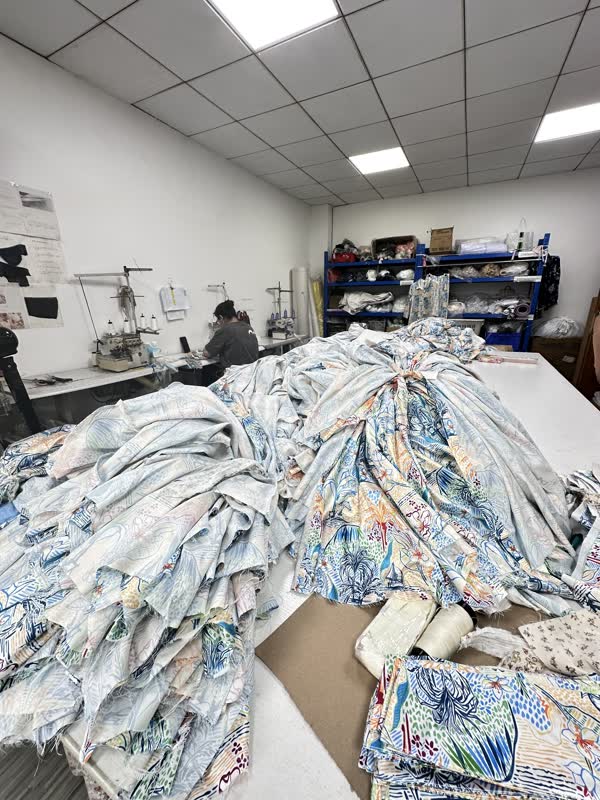
Ask any small MOQ production factory what its floor can do at 30 pieces and the brochure answers fast. The honest answer is a list: five techniques we run happily at MOQ 30, four that quietly triple the price, and the checks that keep the difference off your invoice.
The short answer: cut-and-sew in silk, wool, cupro and linen, machine embroidery, digital and screen print, and hand finishing all run well at 30 pieces. Custom jacquard, gradient prints and anything that needs a mill to spin a new base usually do not. The rest of this guide is how we sort one from the other before we quote, not after you have paid.
Small MOQ production: five techniques that work at 30 pieces
Cut-and-sew from stock cloth is the backbone. A lined dress, blazer or shirt in a fabric the mill already runs costs about the same to make whether the order is 30 or 300; only the setup spread changes. That is why most of our 30-piece runs are wovens and knits in silk, wool, cupro and linen.
Machine embroidery is the second. A programme costs USD 30 to 80 once per design, then USD 6 to 18 per garment depending on the area covered, and repeatability is exactly what a 30-piece order needs. Hand accents, a crystal cuff, a couched cord edge, still work at 30, quoted at USD 25 to 120 per garment, as long as the motif area is fixed in the quote.
One honest note on sampling: at these volumes, development is proportionally larger than the bulk. Budget two to three mock-up rounds in 14 to 21 days and a sealed sample before cutting starts, and the 30-piece run itself becomes the predictable part of the calendar.
Digital and screen print survive small runs too. Digital charges a one-off set-up per design; screen print needs 50 to 100 metres per colourway, which a 30-piece style usually reaches once the yardage is added up. What dies at 30 is rarely the printing, it is the fabric the print needs.
What a 30-piece run cannot do cheaply
Custom jacquard needs a mill to set a loom, and mills ask for 800 to 1,500 metres before they start. Custom-dyed stretch wools and cupro behave the same way, usually from 600 metres up. A gradient or engineered print that must match across panels carries the same logic.
Trims hide the second minimum. Custom metal buttons start around 1,000 pieces, printed labels around 500, and a bespoke woven label rarely makes sense below 300. We flag these before sampling, and we have steered clients to stock cloth and printed main labels when the maths did not work.
We have also turned work down. If a client needs a custom-woven jacquard at 30 pieces, the honest answer is a quote for the mill minimum and a much bigger order than they planned, not a promise we cannot keep.
How a low MOQ factory keeps 30 pieces affordable
Three habits do the work. We cut one marker for the whole run instead of one per size, we plan each capsule so its styles share fabric and trims, and we run small orders through multi-skill operators rather than a fixed production line.
A capsule marker alone usually saves 8 to 12 percent on fabric, because sizes nest together on one spread. Batching two styles cut from the same cloth in a single cutting session saves again, which is why we ask to see the whole capsule before we quote, not style by style.
Below 50 pieces the fixed lines, pattern, grading, marker, setup, are spread thin, and that is the per-piece premium on the quote. We print it as its own line so you can see exactly what 30 costs versus 150.
Three rules that protect a 30-piece budget
First, seal every finish on the real fabric, never on substitute cloth. The mock-up is where placement, puckering and drape are decided, and our mock-up guide explains why that round carries the whole project.
Second, confirm the stock-cloth lot before you approve the sample. Two lots of the same silk can differ in shade and width, and the checks in our fabric sourcing guide catch that before cutting, not after.
Third, narrow the capsule before you spend on sampling. Three to eight styles that share cloth and trims cost a fraction of eight unrelated ones, and one tight range sells better than a loose one. When a founder is deciding which styles deserve a run at all, our first design agent, A1, still in training and coming online, drafts design images from your brand positioning, the styles you describe and a colour theme, so the shortlist arrives as a visual brief instead of a guess.
Treat A1's early output as a sketch. The production decision still runs through sealed mock-ups and a signed sample, the agent shortlists, the floor decides what is sewable.
When 30 pieces is the wrong number
Thirty is for testing a style, a stockist meeting, or a first season where you can absorb a miss. Once a style sells through at full price and the channel asks for depth, order 60 to 150, the per-piece price drops at those tiers, and the small-run premium stops applying.
We say this out loud because it protects both sides. The arithmetic of 30 versus 500 is on our MOQ cost guide, and the honest rule is simple: run small when the answer is unknown, run bigger when the answer is already on the books.
Every order we ship is inspected three times per garment against the sealed sample. The full sequence is on our production process page, fit and sampling questions are answered on the FAQ page, and past 30-piece runs across four markets are documented on our case studies page.
Go deeper: MOQ 30 vs 500: the real cost per piece · fabric sourcing: where orders go wrong · mock-up rounds that keep coming back wrong · Case studies: 30-piece runs
Questions we get about this
Can a fully beaded evening dress really be made at a 30-piece MOQ?
Yes, we do it regularly, the one-time costs are the bead programme and the placement sample, not the sewing. Seal the bead density on the real fabric in the mock-up, anchor every stone with a double-back stitch, and bulk matches the sample. The per-piece premium is real but small next to the alternative of a 500-piece bet on an unproven style.
How many pieces do I need before custom jacquard or custom-dyed fabric makes sense?
Usually 150 pieces and up, and that is driven by the mill, not by us. Jacquard mills quote from 800 to 1,500 metres and dye houses from around 600 metres, which lands well above a 30-piece order. Below that we steer you to stock cloth or an existing colourway from the mill's range.
Quick Take
Five techniques run well at 30. Cut-and-sew in stock cloth, machine embroidery, digital and screen print, and hand accents, the setup is one-time, and repeatability is the point.
Four things quietly triple the price. Custom jacquard, custom-dyed cloth, gradient prints and bespoke hardware carry mill minimums of 500 to 1,500 units.
Plan the capsule, not the style. Styles that share cloth and trims spread one setup across several runs, that is where the small-run premium shrinks.
About UP Fashion
UP Fashion is a Guangzhou garment manufacturer founded in 2016, run by a team with 20+ years of OEM experience in silk, wool and embroidery. We produce 30 to 150 pieces per style on our own floor, inspect every piece three times, and hold colour to Delta E under 1.0. This guide is the feasibility list we walk every brand through before the first quote.





