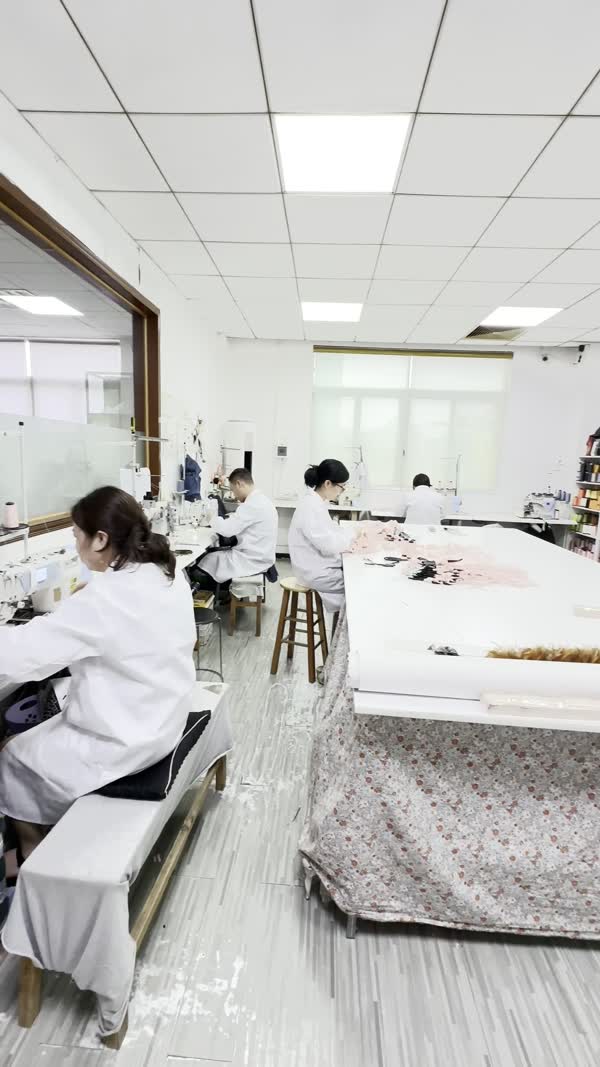
A small batch clothing manufacturer quotes a minimum order quantity as a starting position, not a rule written into the building. Ours is 30 pieces per style, and we have gone below it when the levers below made sense. So when a factory says 300, ask which part of that number is the machine and which part is the margin.
The short answer is that most minimums are set by setup cost, not by capacity. A line that has to change over twelve stations, buy 1,000 woven labels and dye 300 metres of cloth is expensive to start. Remove any one of those three and the number drops. Here are the five levers we use, in the order they save the most.
What actually sets a manufacturer's minimum order quantity
Two blocks sit behind every quote. Fixed cost, which does not scale with quantity, and variable cost, which does.
Fixed cost on a lined style runs about $1,100 before a single garment exists. Pattern $180, grade set $120, two mock-up rounds $420, tech pack work $180, marker $200.
Divide that by 30 and it is $36.67 a piece. Divide it by 300 and it is $3.67. The work is identical either way, and that one division is most of the difference between the two quotes in your inbox.
So the useful question is never whether we will lower our minimum. It is which fixed cost can be removed, shared or delayed.
Lever one: stock fabric instead of dyed-to-order cloth
This is the biggest lever and the least popular, because it means changing your colour.
Dyed-to-order has a mill minimum of about 300 metres. On a 50-piece dress at 2.1 metres a piece you need 105 metres, plus 8 to 12 percent for marker waste. You are buying three times what you need, and the leftover sits on a shelf in Guangzhou.
Stock fabric has no minimum. Buy 120 metres of a stocked viscose and the gate disappears. The trade is real: you pick from the mill's colour card instead of your own.
Lever two: fewer colours, more sizes per colour
Every colour is its own small order. Two colours at 30 pieces each is two setups, two markers and two cutting lays.
One colour at 60 pieces in five sizes costs close to a single 30-piece run. If you need a second colour, run it as a reorder once the first sells. We have watched brands spend a whole launch budget on a colour that did not sell.
Five sizes at 30 pieces is six garments a size, which is thin for a first read. Three sizes at ten is often the better split.
Lever three: batch two styles on one marker
A marker is the layout that decides how much cloth you waste. Nesting five sizes of one style recovers 4 to 5 metres against cutting them separately, roughly $18 to $25 on a 50-piece run.
Batch two styles that share a fabric and a colour and the recovery is larger. You lose the ability to pull one style mid-run, so only do this once both are approved.
Lever four: accept a longer window
A small line gets scheduled into gaps between larger orders. That means a date we pick, not a date you pick.
Give us a three-week window instead of a fixed Friday and we can often fit 30 pieces where 300 would not go. What you cannot ask for is the small-run price and the large-run date.
One more note on windows. A date that is two weeks out is a favour, and a date that is eight weeks out is a plan. Ask for the second and you will usually get it.
Lever five: pay the fixed cost once, in writing
Development is the expensive part of a first order and the cheapest part of a second. The pattern and the grade set carry over. The two mock-up rounds do not, but the corrections they produced do.
Our second-run quote on the same style comes in about 18 percent below the first, and five weeks instead of twelve. That is not a discount. It is work that no longer has to happen.
When a 300-piece minimum is the honest answer
Three cases. Custom dyed cloth in a colour only you want. Custom hardware, where the mould starts at 1,000 pieces. And custom jacquard, where the loom setup begins at 800 metres.
In those cases we say so on the first call rather than take the order and quietly substitute something cheaper. In 2019 we did the second thing for a client on a custom-dyed satin. The substitute arrived two shades off under daylight and 40 garments were re-cut. We have not repeated it.
What we will not do to reach your number
We will not skip the second mock-up round, drop an inspection, or shave the seam allowance. Those are the three things that make a cheap order expensive later.
What we will do is put the fixed cost on its own line so you can see what you are buying. A quote that hides setup inside the unit price is a quote you cannot negotiate.
Our small batch program sets out what we run from 30 pieces. The FAQ page answers minimum order questions directly, and the case studies page lists delivered runs with their real quantities. Our production process page shows where each fixed cost is incurred. The Fashion Pains Solver we are bringing online will read a tech pack against our cost model and show which levers apply to your style before you have to ask.
Go deeper: MOQ 30 vs 500: the real cost per piece in Guangzhou · small MOQ production: what 30 pieces can and can't do · fabric minimums: how a small brand buys 100 metres
Questions we get about this
Can I get a minimum order quantity below 30 pieces?
Sometimes, and only when the style shares a fabric, a colour and a size set with something we are already running. Below 30 the fixed cost is spread so thin that the per-piece price stops being the point, and we would rather tell you to wait than take an order that loses money on both sides.
Why do two factories quote very different minimums for the same style?
They are counting different things. One quotes the quantity that covers its setup, the other quotes the quantity that makes the order worth scheduling at all. Ask each one what changes if you halve the number, and the honest answer tells you which is which.
Quick Take
Minimums are setup cost, not capacity. About $1,100 of fixed work sits behind every style, and it is the same at 30 pieces or at 300.
Stock fabric is the biggest lever. Dyed-to-order starts at 300 metres; stock cloth has no minimum. You trade colour choice for the gate.
Second runs are where it pays. Same style, same pattern, roughly 18 percent less and five weeks instead of twelve.
About UP Fashion
UP Fashion is a Guangzhou garment manufacturer founded in 2016, run by a team with 20+ years of OEM experience in silk, viscose and embroidery. We quote orders from 30 pieces, publish our tolerances, and inspect three times before shipping.




